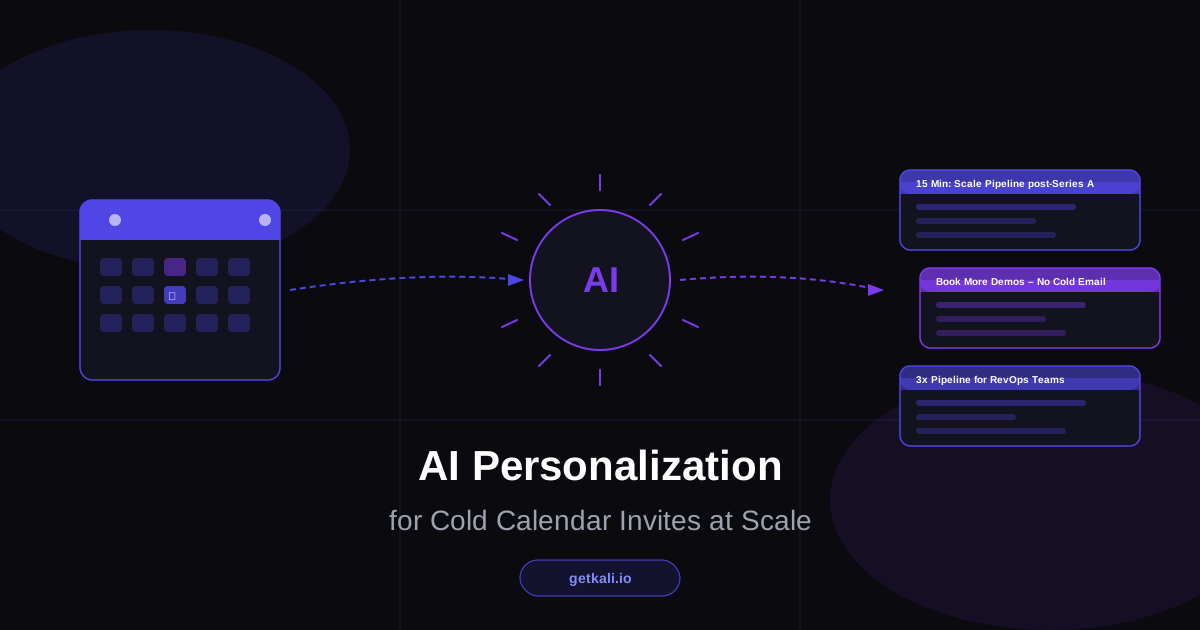
The single biggest reason cold calendar invites fail is not the channel — it is the message.
A generic invite that says “Let’s connect” with no context will get declined faster than a cold email with no subject line. Prospects see the invite, recognize it is templated, and hit Decline before they even read the description.
The fix is personalization. And the bottleneck to personalization at scale has always been time. That bottleneck is now gone.
Why Personalization Matters More for Calendar Invites Than Email
Cold email gives you a subject line and body copy to explain your value before you ask for anything. You have room to build context.
A cold calendar invite is asking for something first: block on my calendar, right now, no context other than what fits in a title and a short description.
That means the bar for relevance is higher. You need to prove in fewer words that this meeting is worth the prospect’s time. Generic messaging cannot clear that bar. Personalized messaging — the right hook, the right company context, the right timing — can.
The challenge is that building a personalized invite for every prospect manually would take longer than the meeting itself.
What AI-Powered Personalization Actually Looks Like
Modern AI tools can pull together several data signals and use them to draft a cold calendar invite that reads like a rep wrote it specifically for that person.
Here is what effective AI personalization typically draws on:
Recent news and triggers. If the prospect’s company just raised a Series B, closed a major partnership, or expanded into a new market, the invite can reference it. “Congrats on the funding round — wanted to reach out about how teams at your stage are using Kali to accelerate pipeline” lands differently than “Hi, I’d love to show you our product.”
Job title and function. The invite description for a VP of Sales should emphasize pipeline metrics and quota attainment. For a Head of RevOps, it might focus on process efficiency and CRM hygiene. AI can generate title-specific copy without the rep needing to write a custom variant for each persona.
Company size and stage. A 12-person startup cares about speed and scrappiness. A 400-person enterprise cares about compliance, integrations, and rollout. AI personalization layers in the right language for each context automatically.
Prior engagement signals. If the prospect visited the pricing page, attended a webinar, or interacted with a LinkedIn post, that context can inform the invite. “Saw you were looking at options for outbound — wanted to put 15 minutes on your calendar” is both personalized and timely.
The Anatomy of a Personalized Cold Calendar Invite
Even with AI doing the heavy lifting, good invite copy follows a structure. Here is a framework that works:
Title: Lead with value, not a product name.
Bad: KALI Demo – 15 Min Good: Book 3x More Demos Without Cold Email – 15 Min
Description (3-4 sentences max):
- Acknowledge something specific about the prospect or their company.
- State the problem you solve in one sentence.
- Make the ask — what happens in the 15 minutes.
- Reduce friction — include a one-line reassurance that it is no-pressure.
Example:
“Saw that Acme is scaling the sales team after your Series A — congrats. Most teams at your stage tell us that cold email reach rates have cratered and they are scrambling to fill pipeline. Kali books demos for reps via cold calendar invites — I’d love to show you a 10-minute live walkthrough. No deck, no pitch, just the product.”
That description took about 30 seconds for an AI to generate with the right inputs. It would take a rep 5-10 minutes to write from scratch. At 100 invites a day, that difference is the difference between scalable and not.
How Reps Use AI Personalization in Practice
The workflow looks something like this:
-
Build your account list. Start with a targeted list of accounts and contacts that fit your ICP. Personalization only works when you are targeting the right people — AI cannot fix a bad list.
-
Enrich with signals. Pull in recent news, job changes, funding events, or engagement data. Tools like Clay, Apollo, or a manual research process can surface the signals that make personalization meaningful.
-
Feed signals into AI. A prompt that includes the prospect’s name, title, company, and one or two relevant signals can generate a draft invite description in seconds. With the right setup, this runs automatically at the account level.
-
Review and approve. Reps spot-check the AI output, make quick edits, and approve batches. The goal is not to remove the human — it is to give the human a 90%-done starting point instead of a blank page.
-
Send and track. Invite goes out. Acceptance, decline, and tentative responses feed back into the outreach sequence so reps know exactly what to do next.
Common Mistakes That Kill Personalized Invite Campaigns
Over-personalizing the subject. Including the prospect’s company name in the invite title can read as a sales tactic, especially when the name is long or unusual. Test first-name-only hooks versus company-name hooks to see what your audience responds to.
Using stale signals. AI personalization is only as good as the data it works with. A news event from six months ago is not a trigger — it is a reminder that you did not do your homework. Use signals from the last 30-60 days where possible.
Sending without a calendar buffer. If you send a cold invite for a time slot and then that slot is already booked on the prospect’s end, they have to decline and the moment is lost. Send invites for times slightly further out — 3 to 7 business days — to give both sides room.
Personalizing the hook but not the body. It is easy to nail the opening line and then fall back into generic copy. If the first sentence references a real signal, the description needs to follow through with relevant context. Inconsistency signals that the personalization was just a trick.
The Scale Equation
Here is why this matters from a pure volume standpoint.
A rep sending 50 truly personalized cold calendar invites per day — well-researched, well-timed, relevant — will outperform a rep sending 200 generic invites. That is table stakes.
But a rep who can send 100 AI-personalized invites per day — at the quality level of the 50 hand-crafted ones — now has a compounding advantage. More volume. Same quality. More meetings.
That is the unlock. Not AI instead of reps. AI multiplying what reps can do.
Putting It Together
Cold calendar invites are already one of the highest-visibility outbound channels available to B2B sales teams. Prospects see them. They can not scroll past them. They show up on the calendar whether the prospect wants them to or not.
But high visibility without relevance is just noise. Personalization is what turns a visible invite into a booked meeting.
AI makes it possible to deliver that relevance at the volume modern outbound requires. The teams winning pipeline right now are the ones who figured that out first.
See how Kali handles AI-personalized calendar outreach — built for reps who need to book more meetings without burning more hours.