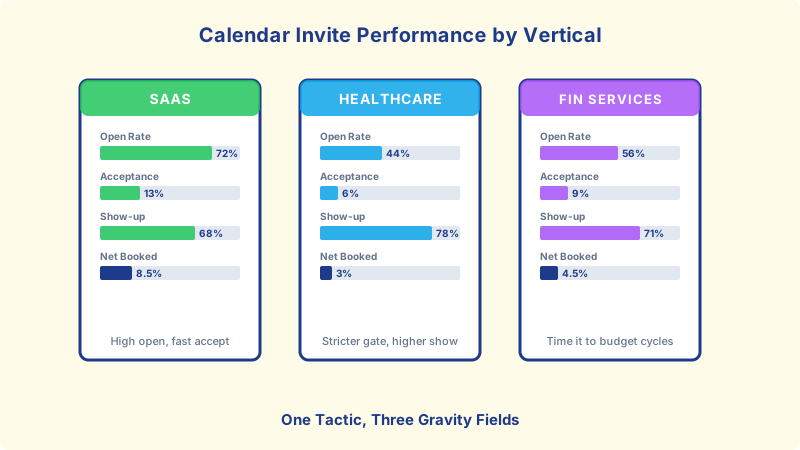
Most cold calendar invite benchmarks get published as a single industry-agnostic number. “Calendar invites get 60 to 80 percent open rates.” That number is directionally true and operationally useless, because the variance between verticals is enormous. A SaaS sales team running calendar invites at scale sees one set of numbers. A healthcare sales team running the same play sees a different set. A financial services team running it again hits a third pattern entirely.
The differences are not random. They come from how each industry handles email security, calendar policy, vendor outreach norms, and what counts as a credible reason for a stranger to put time on the buyer’s calendar. Operators who copy SaaS-vertical tactics into healthcare or financial services without adjusting tend to get the worst of both worlds: low acceptance from the buyer side, plus negative deliverability signals on the sender side.
This breakdown walks through realistic open rate, acceptance rate, and show-up rate benchmarks for the three highest-volume B2B verticals where calendar invite outreach is in play, plus the specific tactical adjustments that move the numbers in each.
Why Industry Matters More Than Anyone Admits
Cold outreach benchmarks get treated as universal because that is how vendors prefer to market their tools. Real numbers segment differently. There are three structural reasons calendar invite performance varies by vertical.
Calendar security policies differ. SaaS companies running on Google Workspace generally have permissive calendar settings: anyone with a working email can place an event on a calendar, the event appears in the recipient’s inbox and calendar even before acceptance, and the recipient can accept or decline with one click. Healthcare and financial services run more often on Microsoft 365 or Exchange with stricter calendar policies. External calendar invites get filtered, flagged, or require admin-level approval before they reach the recipient. Some healthcare systems strip external calendar invites entirely at the mail gateway.
Compliance and risk posture. Financial services and healthcare buyers cannot accept vendor meetings as casually as a SaaS buyer. Regulated industries have procurement processes, vendor risk assessments, and compliance reviews that gate any new vendor relationship. Accepting a calendar invite from an unknown vendor can imply an evaluation that the buyer has not yet authorized internally. SaaS buyers face less of this friction; they evaluate vendors more freely.
Persona buying behavior. A SaaS VP of Sales is online, in inbox, responsive within hours. A healthcare CIO operates in clinical environments, may not check email for half a day, and treats calendar invites with more caution. A financial services COO has a calendar managed by an executive assistant who is the actual gatekeeper. The buyer behavior on the receiving end of a calendar invite is industry-specific.
These three structural differences produce the benchmark gaps below.
SaaS Vertical Benchmarks
SaaS is the home turf for cold calendar invite outreach. It is also the vertical where the play is most copied, which means competitive pressure is higher and the numbers are starting to compress as the tactic matures.
Open rate: 65 to 80 percent. The calendar invite lands as a calendar event in the recipient’s Google Calendar or Outlook, generates a notification, and gets at least a glance from the recipient. Open rates are well above cold email’s typical 20 to 35 percent because the delivery mechanism is calendar-native, not email-native.
Acceptance rate: 8 to 18 percent. The accept-or-decline decision is made on the same screen as the invite preview. SaaS buyers who see a credible reason to take the meeting accept at meaningful volume. The variance between 8 and 18 percent is mostly driven by the invite title, the description quality, the sender credibility, and how well-targeted the ICP fit is.
Show-up rate: 60 to 75 percent of accepted meetings. SaaS calendars are crowded, and a meeting accepted today often gets bumped tomorrow. Holds and re-schedules erode show-up rates. Reminders and one-day-before nudges close some of that gap.
Net booked-meeting rate per send: typically 5 to 12 percent of sends result in a held meeting. This is the metric that actually compounds to pipeline.
The tactical adjustments that move these numbers in SaaS:
- Invite titles framed as the buyer’s outcome (
Reduce SDR ramp time at <Buyer Co>), not the seller’s product (<Vendor> intro call) - Descriptions under 400 characters, structured as: context, agenda, time commitment, opt-out
- A specific time pre-filled (Tuesday 2:00 PM Eastern), not a “what time works?” framing
- Avoid sending invites on Mondays before 10 AM or Fridays after 2 PM (heaviest decline rate windows)
The deeper play for SaaS sellers running this at scale is described in the Kali approach to calendar invite personalization beyond first-name tokens.
Healthcare Vertical Benchmarks
Healthcare sales is where most calendar invite outreach playbooks need the heaviest modification. The tactic still works, but the numbers and the approach diverge from the SaaS template.
Open rate: 35 to 55 percent. Significantly lower than SaaS because of two structural friction points. First, healthcare IT often runs strict mail gateways (Mimecast, Proofpoint, Microsoft Defender for Office) that flag or filter unfamiliar external calendar invites. Some invites never reach the inbox; they sit in a quarantine that the recipient may or may not review. Second, healthcare administrators get a high volume of vendor outreach and have learned to skim past calendar invites that do not match an active procurement track.
Acceptance rate: 4 to 9 percent. Lower than SaaS, and the variance is driven heavily by sender credibility. Healthcare buyers will not accept a meeting from an unknown vendor unless the invite signals that the sender already understands the buyer’s environment (specific clinical specialty, payer mix, EHR vendor, regulatory state). Generic invites that would work in SaaS get declined immediately in healthcare.
Show-up rate: 70 to 85 percent of accepted meetings. Once a healthcare buyer accepts, they generally show up. Clinical and administrative schedules are tightly managed; a meeting on the calendar is treated as a committed obligation more than in SaaS. This is the bright spot.
Net booked-meeting rate per send: typically 1.5 to 5 percent of sends result in a held meeting.
Tactical adjustments for healthcare:
- Sender credibility signaling in the first 100 characters of the invite description. Mention a comparable healthcare customer (with permission), reference the buyer’s EHR vendor or payer environment, name-drop a clinical specialty fit.
- Avoid jargon that signals “generic vendor.” Phrases like “scalable,” “best-in-class,” “transformative” instantly tag the invite as untargeted.
- Use a sender domain that does not look like a marketing automation domain. Lookalike domains and aggressive automation patterns get filtered at healthcare mail gateways more aggressively than at SaaS gateways.
- Validate email lists with a deliverability tool like Scrubby before send. Healthcare lists rot faster than other verticals (clinical staff turnover is high, role-based addresses are common, mailbox provisioning is centralized and tight) and a bad list damages your sender reputation across all healthcare prospecting.
- Avoid scheduling invites during shift changes, on-call rotations, or known administrative deadlines. Healthcare buyers’ calendars are dictated by clinical operations more than by office hours.
Financial Services Vertical Benchmarks
Financial services (banking, capital markets, asset management, insurance, fintech) sits between SaaS and healthcare on most metrics but has its own quirks.
Open rate: 45 to 65 percent. Higher than healthcare because financial services IT is generally more permissive on external calendar invites (the industry runs on email-based deal flow), but lower than SaaS because the buyers themselves are more cautious about signaling vendor evaluation.
Acceptance rate: 6 to 12 percent. The gap from SaaS comes from compliance posture. Financial services buyers cannot casually accept meetings from new vendors without an internal trigger (vendor management approval, procurement review, board-mandated category review). Invites that align with a known buying cycle convert well; cold invites without that signal underperform.
Show-up rate: 65 to 78 percent of accepted meetings. Slightly higher than SaaS because financial services calendars are managed more formally, often by executive assistants who treat accepted meetings as committed. Slightly lower than healthcare because financial services buyers also juggle deal flow, board prep, and quarterly reporting cycles that bump scheduled meetings.
Net booked-meeting rate per send: 2.5 to 7 percent.
Tactical adjustments for financial services:
- Reference compliance-relevant context in the invite. Phrases like “SOC 2 Type II,” “FINRA-compliant,” “OCC-relevant,” “ISO 27001,” or “GDPR / CCPA aligned” signal that the sender understands the buyer’s risk posture.
- Time invites around earnings cycles, regulatory deadlines, and budget cycles. Mid-quarter, after the rush of quarterly reporting, is the highest-acceptance window. The two weeks before quarter-end is dead.
- Send to the executive assistant or chief of staff for very senior personas. The EA is the calendar gatekeeper, and an invite that addresses them by name (with a brief explanation of why the meeting is relevant to their principal) converts dramatically better than a direct send to the executive’s calendar.
- Avoid free-trial framings or “let me show you a quick demo” language. Financial services buyers expect formal evaluation processes; informal vendor framing reduces credibility.
Cross-Vertical Patterns That Always Work
Across SaaS, healthcare, and financial services, a few patterns hold:
Calendar invite outreach beats cold email on every metric in every vertical. Even healthcare, where the friction is highest, sees 2 to 3x better open rates than equivalent cold email. The relative advantage is biggest in SaaS but the absolute advantage is real everywhere.
Show-up rates are usually higher than SaaS sellers assume. Once a meeting is accepted, the human commitment to honor the calendar entry is meaningful in every industry. The bigger leakage is between send and accept, not between accept and show.
Sender credibility scales every metric. Invites from a domain the recipient recognizes, from a person they have heard of, mentioning customers they respect, perform multiples better than otherwise identical invites without those signals. This is true in SaaS, more true in healthcare, most true in financial services.
List hygiene matters more than copy. A 20 percent improvement in copy moves acceptance rates a few points. A 30 percent improvement in list quality (validated emails, role-relevant titles, currently-employed prospects) moves every downstream metric. AI inbound response systems like Underfive handle the reply side cleanly only if the outbound list was clean to begin with.
What to Do With These Benchmarks
Use them as gravity, not gospel. The right way to use vertical benchmarks is to set a baseline that your campaign should clear and then optimize the campaign-specific levers (title, description, time slot, sender, list quality) to push above the baseline. If you are running calendar invites into healthcare and seeing a 1 percent net booked-meeting rate, you are below the floor and the campaign needs surgery. If you are seeing 4 percent in financial services, you are at the top of the range and the next gain comes from segmenting the list further.
The biggest mistake is treating a SaaS-vertical benchmark as the standard and concluding that a healthcare campaign is “broken” because it lands at 3 percent. It is not broken. It is operating in a different gravity field. Adjust the play for the vertical and the numbers compound from there.
Closing Checklist
Before your next vertical-specific calendar invite campaign:
- Have you set vertical-specific benchmarks for open rate, acceptance rate, show-up rate, and net booked-meeting rate?
- Is the invite title framed as the buyer’s outcome, in language native to the vertical?
- Does the description reference vertical-specific context (EHR vendor for healthcare, compliance frameworks for financial services, scaling pain points for SaaS) in the first 100 characters?
- Are you scheduling invites in time windows that match the vertical’s operational rhythm (avoiding shift changes for healthcare, quarter-end for financial services, Monday mornings for SaaS)?
- Is the list cleaned for deliverability before the first send?
- Are you measuring net booked-meeting rate, not just acceptance rate, so vertical variance shows up correctly?
Calendar invite outreach is a universal lift over cold email, but the size of the lift, the shape of the funnel, and the tactical adjustments are all industry-specific. Treat the vertical as the first variable, not the last.