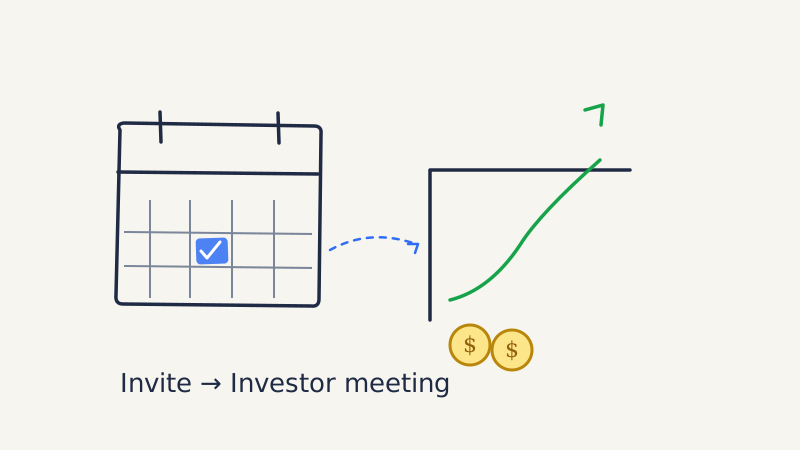
Raising a round is a sales process, and the first thing you have to sell is a 30 minute meeting. Most founders try to do that with cold email, and most of those emails never get a reply. A partner at an active seed fund can receive 100 inbound pitches a week. Your carefully written paragraph about traction and TAM lands in the same pile as every other deck-link email, and it gets skimmed for two seconds or ignored entirely.
Calendar invites work differently. An invite does not ask the investor to read and reply. It asks them to make a yes or no decision about a specific block of time. That single shift in framing is why calendar-based outreach is quietly becoming one of the more effective channels for founders trying to break into a cold investor’s schedule. This playbook covers when to use it, how to write the invite, the timing that maximizes acceptance, and the etiquette that keeps you looking fundable rather than desperate.
Why investor inboxes are the wrong battlefield
Investors are professional inbox triagers. Their entire job during sourcing is to filter signal from noise as fast as possible, and the default filter is “warm intro or ignore.” A cold email starts you at a structural disadvantage because it competes inside the exact medium they have optimized to dismiss.
A calendar invite sidesteps that filter. It appears in a different surface, the calendar, which most investors treat as a source of truth rather than a stream of pitches. When a tentative event shows up with a clear title and a tight description, it forces a quick mental check: do I have anything at that time, and is this worth 30 minutes? That is a far more favorable question than “should I reply to one more stranger’s email.”
This is the same psychology that makes calendar outreach effective in B2B sales, and tools like Kali were built specifically to send cold calendar invites at scale so the invite itself becomes the first touch rather than an afterthought buried under an email thread.
When calendar invites beat the warm intro hunt
The standard advice is that you should only approach investors through warm introductions. That advice is correct and incomplete. Warm intros are the highest converting path, but most founders run out of warm paths long before they run out of relevant investors. There is a long tail of funds and angels who are a genuine fit for your stage and thesis, where you simply do not have a mutual connection willing to make the ask.
Calendar invite outreach is for that long tail. Use it when:
- You have already exhausted your warm network and want to widen the funnel without waiting weeks for introductions to materialize.
- You are targeting thesis-aligned investors who publicly publish that they take cold outreach (many do, and they say so on their sites and on X).
- You have a concrete, time-bound reason to meet now, such as a round that is actively filling or a milestone you just hit.
It is not a replacement for relationship building. It is a way to compress the top of your fundraising funnel so you spend your weeks in meetings instead of waiting on intro chains.
How to write an investor calendar invite that gets accepted
The invite has three parts that matter: the title, the description, and the timing of the slot. Treat each one like ad copy, because that is what it is.
Title. Keep it specific and low-pressure. The title is visible in the calendar list view before the investor opens anything, so it has to earn the open on its own.
Bad: “Quick chat” Good: “Acme (AI for warehouses) <> [Fund]: 30 min on our seed”
Description. This is where the deck-link email content goes, but compressed to its strongest three sentences. State the one-line thesis, the single most impressive traction number, and the specific reason you are reaching out to this investor in particular. Then make the logistics frictionless: a reschedule link and a note that they can move the time freely.
Hi [Name], we are building [one line]. We hit [the single strongest metric] in the last [timeframe] and are raising a [stage] round. I am reaching out because you led [relevant deal] and wrote about [relevant thesis]. Tentative hold below, please move it to any time that works or decline if it is not a fit. Deck: [link].
The ask to move freely is essential. It signals confidence and respect for their time, and it converts a cold imposition into a flexible offer. A founder who says “move this anywhere” reads very differently from one who demands a fixed slot.
Personalization is what separates a fundable invite from spam. Reference a specific portfolio company, a specific blog post, a specific thesis. Generic invites to investors do real reputation damage because this is a small, gossipy world, so the bar for relevance is higher here than in ordinary B2B prospecting.
Timing and cadence
Send the invite for a slot roughly five to eight business days out. Too soon reads as pushy, too far out gets forgotten. Mid-morning on Tuesday through Thursday tends to land best, when investors are reviewing their week rather than buried in existing partner meetings.
If the invite is not accepted, do not resend the same invite repeatedly. That is the fastest way to look desperate and get blocked. Instead, run a short, polite multi-touch sequence: the calendar invite first, then a single brief email a few days later referencing the hold, then one final LinkedIn note. Stop after that. A disciplined three-touch sequence respects the investor’s attention and still gives you three different surfaces to be seen on.
Clean targeting data makes or breaks this. Sending invites to a partner who left the fund eighteen months ago, or to a role-based alias, gets you nothing and can hurt your sender reputation. Before you load a list of investor contacts, run it through a validation pass so you are only sending to live, reachable inboxes. Email validation tools like Scrubby catch the dead and risky addresses that would otherwise sink your deliverability mid-raise, which matters because a raise is exactly the wrong time to land in spam folders.
Etiquette: stay fundable
Fundraising outreach has a reputational dimension that ordinary sales does not. Investors talk to each other. A founder who blasts low-effort invites across a whole fund’s partner list, or who games tentative holds to look busier than they are, builds a reputation that follows the company into future rounds.
A few rules keep you on the right side of that line:
- One invite per fund, to the most thesis-relevant partner, not a shotgun blast across the whole team.
- Never auto-add a video conferencing link that implies the meeting is already confirmed. The slot is tentative until they accept.
- If they decline, accept it gracefully and move on. A clean no today preserves the relationship for your Series A.
- Keep your deck link and data room tidy, because the invite is only the door, and what is behind it has to deliver.
Measure what works
Track acceptance rate by investor segment the same way you would track a sales pipeline: invites sent, accepted, met, and advanced to a second meeting. You will quickly learn which thesis-fit segments respond to cold calendar outreach and which require a warm path. That feedback loop lets you reallocate your limited fundraising energy toward the partners most likely to actually take the meeting.
Fundraising is a numbers game wrapped in a relationship game. Calendar invites do not replace the relationship work, but they give founders a credible, respectful way to get in front of cold investors who would never have surfaced your email. Used with tight targeting, real personalization, and disciplined etiquette, the humble calendar invite can be the difference between a round that stalls and one that fills.
Ready to turn cold investor lists into booked first meetings? See how Kali puts your invite directly on the calendars that matter.