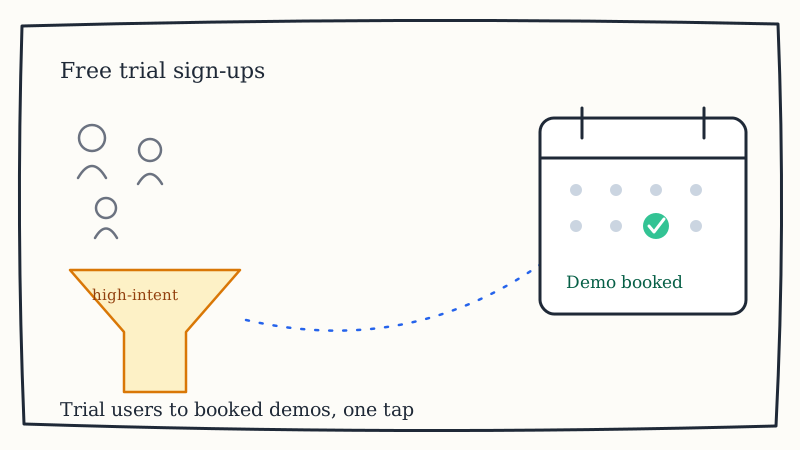
Product-led growth promises a clean story: people sign up, try the product, fall in love, and upgrade themselves. For a slice of your users that actually happens. For the larger slice it does not. They sign up, poke around for nine minutes, get pulled into a meeting, and never come back.
The standard fix is the “sales-assist” motion: a human reaches out to high-intent trial users to help them get value and nudge them toward a paid plan. The problem is that almost every PLG team runs this motion over email, and trial-user email is some of the lowest-converting outreach there is. The user is busy, half-committed, and drowning in onboarding messages from a dozen other tools they signed up for the same week.
Calendar invites are a better fit for this exact moment. A calendar invite cuts through the onboarding noise because it asks for a single tap instead of a reply, and it converts the vague “let me know if you want a demo” into a specific, dated slot the user can accept without thinking. This guide covers how to layer calendar invite outreach onto a free trial funnel, which users to target, when to send, and how to keep the whole thing from feeling like a sales ambush.
Why Trial-User Email Underperforms
Sales-assist email looks reasonable on paper and underdelivers in practice for three structural reasons.
The user has not decided they care yet. A trial user is, by definition, undecided. They are evaluating, not buying. An email that asks “want to hop on a call?” requires them to first conclude that your product is worth their time, then take an action. Most of them never finish the first step, so the second never happens.
Onboarding inboxes are saturated. The week someone starts a trial of your tool, they often start trials of three or four others. Every one of those tools fires the same drip: welcome email, “did you get stuck?” email, “here is a case study” email. Your demo offer competes with all of them, and it loses to the noise.
The ask is a two-step decision. “Reply with a time that works” forces the user to open their calendar, find a slot, type it out, and send. That is a lot of friction for a meeting they are lukewarm about. Each step is a place to stall, and lukewarm intent stalls easily.
A calendar invite removes all three problems at once. It proposes a specific time, so the user is no longer deciding whether to meet but only whether that slot works. It looks different from every onboarding email in the inbox, so it stands out. And accepting is a single tap, which is roughly the friction level a lukewarm trial user will tolerate.
Target the Right Users, Not Every Sign-Up
The fastest way to make sales-assist outreach feel spammy and tank your numbers is to blast every new sign-up with a demo invite. PLG works because users self-serve. Interrupting a happy self-serve user with a sales touch annoys them and wastes your team’s time. The art is sending invites only to the users where a human conversation actually moves the deal.
Three signals tell you a trial user is worth a calendar invite:
Activation depth. A user who hit a core “aha” action (created a project, invited a teammate, ran a real workflow) is a far better demo target than one who logged in once and bounced. Activation is the single strongest predictor that a conversation will convert.
Account shape. A trial sign-up from a 600-person company on a business email is a different animal from a solo user on a free webmail address. The first one may need a security review, multiple stakeholders, and a real procurement path, which is exactly where a human demo earns its keep. The second usually wants to be left alone to self-serve.
Explicit friction signals. Users who opened your pricing page three times, started inviting teammates, or hit a plan limit are telling you they are evaluating seriously. These are your highest-intent invite targets. This is where mapping buying signals to the right outreach moment turns a generic blast into a precise, well-timed touch.
Score your trial base on these signals and reserve calendar invites for the top tier. A smaller volume of well-targeted invites will beat a flood of generic ones on every metric that matters.
Timing: Send the Invite at the Moment of Intent
In a PLG funnel, timing is everything, because trial intent decays fast. A user who hits a plan limit today is interested today. Reach them on day six and the moment has passed.
Trigger invites off behavior, not off a fixed day. A day-three drip sends the same message to a power user and a tourist. Instead, fire the calendar invite when the user crosses an intent threshold: second pricing-page visit, first teammate invite, hitting a usage cap. The invite arrives while the question (“is this worth paying for?”) is live in their head.
Catch the trial-end window. The days right before a trial expires are a natural intent spike. A user who has been getting value is suddenly forced to decide. A well-timed invite here (“15 minutes to map out your rollout before your trial ends”) lands when motivation peaks.
Respect the user’s working hours and time zone. A calendar invite that lands at 2 a.m. local time looks careless and gets ignored. Aligning send time to the prospect’s zone matters even more for invites than for email, since the invite shows up as a dated event on their calendar. The same discipline that governs scheduling calendar invites across time zones applies directly to a globally distributed trial base.
Write the Invite Like a Product Person, Not a Sales Rep
Trial users chose your product partly to avoid talking to sales. A pushy invite confirms their fear and gets declined. The invites that convert read like helpful product guidance, not a pitch.
Lead with the user’s goal, not your demo. “Walk through setting up your first automated workflow” beats “Product demo with the sales team.” Tie the meeting to the outcome the user signed up to achieve.
Put substance in the description. A blank invite gets ignored. Use the description to preview exactly what the 15 minutes delivers: the specific feature you will set up with them, the result they will leave with, and a clear agenda. Treat the invite description as a mini landing page that earns the accept.
Keep it short and optional-feeling. Fifteen minutes, not “a 45-minute discovery call.” Offer it as help, not a hurdle to buying. The lower the perceived commitment, the higher the acceptance from lukewarm trial users.
Make declining graceful. Some users genuinely prefer to self-serve, and that is fine in PLG. An invite they can quietly decline without a guilt-trip follow-up protects the relationship and keeps your sender reputation healthy.
Keep Your Trial Contact Data Clean
A calendar invite is only as good as the address it reaches. PLG sign-up forms are magnets for typo’d, throwaway, and role-based emails, and an invite sent to a dead mailbox is a silent miss that never shows up in your acceptance rate, it just quietly fails.
Before you fire invites at a batch of trial users, run the list through an email verification tool like Scrubby to strip out addresses that will bounce or sit in an unmonitored inbox. This matters more for calendar invites than for email, because a bounced invite can ding the sender reputation of the calendar account you rely on for the whole motion. Clean data keeps your invites landing with real, reachable users and keeps your acceptance numbers honest.
It also sharpens targeting. Knowing which sign-ups used a real corporate domain versus a disposable address feeds directly back into the account-shape scoring from earlier, so you spend invites on users who can actually become paying accounts.
Measure the Right Outcome
The vanity metric for a sales-assist motion is “demos booked.” The metric that matters is “trials converted to paid because of the demo.” Track both, and watch the gap.
Acceptance rate tells you whether your targeting and invite copy are working. Low acceptance means you are inviting the wrong users or writing the wrong descriptions.
Show rate tells you whether the invite created real intent or just an easy tap the user forgot about. A reminder touch the day before protects this number.
Trial-to-paid lift is the only number that justifies the motion. Compare conversion for invited-and-attended users against a holdout of similar high-intent users who got no invite. If the demo is working, the lift is obvious. If it is not, you are interrupting users who would have converted anyway.
Run this as a real experiment, not a vibe. A clean holdout is the difference between knowing your sales-assist motion works and assuming it does.
The Takeaway
Product-led growth does not mean no humans. It means humans show up at the right moment, for the right users, with the lowest possible friction. Free trial email asks lukewarm users to make two decisions in a saturated inbox, and most of them make neither. A calendar invite collapses that into one tap, arrives the moment intent spikes, and reads like help instead of a pitch.
Target trial users on activation, account shape, and friction signals. Trigger invites off behavior, not a fixed calendar day. Write the invite around the user’s goal, keep your contact data clean so the invites actually land, and measure trial-to-paid lift against a holdout. Done this way, calendar invite outreach becomes the connective tissue between self-serve and sales that most PLG funnels are missing. If you want to run this motion at scale, Kali is built to turn high-intent sign-ups into booked demos without the inbox guesswork.