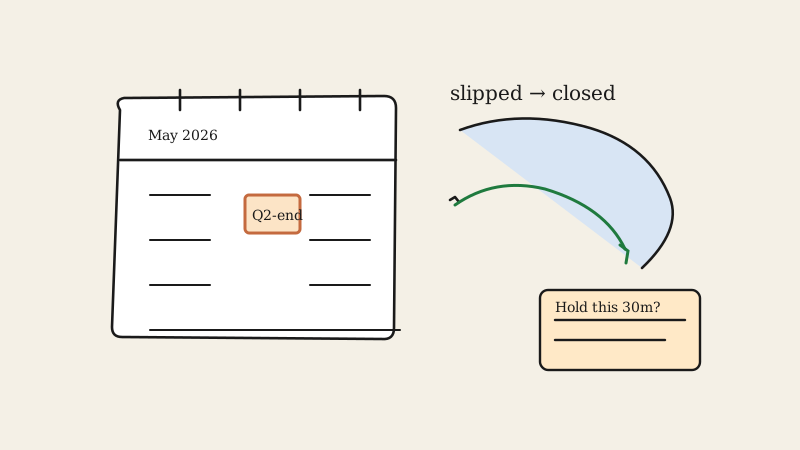
The pattern is familiar to every AE who has ever carried a quota. A deal sits at 80 percent probability with a close date of June 30. June 28 arrives and the champion goes quiet. The redline review that was scheduled for Tuesday gets bumped to “next week.” Procurement has a question that nobody can route. Then the close date slips to July 15, then July 30, then “this quarter probably.”
That deal is not lost. It is drifting. And the longer it drifts, the more likely it dies, not from a competitor and not from a “no”, but from organizational entropy. Decision-maker priorities shift. A budget reorg lands. The champion gets pulled onto a different initiative.
Late-stage acceleration is the discipline of pulling a drifting deal back into a close motion before entropy wins. The single most underused tool for it is the calendar invite.
Why drift kills more deals than rejection does
Most CRM dashboards track closed-lost reasons like “competitor,” “no budget,” and “no decision.” The actual cause of a startling percentage of late-stage losses is none of those. It is calendar drift: a missed meeting, a rescheduled review, a champion who goes silent for 11 business days, a procurement queue that fell behind.
Calendar drift looks neutral while it is happening. The deal does not move backward. It just stops moving. By the time someone notices, the urgency that built up over a six-month sales cycle has dissipated, and rebuilding it takes weeks the quarter does not have.
The intervention that works is not a “checking in” email. It is a specific, time-bound meeting that forces the deal forward.
The late-stage calendar invite, three patterns
There are three calendar invite patterns that consistently move slipped deals back into a close motion. Each addresses a different source of drift.
Pattern 1: The redline working session
Use when the deal has stalled in legal review. A standard email asking “any update on the redlines?” gets ignored because everyone involved knows they have not finished. A calendar invite titled “Working session: redline alignment, [Customer] x [Vendor]” with the right people on it (your legal counsel and theirs) reframes the next step. It is not a status check. It is a meeting that will produce an outcome.
Send the invite directly with a 30-minute hold and a one-line agenda: “Walk through outstanding redlines together, agree on resolution path.” The acceptance rate on these invites is high because legal teams would rather get the meeting done than continue exchanging async markup.
Pattern 2: The procurement unblock call
Use when the deal has slipped into a procurement queue. Procurement teams in mid-market and enterprise companies process vendors in batches, and a request that misses the cutoff sits for two to four weeks. Email follow-ups to the procurement contact rarely accelerate this; they get filed.
The intervention that works is a calendar invite to the champion (not procurement) titled “Procurement unblock: [Vendor] alignment.” The agenda: “Confirm the current procurement step, identify what we can prepare on our side to keep momentum, and align on a target close date.” The point is to give the champion ammunition to push internally. They cannot do that without a meeting and an explicit timeline.
Pattern 3: The decision-maker recap
Use when the deal has lost its primary champion’s attention. This happens when the champion gets promoted, reorged, or pulled onto a different priority and your deal stops being top of mind. The fix is a 25-minute calendar invite to a recap meeting with the original decision-maker, framed as a value alignment check, not a sales call.
The invite description should read: “Quick recap of where we landed on scope, ROI, and next steps. Confirm the deal still maps to your Q2 priorities and align on close timing.” This works because it gives the decision-maker permission to either accelerate the deal or kill it cleanly. Either outcome is better than continued drift.
What makes the invite acceptable instead of pushy
The difference between a calendar invite that pulls a slipped deal forward and one that gets declined is rarely the timing. It is the framing. Three rules.
Make the agenda explicit and outcome-based. “Catching up” is a non-agenda. “Confirm the redline path and target signature date” is an agenda. Decision-makers accept the second one and decline the first.
Keep the meeting under 30 minutes. Late-stage stakeholders are busy with other deals (yours and not yours). A 60-minute hold gets declined; a 25-minute hold gets accepted.
Include the right people from the start. Do not invite a procurement contact to a redline call, and do not invite legal to a value recap. The wrong attendee list is the fastest way to get an invite politely declined.
If you are scaling this motion across an AE team, Kali automates the invite mechanics (timing, room generation, reminder cadence, multi-recipient threading) so the AE can focus on the agenda and the prep instead of the calendar logistics.
How to spot the deals that need this intervention
A calendar invite will not save every slipped deal, but it reliably saves deals where the drift signal matches one of three patterns:
- The redline pattern. No legal response in 7+ business days after sending the redlines back.
- The procurement pattern. Vendor onboarding form submitted, no follow-up from procurement in 10+ business days.
- The champion-quiet pattern. No response from the primary champion in 5+ business days after the proposal review.
Pull a list of every late-stage opportunity with one of those signals. Each one is a candidate for a targeted calendar invite this week.
Where this fits in the broader stack
Calendar invite outreach for acceleration is a different motion from calendar invite outreach for cold prospecting, but the underlying mechanic is the same: a specific, time-bound meeting commits both sides to a forward step that an email cannot.
For the deals that did die in late-stage drift and went truly cold, CAM helps you watch the customer’s organization for a trigger event (new hire, leadership change, public initiative) that opens a re-engagement window. And before you rebuild that contact list, run it through Scrubby so the re-engagement email actually lands instead of bouncing into a defunct inbox.
What to expect when this works
Teams that adopt this motion intentionally see two changes inside a quarter:
- Stalled-deal cycle time drops by 20 to 40 percent. Deals that would have slipped two quarters slip one or none.
- Closed-won rate on late-stage drifts roughly doubles. Most of the lift comes from rescuing deals the team would have written off as inevitable losses.
The calendar invite is not magic. It is the mechanism that converts intent into a forced forward step. In late-stage pipeline, that is usually all the deal needs.