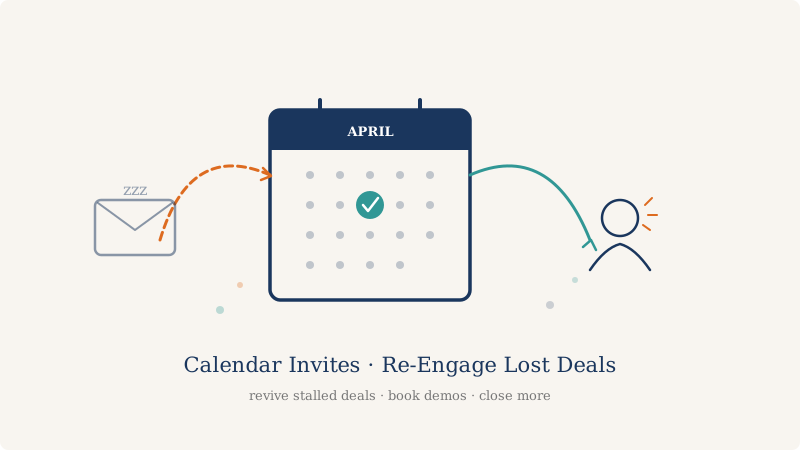
Most B2B sales teams write off stalled deals too early. A prospect who went dark after a discovery call isn’t necessarily uninterested — they got distracted, a priority shifted, or the timing wasn’t right. The problem is that re-engagement follow-ups almost always take the same form: another email, another sequence, another message that looks exactly like what they already ignored.
Calendar invites change the dynamic entirely. Instead of asking a prospect to reply, read a link, or fill out a form, a calendar invite asks them to do one thing: accept or decline. That single-action friction model is why calendar-based re-engagement consistently outperforms email follow-up sequences for reviving stalled deals.
This is the core idea behind Kali — booking demos through calendar invites rather than cold email, so the path from interest to conversation is as short as one click.
Why Email Re-Engagement Sequences Fail
Before getting into tactics, it’s worth understanding why standard email re-engagement fails at the rate it does.
Inbox Saturation Is Worse Than You Think
The average B2B decision-maker receives 120+ emails per day. A “just checking in” follow-up from a vendor they spoke with three months ago is competing with internal Slack exports, board updates, customer escalations, and two dozen other vendor pitches. The signal-to-noise ratio is catastrophic.
Your re-engagement email might be perfectly written. It doesn’t matter if it never gets read.
Asking for a Reply Requires Mental Effort
When you send a follow-up email asking a prospect to “let me know if you’d like to reconnect,” you’re asking them to:
- Remember who you are and what you do
- Decide whether the conversation is still relevant
- Compose a reply
- Send it
That’s four cognitive steps before anything productive happens. Most prospects stop at step one.
Timing Is Everything, and Email Has No Timing Mechanism
A follow-up email sits in an inbox until someone acts on it — or doesn’t. There’s no natural forcing function that connects the email to a specific moment in the prospect’s calendar. Calendar invites, by contrast, create a concrete moment in time. Accepting the invite makes the conversation real and scheduled. The prospect now has a commitment, not just a message to respond to someday.
The Re-Engagement Playbook: Calendar Invites That Actually Work
Here’s how to use calendar invites as a structured re-engagement channel, not just a one-off tactic.
Identify the Right Candidates
Not every lost deal is worth re-engaging. Before you start sending calendar invites, segment your pipeline history to find the best candidates:
High-fit, low-urgency losses. Deals where the prospect expressed genuine interest but timing or budget was wrong at the point of last contact. These are your best targets — they already understand your value proposition.
Decision-maker changes. Deals where the original champion has moved on, or a new executive has joined the buying committee. A new stakeholder is a fresh conversation, not a reopened failure.
Trigger-based re-engagement. Prospects who have recently shown buying signals — visiting your pricing page, engaging with a competitor (signals you can track with a tool like CAM), or posting about a pain point your product solves. Timing a calendar invite to a visible buying signal dramatically improves acceptance rates.
Time-based re-engagement. Deals that went cold 90, 180, or 365 days ago. Markets change, budgets refresh, priorities shift. A deal that was definitively “not now” six months ago may be “yes now” today.
The Anatomy of a Winning Re-Engagement Invite
A calendar invite for re-engagement isn’t just a meeting request. It’s a micro-pitch compressed into subject line, description, and duration. Every element matters.
Subject line: Keep it direct and low-pressure. “Quick catch-up — [Your Company] x [Their Company]” outperforms “Following up on our conversation” because it doesn’t signal desperation. For cold re-engagement, something like “15 min — new [specific outcome] approach” ties the invite to a concrete value.
Description: Use the description field as a one-paragraph pitch. Lead with a context hook (“We last connected in Q3 around your [pain point]”), then give them one new reason to show up. A product update, a relevant case study result, or a market shift that makes your solution more relevant now. Close with explicit opt-out language — “If timing still isn’t right, feel free to decline and I’ll reach back out in a few months.” This reduces friction and actually increases acceptance rates because it signals you’re not going to be pushy.
Duration: 15 or 20 minutes. Never 30 or 45 for a re-engagement invite. A shorter time commitment makes the decision to accept much easier, and most re-engagement conversations that go well naturally extend themselves.
Time slot: Offer one specific slot, not multiple. The paradox of choice applies to calendar invites. Sending an invite for a specific time performs better than sending a scheduling link with ten options, because it makes a decision for the prospect rather than asking them to make one.
Timing and Cadence
Re-engagement via calendar invite works best as a multi-touch sequence, not a single send. Here’s a structure that converts:
Touch 1 (Day 1): Send the calendar invite directly. No email preamble, no LinkedIn message first. Just the invite. This is counterintuitive but effective — it eliminates a layer of friction and gets straight to the ask.
Touch 2 (Day 5, if no response): Send a one-line LinkedIn message or short email: “Sent you a calendar invite earlier this week — wanted to make sure it landed. Happy to adjust the time if that slot doesn’t work.” No pressure, just acknowledgment.
Touch 3 (Day 14, if still no response): Send a new invite with a different time slot and a slightly updated description referencing something new — a product release, a relevant industry news event, or a case study from a company similar to theirs.
Touch 4 (Day 30, final touch): One final invite or short note. Something like “Last time reaching out for now — if timing shifts on your end, you know where to find us.” This is your break-up touch. It’s also often the one that generates replies, because people respond to finality.
After touch four, mark the deal as dormant and let trigger-based signals dictate if and when you re-engage again.
Building Clean Re-Engagement Lists
Calendar invite re-engagement only works if you’re reaching the right people. Lost deals in your CRM can go stale fast — champions leave companies, email addresses change, roles shift.
Before running any re-engagement campaign, validate that your contact data is still accurate. This is especially important for deals that went cold 6+ months ago. Scrubby handles the email validation layer — it verifies whether addresses (including catch-all corporate domains) are still deliverable, which tells you whether your contact is still reachable at that company before you invest time in a calendar invite sequence.
Running validation before your re-engagement push keeps your outreach domain clean and ensures you’re not burning send reputation on addresses that have been dead for months.
Using Competitor Signals to Time Re-Engagement
The best re-engagement campaigns aren’t arbitrary — they’re timed to moments when a prospect’s pain is highest or their current solution is failing them. Competitor signals are one of the most reliable triggers.
If a prospect who went dark is currently using a competitor and that competitor just had a price increase, a public outage, or a negative press event, that’s your window. CAM tracks these competitive signals automatically, so you can build a workflow where a competitor trigger fires a re-engagement invite rather than waiting for a scheduled cadence to kick in.
A calendar invite that lands the day after a prospect’s current vendor has a visible problem is not cold outreach — it’s perfect timing.
The Kali Approach: Calendar Invites as the Primary Outreach Channel
Most sales teams treat calendar invites as the output of a successful email or call sequence. You do outreach, you build rapport, you get the meeting, and then you send the invite. Kali inverts this: the calendar invite is the first touch, not the last.
For re-engagement specifically, this approach works because it eliminates the preamble. Your prospect already knows you. They had a conversation, evaluated your product, and moved on. They don’t need to be nurtured back through a sequence — they need a direct, low-friction reason to pick the conversation back up. A calendar invite with a sharp, specific description delivers that in seconds.
This is especially effective when combined with a strong signal — a prospect visiting your pricing page again, a new stakeholder joining the company, or a competitor trigger. When you can tie the invite to the right moment, acceptance rates for re-engagement campaigns run significantly higher than standard cold outreach.
Measuring What Works
Re-engagement campaigns are worth running because the upside is high — these are already-warm prospects who know your product — but you need to track the right metrics to know if the approach is working.
Invite acceptance rate: The primary signal. Aim for 15-25% on well-targeted re-engagement lists. Below 10% means either your targeting is off or your invite description isn’t giving prospects a compelling reason to accept.
Show rate: How many accepted invites actually result in a conversation. A strong re-engagement invite drives 85%+ show rate because the prospect made an active choice to accept rather than passively clicking “reply” to an email.
Conversion from reconnect to pipeline: How many re-engagement conversations move back into active pipeline. Track this separately from new business conversion — the cycle is different and the benchmark is different.
Time to re-engage: How long after a deal goes dark is the optimal point to re-engage? This varies by deal size and industry, but tracking it helps you build better segmentation rules over time.
What the Stack Looks Like
A complete re-engagement motion built around calendar invites looks like this:
- Signal layer — CAM monitors competitor activity and buying signals for dormant prospects. Scrubby validates that contact data is still accurate before outreach fires.
- Outreach layer — Kali sends calendar invites directly to the right contacts, with descriptions tailored to the trigger that fired the re-engagement.
- Sequence layer — A four-touch cadence runs automatically, adjusting based on response signals (invite accepted, declined, or ignored).
- CRM layer — Accepted invites and resulting conversations feed back into your pipeline with clear attribution, so you know which re-engagement signals are worth prioritizing.
The Vendisys ecosystem is designed to make this stack simple — each product handles one layer cleanly, and they’re built to work together without complex custom integrations.
Stop Writing Off Cold Prospects Too Early
The deals in your lost/closed column aren’t necessarily dead. Many of them went cold because of timing, internal politics, or budget cycles — not because the prospect decided your product was wrong for them. A well-timed, low-friction calendar invite is often all it takes to pull them back into an active conversation.
The key is ditching the follow-up email playbook for re-engagement. Your prospect already ignored that approach once. Give them something different: a specific time, a specific reason to show up, and a one-click path back to a conversation worth having.
That’s the whole idea. And it works.