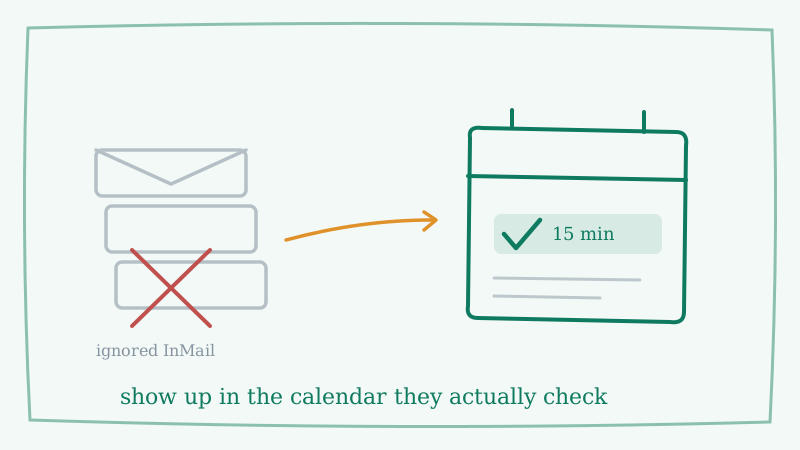
Every recruiter knows the math on passive candidates. The best engineers, operators, and salespeople are not on the job market, are not refreshing job boards, and have trained themselves to ignore the channel where recruiters live: the recruiter inbox and the LinkedIn InMail folder. Your message is one of fifteen that week, all of them some variation of “exciting opportunity,” and it gets archived in the time it takes to read the sender name.
The problem is not your pitch. It is the surface. You are competing in the one inbox a passive candidate has already learned to tune out. Calendar invite outreach changes the surface, and that is why recruiters are starting to use it.
Why the inbox fails for passive talent
A passive candidate is not avoiding you out of malice. They are protecting attention. The recruiter channel is saturated, so their filter is brutal and fast:
- InMail sits in a folder they open intentionally, which they rarely do when they are not looking.
- Cold email competes with newsletters, internal threads, and every other recruiter.
- The signal is the channel itself. The moment a message looks like recruiter outreach, the filter fires before a single word is read.
You can write the perfect message and still lose, because the candidate decided not to engage with the category, not with you.
What a calendar invite does differently
A cold calendar invite arrives in the candidate’s calendar, not their promotions tab. A calendar is a tool people check to run their day, and an entry on it carries a different weight than a message in a queue. It reads as a concrete, specific thing with a time attached, not a pitch asking for unbounded attention.
The mechanics that make it work for recruiting specifically:
- It interrupts a different context. The candidate sees it while looking at their actual schedule, when they are in planning mode rather than triage mode.
- It is low-commitment and specific. A 15-minute hold for “a quick conversation about a [specific role] at [company]” asks for a defined slice of time, not an open-ended reply.
- It survives the recruiter filter because it does not look like the fifty other recruiter touches that week.
This is the core idea behind the calendar-invite approach that tools like Kali are built around: meet the person in the surface they actually act on, with a touch that is concrete enough to accept or decline rather than ignore.
How to write a calendar invite a passive candidate will accept
The format only helps if the content respects the candidate’s attention. A few rules that hold up in recruiting:
- Be specific about the role and the why-them. “Senior backend role” is noise. “Your work on distributed systems at [company] is exactly the problem this team is solving” is a reason.
- Make the time tiny and theirs. Propose a short slot and make clear it moves if it does not fit. The ask is a conversation, not a commitment.
- Write a human description, not a job post. The invite body is where you give context: what the team is, why you reached out to them specifically, and what the call is actually about.
- One invite, then patience. A second touch is fine. A barrage reads as desperation and burns the channel.
The goal is a calendar entry that feels like it was sent by a person who did their homework, because it was.
Where it fits in a recruiting sequence
Calendar invite outreach is not a replacement for everything else, it is a different angle for the candidates who have stopped responding to the obvious channels. A practical pattern:
- Use it as a first touch for high-value passive candidates who are likely buried in InMail from competitors.
- Use it as a re-engagement touch for candidates who went quiet after an earlier email, the same way sales teams use it to revive ghosted deals.
- Pair it with the rest of your sourcing, so a candidate who declines the invite still sees you in the channels they do check.
One operational note before any of this works: a calendar invite is only as good as the address it is sent to. Sourced candidate emails are notoriously stale, and an invite to a dead or mistyped address is a touch that never happened. Running your sourced list through validation first, the kind of catch-all-aware checking that tools like Scrubby handle, makes sure the invites you send actually reach a live calendar instead of bouncing silently.
Reaching passive talent has always been about getting in front of people who are not looking, in a way that does not feel like everyone else who is trying to do the same thing. The recruiters winning that game in 2026 are the ones who stopped fighting for space in the inbox the candidate already ignores, and started showing up in the calendar they actually run their week from. The team behind Kali built the channel for exactly that shift, and recruiting is one of the clearest places it pays off.