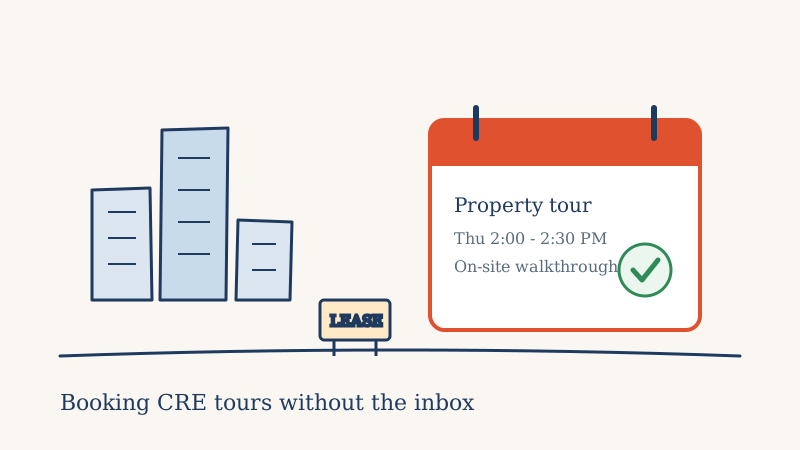
Commercial real estate is a relationship business that runs on booked meetings. A tenant rep needs a face to face with a corporate real estate director before a lease expiration window closes. A landlord rep needs the owner of a vacant building to sit for a listing pitch. An investment sales broker needs 20 minutes with a principal to walk through a broker opinion of value. None of that happens without a meeting on the calendar, and getting that meeting is the entire job.
The problem is that the people CRE brokers need to reach are exactly the people who have stopped answering. Corporate real estate directors, property owners, and private equity principals get prospected constantly. Their inboxes are a graveyard of “just following up” emails, and their phones screen anything not already saved as a contact. The channels most brokers rely on have quietly stopped working.
This is where the cold calendar invite earns its place in a CRE prospecting stack. Instead of asking for a meeting inside an email that never gets opened, you send a real calendar event that lands in the decision maker’s calendar app. This playbook covers how tenant reps, landlord reps, and investment sales teams use cold calendar invites to book tours, listing presentations, and BOV meetings with the people who never reply to email.
Why email and cold calls fail CRE brokers specifically
Every outbound channel decays, but commercial real estate punishes the traditional ones harder than most industries for three reasons.
First, the buyers are saturated. A corporate real estate director at a company with a national footprint might field cold outreach from a dozen brokers in a single market during any given lease cycle. A building owner with a visible vacancy gets called by every landlord rep in town within a week of the sign going up. When everyone is running the same “I noticed your lease is expiring” email, the entire category gets muted.
Second, the messages look identical. CRE cold email has converged on a handful of templates: the lease expiration angle, the “off market opportunity” tease, the market report offer. Decision makers have seen all of them. What reads as tailored to the broker who wrote it reads as mail merge to the person receiving the fifteenth version of it that quarter.
Third, deliverability quietly kills the channel. Many brokers blast from a single overused domain, buy stale contact lists, and never validate addresses, so a large share of their sends bounce or route straight to spam. The open rate is not low because the subject line is weak. It is low because the message never reached a human at all. Cleaning your list with a verification tool like Scrubby before any campaign is the difference between reaching an inbox and burning your sender reputation on dead addresses.
Cold calendar invites sidestep all three problems. They surface as a calendar event as well as a message, so they are not fighting for attention in the promotions tab alone, they render as a structured event instead of yet another marketing email, and they are still rare enough in CRE outreach that they earn a genuine second look. Tools like Kali send cold calendar invites at scale so brokers can reach owners and directors who have trained themselves to ignore the inbox entirely.
The three CRE meetings worth booking with invites
Not every touch should be a calendar invite. The invite is a high intent, high commitment ask, so reserve it for the meetings that actually move a deal forward.
1. The property tour
For tenant reps and leasing brokers, the tour is the conversion event. A calendar invite for a specific building, at a specific time, with the address in the location field, reframes the ask from “would you ever consider looking” to “here is a slot to walk the space.” The specificity does the persuading. A prospect who deletes a paragraph of email will pause on an event titled with a real address and a 30 minute window.
2. The listing or BOV pitch
Landlord reps and investment sales brokers need the owner in a room to present a broker opinion of value or a listing strategy. Owners rarely reply to an email asking for that time, but a calendar invite that proposes a concrete 20 minute slot to “review current pricing and buyer demand for the asset” is a far lower friction yes. The invite implies you have already done the work and just need the time.
3. The market briefing for corporate accounts
For brokers chasing enterprise tenant rep mandates, the way in is often a short market briefing rather than a hard pitch. A calendar invite for a “15 minute Q3 submarket rent and availability update” gives a corporate real estate director a reason to accept that does not commit them to anything. It gets you on the calendar and in the relationship, which is where CRE deals actually start.
How to write a cold calendar invite that gets accepted
The invite is not an email with a different delivery method. It is its own format with its own rules, and the details that matter are different.
The title carries the pitch. A calendar app shows the event title before anything else. “Intro call” gets declined. “Tour: 1200 Market St, 12k SF creative office” gets a click because it is specific, relevant, and clearly about the recipient’s world. Put the value in the title, not buried in the notes.
The time slot signals respect. Propose a real, tight window: 20 or 30 minutes, mid morning or early afternoon, a few business days out. A vague “sometime next week” invite feels lazy. A precise slot feels like you have thought about their schedule.
The location field does real work. For a tour, put the actual property address in the location field so it maps directly. For a virtual briefing, drop a clean video link. Either way, filling the field correctly makes the event feel legitimate rather than spammy.
The description is short and specific. Two or three sentences: who you are, why this property or market matters to them specifically, and exactly what the meeting covers. Reference a real detail, their lease timing, a comparable deal in their submarket, the vacancy in their portfolio, so it cannot read as generic. Keep it human and skip the marketing voice.
Sequencing invites into a CRE prospecting motion
A single invite is a coin flip. A sequence that treats the invite as one deliberate touch inside a multi channel motion is a system.
A motion that works for most brokerage teams looks like this. Open with a short, personalized email or LinkedIn message that references a specific trigger: a lease approaching expiration, a new vacancy, a recent sale comp in the submarket. That first touch is context, not the ask. A few days later, send the calendar invite for the specific meeting, tour, BOV, or briefing. The prior touch means the invite does not arrive cold, and the invite gives the earlier message a concrete next step.
If the invite goes unaccepted, do not resend the same event on repeat. Follow up with a brief note that acknowledges the invite, restates the single reason the meeting is worth their time, and offers to move the slot. Unaccepted is not the same as uninterested in CRE, where decision makers are often traveling, in escrow, or simply behind on email. A patient, specific follow up recovers a meaningful share of non responses.
Across the whole motion, protect your deliverability. Warm your sending domain, keep volume sane, and validate every address before it enters a campaign so bounces do not wreck your sender reputation and drag your invites into spam. The brokers who win with this channel treat it as infrastructure, not a blast.
What to measure
Track the metrics that actually predict booked business, not vanity numbers.
- Invite acceptance rate. The share of sent invites accepted. This is your leading indicator that the title, timing, and targeting are right.
- Meeting held rate. Accepted invites that turned into an actual tour or call. A gap between accepted and held usually means weak confirmation or too long a lead time.
- Meeting to opportunity rate. Meetings that produced a live listing, tour, or mandate. This tells you whether you are booking the right people, not just booking.
- Deliverability health. Bounce rate and spam placement on the email touches around the invite. When these degrade, everything downstream degrades with them.
Watch these together. A high acceptance rate with a low held rate points at confirmation and timing. A high held rate with a low opportunity rate points at targeting the wrong accounts. Each pairing tells you where to fix the motion.
The takeaway for brokers
Commercial real estate has always rewarded the broker who gets the meeting first. The channels that used to win that race, cold email and the cold call, are now the most crowded and the most ignored. The cold calendar invite is not a gimmick. It is a way to convert the specific, high intent ask CRE runs on, the tour, the pitch, the briefing, into a real event on a decision maker’s calendar without fighting through an inbox that already tuned you out.
Start narrow. Pick one meeting type, one submarket, and a clean, validated contact list. Write invites where the title carries the value and the details prove you did the homework. Sequence them into a patient multi touch motion, and measure acceptance through to opportunity. Brokers who run calendar invites this way book tours and pitches from the exact owners and directors who never reply to email, and in a business where the meeting is the deal, that is the whole edge. Platforms like Kali make it possible to run this motion at the scale a brokerage pipeline demands.