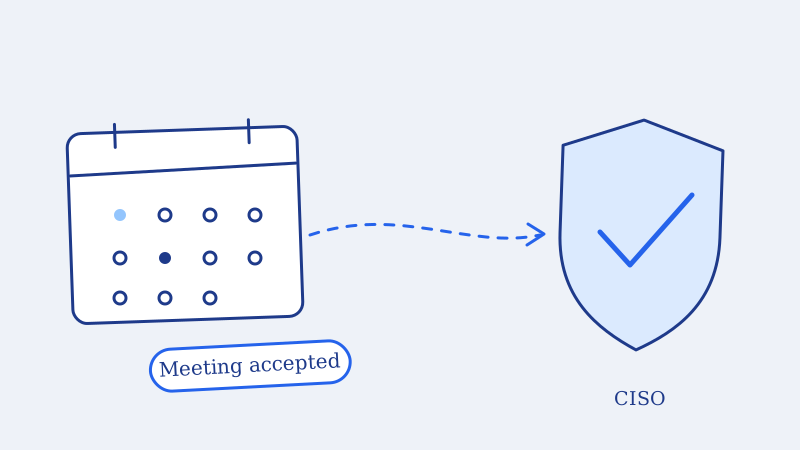
Selling security software means selling to the single most skeptical buyer in the enterprise. A CISO spends their day assuming every inbound message is a phishing attempt, every unknown sender is a threat, and every vendor pitch is noise until proven otherwise. That instinct is the job. It is also exactly what makes them nearly impossible to reach through the channels every other rep leans on. If you sell to security teams, your hardest problem is not the demo or the pricing conversation. It is getting the first meeting on the calendar at all.
The math is brutal. A mid market CISO gets flooded with vendor email the moment their title updates on LinkedIn. Endpoint vendors, SIEM vendors, identity vendors, GRC platforms, and a rotating cast of “next generation” everything all land in the same inbox on the same day. Security leaders have responded by turning their inbox into a fortress: aggressive filtering, delegated screening, and a blanket policy of ignoring anything that reads like outbound. The traditional cold email playbook does not just underperform here. It actively trains the buyer to tune you out.
This is where the cold calendar invite becomes a real weapon for security sales teams. Instead of hoping an email survives a CISO’s filters and skepticism, you send a legitimate calendar event that lands directly in their calendar app. This playbook covers how cybersecurity and infosec reps use cold calendar invites to book discovery calls, technical demos, and security reviews with the exact buyers who never reply to email.
Why email and cold calls fail security reps specifically
Every outbound channel decays over time, but cybersecurity punishes the traditional ones harder than almost any other market, for three reasons.
First, the buyers are trained to distrust the channel itself. A CISO whose entire job is stopping email based attacks is not going to reward a stranger who shows up in their inbox with a link and an ask. What looks like a normal cold email to a SaaS seller looks like a low grade social engineering attempt to a security leader. The channel works against your credibility before your copy ever gets read.
Second, the messaging has gone completely flat. Security outreach has converged on the same handful of openers: the breach fear tease, the “saw you are hiring a SOC analyst” trigger, the compliance deadline nudge. CISOs and their teams have seen every version thousands of times. What reads as tailored to the rep who wrote it reads as one more automated sequence to the person who gets forty of them a week.
Third, deliverability quietly kills the channel before the copy ever matters. Many security sales teams blast from a single overworked domain, buy stale contact lists that churn constantly as security staff change roles, and never validate addresses, so a large share of sends bounce or route straight to spam. A low open rate usually is not a subject line problem. It is a the message never arrived problem. Cleaning your list with a verification tool like Scrubby before any campaign is the difference between reaching a real inbox and torching an already fragile sender reputation on dead addresses.
Cold calendar invites route around all three obstacles. They surface as a calendar event as well as a message, so they are not fighting for attention in the promotions tab alone, they render as a structured event instead of another marketing email, and they are still rare enough in security outreach that they earn a genuine second look. Tools like Kali send cold calendar invites at scale so reps can reach security leaders who have trained themselves to ignore the inbox entirely.
What a cold calendar invite actually is
A cold calendar invite is a legitimate calendar event you send to a prospect you have not met yet. It shows up in Google Calendar, Outlook, or Apple Calendar the same way an internal meeting request would, with a title, a proposed time, a short description, and a video link. The prospect can accept, decline, or propose a new time with a single tap.
The power comes from the surface it lands on. A CISO who deletes vendor email without reading it still glances at anything that appears on the calendar, because a calendar entry implies a commitment that needs a decision. That built in prompt to respond is exactly what a cold email lacks. You are not asking for attention buried in a paragraph. You are asking for a yes or no on a specific time.
Used well, the invite is not a trick, and that matters more in security than in any other market. It is a clear, respectful proposal: here is who I am, here is the 15 minutes I am asking for, here is what you will get out of it, pick a time or tell me a better one. Transparency is the whole point, because the buyer you are courting punishes anything that smells like manipulation.
How to write a cold calendar invite CISOs accept
The event is short by design, so every field has to earn its place. With a security audience, clarity and restraint beat cleverness every time.
Title. Name the value and keep it human and specific. “Kali <> Acme Security: 15 min on reducing SOC alert fatigue” beats “Product Demo Request.” The title is the one line that is guaranteed to be seen, so lead with the outcome the security team cares about, not your company or your category.
Duration. Ask for 15 minutes, not 30. A shorter ask is easier to accept, and security leaders live in back to back incident reviews and vendor calls. You can always extend a meeting that is going well. You cannot un ask for an hour.
Description. Three sentences maximum. One line on why you are reaching out to this specific person or team, one line on the concrete outcome of the meeting, one line making it easy to decline or reschedule. With a CISO, add nothing that looks like a tracking pixel or an obfuscated link. Respect and transparency are the message.
Timing. Propose a slot that fits a security leader’s reality: early morning before standups, or late afternoon after the day’s fires are out. Avoid Monday mornings, when the weekend’s alerts get triaged. Getting the proposed time right lifts acceptance more than any wording change.
For deeper subject line and description patterns, our guide on cold calendar invite subject lines that get accepted breaks down templates you can adapt to a security audience.
Fit the invite to the security buying committee
Security deals are rarely one signature. A single evaluation can involve the CISO as economic buyer, a security architect or engineering lead as technical evaluator, a SOC or detection lead as daily user, a GRC or compliance owner, and often procurement and IT. Cold calendar invites let you work that committee deliberately instead of hoping one email forwards itself.
- The CISO gets an invite framed around risk reduction, board reporting, and program maturity, the things they answer for.
- The security architect or engineering lead gets an invite framed around integration, deployment effort, and how the tool fits the existing stack.
- The SOC or detection lead gets an invite framed around alert volume, triage time, and analyst workload, the pain they feel every shift.
- The GRC or compliance owner gets an invite framed around audit evidence, framework coverage, and control mapping, not detection speed.
Multi threading a security account with tailored invites moves an evaluation faster than a single email to a single contact ever could, because you seed the internal conversation in more than one place at once.
Why calendar invites clear security filters better
Security orgs run some of the strictest email filtering on earth, which is precisely why a channel that sidesteps the promotions folder is so valuable here. A calendar invite is a structured event object, not a marketing email, so it typically arrives through the calendar system and surfaces as a pending item that needs a decision rather than a message competing with hundreds of others.
That said, the underlying deliverability fundamentals still matter. If your sending infrastructure is misconfigured, even invites can land poorly, and in a security account a message that looks spoofed is worse than no message at all. Get your authentication right, keep your list clean, and treat the security buyer’s suspicion as a reason to be more legitimate, not less. Our breakdown of SPF, DKIM, and DMARC for cold calendar invite deliverability walks through the setup that keeps your invites trusted.
Handle the security buyer’s skepticism head on
A CISO will scrutinize your invite more than any other buyer would, so build for that. Send from a real, warmed domain that matches your company. Use a plain video conferencing link they recognize, not a redirect through a tracking service. Keep the description free of urgency theater and fake scarcity. If a security leader can look at your invite and immediately understand who you are, what you want, and how to say no, you have already outperformed the ninety nine percent of vendors who never earn that clarity.
The counterintuitive truth is that the most suspicious buyer in the building rewards the most straightforward outreach. Cold calendar invites work in security precisely because they force you to be concrete: a real person, a real time, a real ask, one tap to accept or decline.
Measure what actually matters
For a security sales team, the invite acceptance rate is your leading indicator of pipeline. Track how many invites you send, how many get accepted, and how many accepted meetings actually happen. Then watch which framing lifts acceptance for each committee role, and double down on what works.
Once meetings are booking, the next lever is show rate, because a security leader’s calendar changes fast when an incident hits. A short, respectful confirmation touch and an easy reschedule path keep accepted meetings from quietly evaporating. Our guide on reducing no show rates for meetings booked with cold calendar invites covers the follow up cadence that protects the meetings you worked so hard to book.
The bottom line for security sales teams
Cybersecurity is the hardest market in B2B to break into cold, because the buyer’s entire job is to distrust unsolicited contact. That is exactly why the teams that find a channel outside the inbox win more of the calendar. Cold calendar invites reach security leaders on a surface they still respond to, force the kind of transparency that skeptical buyers reward, and let you multi thread an evaluation across the whole committee.
Validate your list with Scrubby so your invites reach real people, then use Kali to send cold calendar invites that land in front of the CISOs and security teams your cold emails never reached. In a market where every competitor is fighting for the same ignored inbox, the calendar is the opening your pipeline has been missing.