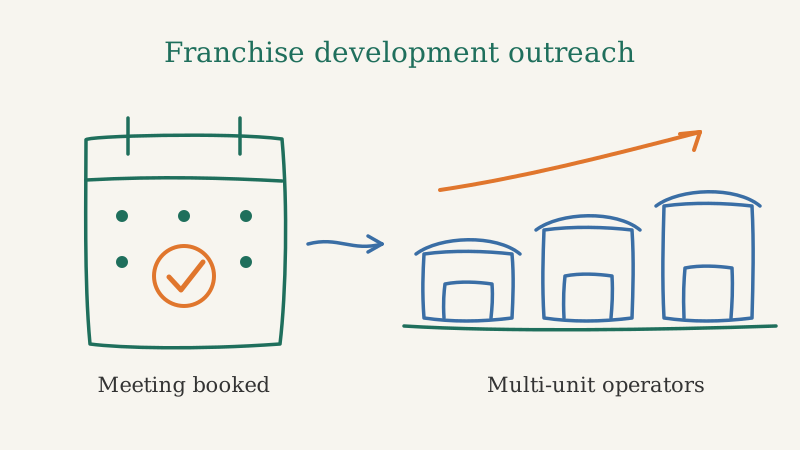
Franchise development is one of the few sales motions where the pipeline is rarely the problem. Portal inquiries arrive, broker referrals land, and discovery day waitlists fill. The problem is conversion, and almost all of the loss happens in the same place: the stretch between a candidate raising their hand and that candidate actually sitting on a call with a development director.
The people you most want in that seat are the hardest to reach. An experienced multi-unit operator running eleven locations of someone else’s brand is not refreshing their inbox for franchisor emails. An area developer evaluating three concepts at once is fielding pitches from every development team in the category. A high net worth career changer who downloaded your franchise information kit at 10pm is being called within the hour by four other brands and has already stopped answering unknown numbers.
So development teams do what everyone does: more email, more calls, more portal retargeting. Meanwhile the candidates who would actually sign and perform go quiet. This playbook covers how franchise development and franchisee recruitment teams use cold calendar invites to put real meetings on the books with multi-unit operators, area developers, and serious candidates who ignore every other channel.
Why email and phone fail against franchise candidates
Three things make franchise development uniquely hostile to traditional outbound.
First, the category is loud. A candidate who fills out one portal form is instantly distributed to a dozen brands. Within a day their inbox holds eight near-identical messages promising a proven system, strong unit economics, and a supportive franchisor, and their voicemail holds five calls from development reps who all opened the same way. Your brand may genuinely be the better fit, and it still drowns, because the candidate cannot tell your email apart from the seven beside it.
Second, your best targets are operators, not desk workers. The multi-unit franchisee you want to convert into a multi-brand franchisee spends the day between locations, in the back office, or on the phone with their own GMs. They are the same persona that makes restaurant technology sales so difficult, and they filter vendor and franchisor outreach with the same reflex. Email is something they clear late at night. An unknown number during the lunch rush gets ignored.
Third, data decay is brutal. Franchise candidate lists go stale faster than almost any vertical. Portal leads are entered with typos and throwaway addresses, broker lists get resold for years, and multi-unit operator rosters still carry the general managers and partners who left two seasons ago. Blast a tired domain into that mess and a meaningful share of your sends bounce or route straight to spam, which drags your inbox placement down for every candidate you try to reach afterward. Running your candidate and operator addresses through a verification service like Scrubby before a campaign is the difference between landing on a real calendar and quietly burning the domain your whole development team depends on.
Cold calendar invites step around all three. They arrive on a different surface than the flooded inbox, they read as a specific commitment rather than one more brand pitch, and they are still rare enough in franchise recruitment that they earn a genuine second look.
What a cold calendar invite actually is
A cold calendar invite is a real calendar event sent to someone you have not spoken with yet. It appears in Google Calendar, Outlook, or Apple Calendar exactly the way an internal P&L review or a landlord call would, with a title, a proposed time, a short description, and a video link. The candidate can accept, decline, or propose a new time with one tap on their phone.
The leverage comes from the surface. An operator who deletes franchisor email unopened will still glance at anything that appears on their calendar, because a calendar entry implies a pending decision. That built-in prompt to respond is precisely what a cold email lacks. You are not competing for attention inside a paragraph. You are asking for a yes or a no on one specific time.
Done properly this is not a trick. It is a clear and respectful proposal: here is who I am, here is the fifteen minutes I want, here is what you get from it, take this slot or name a better one. Tools like Kali send cold calendar invites at scale so development teams can reach candidates who have trained themselves to ignore the inbox entirely.
Step one: give the invite a reason a franchise candidate cares about
The fastest way to burn this channel is a vague invite. A pending event titled “Franchise Opportunity Discussion” from a name the candidate does not recognize reads like spam that jumped the queue, and a serious operator declines it on sight.
Every invite has to carry a reason stated in the candidate’s own terms, and those terms differ sharply by segment. An existing multi-unit operator cares about territory availability, cash on cash return, how your model stacks against the brand they already run, and whether your field support actually shows up. A first time owner operator cares about total investment, ramp to breakeven, financing paths, and how much of their life this consumes in year one. An area developer cares about development schedules, exclusivity, and whether the pipeline in their market is real.
So write the reason for the segment. Not “learn about our franchise opportunity.” More like “15 min on the three territories still open in North Texas,” or “how our average unit volume compares to the brand you run today,” or “what a two unit development schedule looks like with our current incentive.” When the reason maps to a number the candidate is already modeling in a spreadsheet, the request stops reading as a pitch and starts reading as a peer who knows the business.
That demands tight segmentation. Mixing career changers, existing operators, and institutional developers into one list guarantees generic copy. If you are opening a new region or recruiting from an adjacent concept for the first time, our guide on using cold calendar invites to break into new verticals walks through building that segmented motion from nothing.
Step two: protect deliverability before the first invite goes out
Cold calendar invites ride the same sending infrastructure as cold email, so they carry the same deliverability exposure. If invites bounce or get flagged, you damage the domain every future candidate conversation depends on, and in franchise development that domain is usually the brand domain itself. That is a far more expensive asset to burn than a throwaway sending domain.
The most common failure is simply a bad address. An invite sent to a dead mailbox is a wasted touch that still costs reputation when it bounces, and franchise lists are full of them: abandoned portal signups, role addresses nobody reads, partners who exited. Validate before you send. An email verification tool like Scrubby catches the dead and risky addresses so your invites reach real calendars instead of hardening a spam filter against your brand.
Then keep volume deliberately low and human. This is not a channel for ten thousand blind sends a week. A development director working a focused list of a few hundred named operators and qualified candidates, sending a modest number of well-reasoned invites per day, will book more meetings and burn far less reputation than someone treating invites as a spray campaign. For specifics on safe pacing, see our breakdown of how many cold calendar invites to send per day.
Step three: write the invite so a candidate accepts
Three parts of the invite decide the outcome: the title, the time, and the description. Candidates read all three in a few seconds and spot filler instantly.
The title is your subject line, and it should name the outcome rather than your brand. “15 min: open territories in North Texas” beats “Introduction to our franchise system.” Keep it short enough to read in full on a phone notification, since that is where nearly every candidate sees it first.
The time signals whether you respect their operation. If your target already runs units, never propose a slot during a peak daypart or a weekend. Aim for the mid-morning or mid-afternoon lull, on a Tuesday, Wednesday, or Thursday. Offer a genuinely short duration, because fifteen minutes is far easier to accept than sixty, and once you are in the conversation you can earn the longer validation call and the discovery day.
The description closes the distance between a stranger and an accepted meeting. Two or three sentences: who you are, the specific candidate outcome you want to cover, and one concrete proof point such as a comparable operator in their market, a real average unit volume figure, or a current development incentive. Then make declining and rescheduling frictionless. A candidate who trusts that saying no is easy is far more willing to say yes.
Speed matters more here than in almost any other outbound motion. A portal inquiry is being worked by four competing brands the same day, so an invite that lands within the hour of the form fill converts at a completely different rate than one sent on day three. Our guide on using calendar invites for inbound lead follow up and speed to lead covers how to wire that into your intake process.
If the first invite goes unanswered, the follow up is not a nag. It is a short second touch offering a new time or a fresh angle on the same outcome. Serious candidates are busy, not hostile, and a well-timed second invite often lands simply because the first arrived mid-shift. Our follow-up sequence for unaccepted invites lays out the timing so you stay persistent without reading as desperate.
What good looks like
A franchise development team running this channel well is not sending more, it is sending sharper. A curated list of multi-unit operators, area developers, and qualified candidates whose capital and experience match the award you can actually grant. A validated address set that protects the brand domain. Invites with titles that name a candidate outcome, times that dodge every peak, and descriptions that give a skeptical operator one real reason to accept. Fast first touches on inbound, and follow ups that read as helpful.
Done that way, cold calendar invites fix the exact leak that costs franchise development the most: candidates who were genuinely interested but never got into a live conversation before a competing brand got there first. If your team would rather have the motion run for you than build it in house, outsourced go to market groups like Vendisys operate this kind of channel as a service. Either way, pair a purpose-built sending tool like Kali with a clean, verified list from a service like Scrubby, and the operators who ignore every franchisor email become a pipeline you can rely on.