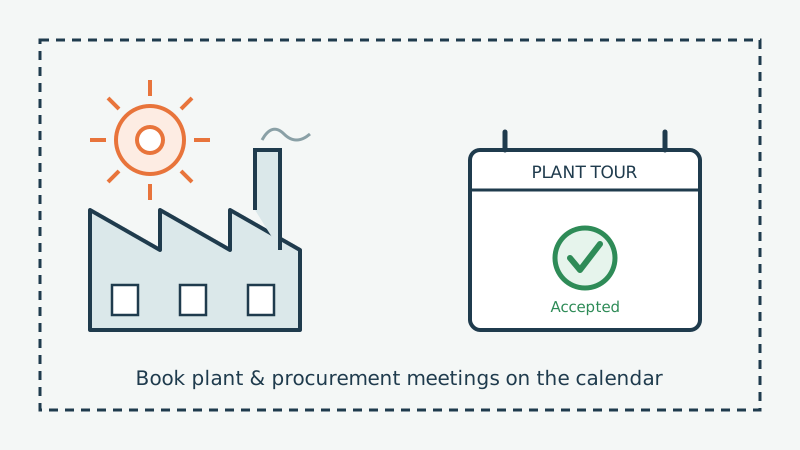
Selling into manufacturing is a grind of a different kind. Your buyers are not glued to a laptop refreshing an inbox. They are on the plant floor, in a supplier review, or walking a line with a quality manager. A plant manager might open email twice a day, skim the first three subject lines, and archive the rest without a second thought. Procurement, meanwhile, filters aggressively for anything that smells like a pitch.
That is why so many industrial sales reps watch their cold email reply rates crater year after year. The channel is not broken because your offer is weak. It is broken because the people you need to reach do not process buying decisions in an inbox. They process them on a schedule.
Cold calendar invites flip the channel. Instead of asking a plant manager to read, decide, and reply, you drop a specific, low-friction meeting proposal directly onto the surface they actually check every morning: their calendar. This guide covers why that works in industrial sales, how to structure invites for plant tours, capability reviews, and procurement conversations, and how to keep your sending clean enough to land.
Why manufacturing buyers respond to the calendar
Industrial buying cycles run on meetings, not messages. A capital equipment purchase, a new component supplier, a maintenance contract: none of these close over a thread of emails. They advance through scheduled conversations, site visits, and formal reviews. Your buyers already think in terms of “who am I meeting with this week.”
A cold calendar invite meets them exactly where the decision lives. When a plant manager sees a 20-minute hold titled “Reduce unplanned downtime on Line 3, 20 min,” the format itself signals that you understand how their day works. It is not a wall of text asking for attention. It is a concrete slot with a concrete purpose.
There are three structural reasons the calendar outperforms email in this vertical:
- Fewer gatekeepers on the calendar. An executive assistant may triage email, but calendar invites often route straight through to the person’s scheduling view, especially when the invite is specific and professional.
- The medium implies seriousness. Anyone can blast a cold email. A calendar invite reads as a real request for time, which matches how industrial buyers expect vendors to behave.
- Decisions are binary and fast. Accept, decline, or propose a new time. There is no drafting a reply, no “let me think about it.” The buyer resolves it in five seconds while clearing their morning.
Tools like Kali are built specifically for running cold calendar invite campaigns at scale, so you can reach a full territory of plants without hand-scheduling every touch.
Map the three meeting types you actually want to book
Generic “let’s connect” invites die in industrial sales. Your buyers are practical and time-poor, so the meeting has to have an obvious payoff. Before you send anything, decide which of these three meetings you are proposing, because each one needs different framing.
1. The plant tour or walkthrough
This is your highest-intent play. You are asking to walk the floor, see the process, and identify where your product or service fits. Plant managers respond to this when the invite makes clear you will bring an outside eye, not a sales deck.
Frame it around observation, not pitching: “Walk Line 2 together, flag the top 3 downtime drivers, 30 min.” You are offering diagnostic value in exchange for access.
2. The capability or fit review
For component suppliers, contract manufacturers, and industrial distributors, the goal is often to get on the approved vendor list. A capability review invite proposes a short session to confirm whether your specs, certifications, and lead times match their requirements.
Keep it tightly scoped: “Confirm whether our tolerances and lead times fit your Q4 sourcing, 20 min.” Procurement respects an invite that respects their qualification process.
3. The procurement or sourcing conversation
When you are selling into a formal buying process, the meeting you want is with the sourcing or procurement lead. These buyers are trained to deflect pitches, so the invite has to lead with a business reason they cannot dismiss: cost reduction, supply continuity, or risk mitigation.
Something like “Second-source options for [component] ahead of your next RFQ, 25 min” gives procurement a reason that fits their mandate.
How to write a cold calendar invite that gets accepted
The invite has three parts that matter: the title, the description, and the time you propose. Get all three right and acceptance rates climb.
The title is the whole pitch. It shows up in the notification, the calendar grid, and the accept or decline prompt. It has to communicate the payoff and the duration in one glance. Compare:
- Weak: “Introduction from [Your Company]”
- Strong: “Cut changeover time on your stamping line, 20 min”
The strong version names a specific pain that matters to a manufacturing operation and caps the time cost. That combination is what earns the accept.
The description gives one reason and one proof point. Keep it to three or four sentences. State why you are reaching out, one relevant result you have delivered for a similar operation, and exactly what the 20 minutes will cover. Do not paste a brochure. A plant manager reads the first two lines and decides.
Propose a real, near-term time. Pick a slot that fits how the plant runs. Early morning before the line ramps or late afternoon during shift overlap often works better than midday. Offering a specific time (with an easy path to propose another) beats “let me know what works,” which just recreates the email back-and-forth you were trying to escape.
For the deeper mechanics of subject lines, timing, and follow-up cadence, the Kali blog has tested breakdowns you can adapt to an industrial audience.
Deliverability still decides whether you land
None of this works if your invites never arrive. Manufacturing contact data is notoriously messy: role changes, plant consolidations, generic info@ addresses, and long-abandoned mailboxes are everywhere. Send an invite to a dead address and you do more than waste a touch. You rack up bounces that quietly damage your sending reputation and start pushing even your good invites toward spam.
Two habits protect your deliverability in this vertical:
- Validate every address before you send. Run your list through a verification tool like Scrubby to strip out invalid, catch-all, and risky addresses before your campaign goes out. Industrial lists especially benefit from this, because so much of the data is stale. Clean lists keep your bounce rate low and your invites landing.
- Warm up and pace your sending. Do not fire 500 invites from a cold domain on day one. Ramp volume gradually and keep authentication (SPF, DKIM, DMARC) in order so mailbox providers trust your sends.
Deliverability is the unglamorous half of outbound, but in a vertical where your data decays fast, it is the difference between a full pipeline and a silent one.
A simple first campaign
If you sell into manufacturing and want to test this without overhauling your whole motion, run a two-week pilot:
- Pull a list of 100 target plants in one region or one process type (say, injection molders or metal fabricators).
- Verify the contacts so you are only sending to real, deliverable addresses.
- Pick one meeting type (start with the capability review, it has the lowest friction).
- Write one strong title and one tight description, then send calendar invites proposing a specific near-term slot.
- Follow up once on non-responders after three business days with a fresh time.
Track acceptance rate, meetings booked, and cost per meeting against whatever your cold email numbers were. Most industrial reps who make the switch find the calendar books meetings the inbox never could, because it reaches buyers on the surface they actually run their week from.
Manufacturing buyers are not ignoring you out of disinterest. They are ignoring the channel. Move the ask to their calendar, keep your list clean, and give them a meeting worth 20 minutes of a very busy day. That is how you turn a cold territory of plants into a booked calendar.
Ready to run calendar invite outreach across your territory? See how Kali automates cold calendar invites so you can book plant and procurement meetings at scale.