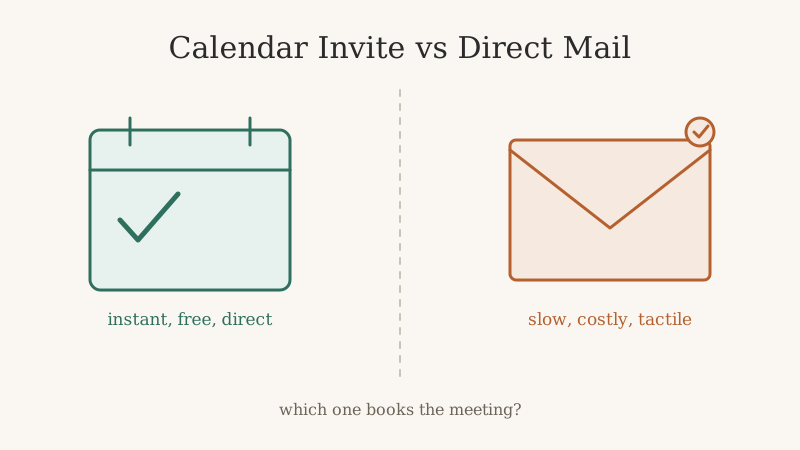
Direct mail keeps coming back into fashion. Every time inboxes get noisier and reply rates sag, some team rediscovers the humble physical package: a dimensional mailer, a handwritten note, a branded gift card that lands on a decision maker’s desk with a thud that no spam filter can suppress. It feels clever precisely because so few teams still do it.
There is real truth to that pitch. A physical object breaks the pattern of the digital day. But direct mail also carries baggage that its fans rarely mention out loud: long lead times, high cost per touch, messy attribution, and a stubborn gap between “they opened the package” and “they booked a meeting.” Meanwhile, a much cheaper channel keeps quietly putting specific times in front of buyers without any of that overhead: the cold calendar invite.
This guide runs direct mail and cold calendar invites through the same scorecard: reach, conversion, cost, speed, attribution, and the moments where one clearly beats the other. By the end you will know which one deserves more of your pipeline budget and where combining them makes sense.
The core difference: an object versus an ask
Direct mail and calendar invites are trying to do the same job through opposite mechanics.
Direct mail wins attention by being tangible. The theory is that a physical item earns a moment of curiosity that an email never gets, and that curiosity buys you the right to a conversation. But notice the extra step buried in there. The mailer earns attention, then it still has to convince the prospect to take a separate action later: scan a QR code, visit a landing page, reply to a follow up email, or answer a call. Every one of those handoffs leaks prospects.
A cold calendar invite collapses that funnel. Instead of earning attention and then asking for a second action, it makes the ask the whole message. The invite lands in the prospect’s calendar as a proposed time with a clear reason to meet. Accepting is one click, and acceptance is the conversion. There is no QR code to scan, no landing page to visit, no reply to compose. The channel and the call to action are the same object.
That structural difference drives almost everything below.
Reach and speed
Direct mail has a hard floor on speed. You need verified mailing addresses, creative that has to be designed and printed, a fulfillment partner, and postal or courier transit time. Even a fast program runs a week or two from “let’s send this” to “it landed on the desk,” and that assumes your address data is clean. In a hybrid-work world, a large share of your prospects are not sitting at the office address you have on file, so a meaningful percentage of expensive packages never reach a human at all.
Cold calendar invites move at the speed of email infrastructure. You can build a segment in the morning and have invites sitting in calendars by the afternoon. There is no printing, no shipping, and no courier. If a campaign underperforms, you can rewrite the invite description and relaunch the same day rather than waiting on a new print run.
The catch on the invite side is deliverability. An invite is only as good as the address it reaches and the reputation of the domain it sends from. Send from a cold, misconfigured domain to a stale list and your invites will get filtered or ignored just like bad email. This is why serious calendar programs verify their lists first. Running your addresses through a validation tool like Scrubby before a send strips out invalids and spam traps, which protects both your acceptance rate and your sender reputation. Direct mail has an analogous tax, address verification, except a wasted physical touch costs dollars instead of fractions of a cent.
Edge on reach and speed: calendar invites, by a wide margin.
Conversion: the honest comparison
This is where the two channels are hardest to compare fairly, because they measure success at different points in the funnel.
Direct mail practitioners love to quote high “response” numbers, but response often means something soft: a QR scan, a website visit, or a reply that still needs to be worked into a meeting. The number that actually matters, meetings booked per thousand touches, is usually far lower and far more expensive than the headline suggests. Premium dimensional mailers aimed at a tight list of named accounts can convert well, but only because someone did heavy manual research and follow up around each package. That does not scale cheaply.
Cold calendar invites convert on the exact metric you care about. The prospect either accepts a proposed meeting time or they do not, and an acceptance is a booked slot rather than a soft signal. That tight loop between action and outcome is the whole appeal. A well targeted invite with a specific, relevant reason to meet routinely outperforms a generic mailer on cost per booked meeting, even when the mailer wins on raw attention.
The nuance: direct mail can lift conversion on a very small, very high value list where the physical gesture signals real investment. For your top twenty dream accounts, a thoughtful package plus a personal note can open a door that no digital touch will. For the other few thousand prospects, the economics collapse.
Edge on conversion: calendar invites at scale, direct mail only for a tiny premium tier.
Cost per touch and cost per meeting
The cost gap here is not close.
A single direct mail touch, once you count creative, printing, the physical item, fulfillment, and postage, commonly runs anywhere from a few dollars to well over fifty dollars for a dimensional mailer or a gift. Multiply that by a list of any real size and the budget balloons before a single meeting is booked. Worse, you pay that cost whether or not the package reaches a human or generates any response.
A cold calendar invite costs a rounding error by comparison: the price of your data, your sending tooling, and an SDR’s time. You are not paying per physical unit, so scaling the volume does not scale a per-piece cost the same way. That is why cost per booked meeting on a well run calendar program tends to sit far below a broad direct mail campaign.
Direct mail defenders will point out, correctly, that cost per touch is the wrong lens for a named-account strategy where one closed deal is worth six figures. On a twenty-account list, spending fifty dollars a package is trivial against the pipeline value. True. But that is an argument for using direct mail as a precision instrument, not a volume channel.
Edge on cost: calendar invites, decisively, everywhere except the smallest premium lists.
Attribution and iteration
Direct mail is notoriously hard to measure. You send a batch, meetings trickle in over the following weeks through multiple channels, and you are left guessing how much credit the mailer deserves versus the email and the call that followed it. Unique QR codes and landing pages help, but plenty of influenced prospects never use them, so your reported numbers understate or misattribute the true effect. The long lag between send and response also makes fast iteration painful, since you cannot cheaply test ten variations of a printed package.
Calendar invites produce clean, near real time data. You can see acceptance rates by segment, by subject line, by send time, and by invite description, and you can act on it the same week. Testing a new angle is free, so you can run structured experiments and compound small wins into a much better program over a quarter. If you also monitor how prospects behave after they land on your site, pairing invite data with a tool like CAM for website and signal monitoring closes the loop between the touch and the intent it creates.
Edge on attribution and iteration: calendar invites, clearly.
Where direct mail genuinely wins
None of this means direct mail is dead. It is a specialist tool, and used as one it is excellent.
- Top-tier named accounts. For a short list of dream logos, a thoughtful physical package signals investment and effort in a way digital cannot match, and it can break a months-long stalemate.
- Reactivating a stalled champion. When a deal has gone quiet, a personal, unexpected gift can restart a relationship where another email would be deleted.
- Executive gifting tied to an event. Pairing a mailer with a dinner, a conference, or a proof of concept kickoff can raise show rates for the high-touch moments that deserve the spend.
In every one of these cases, direct mail is doing what it does best: creating a memorable moment for a handful of high value people where the cost is irrelevant next to the prize.
Where cold calendar invites win
Calendar invites are the right default for almost everything else, especially anywhere volume and efficiency matter.
- Broad, repeatable pipeline generation. When you need dozens of meetings a month rather than three legendary ones, invites deliver at a cost structure direct mail cannot touch.
- Fast experimentation. When you are still finding the message that resonates, the same-day feedback loop lets you learn in weeks what direct mail would take quarters to teach.
- Speed to pipeline. When the quarter is closing and you need meetings on the calendar now, you cannot wait on a print run and a courier.
- Lean teams. When you do not have the budget or ops muscle to run a fulfillment pipeline, invites give you a serious outbound channel without the logistics.
The smart play: use both, deliberately
The strongest programs do not pick a side. They match the channel to the tier.
Run cold calendar invites as your scalable workhorse for the broad middle of your list, where cost per meeting and speed decide whether the number gets hit. Reserve direct mail for the narrow top of the pyramid, the named accounts where a physical gesture earns a door that nothing else will open, and even then, follow the package with a specific invite so the memorable moment has a concrete next step rather than a vague “let’s find time.”
Sequence them so each does its job. Use the mailer to earn attention on a dream account, then land a calendar invite a few days later that turns that attention into a booked slot. The gift creates goodwill; the invite converts it. Whichever you lead with, verify your data first, keep your sending domain healthy, and measure cost per booked meeting rather than cost per touch or soft response.
Do that, and the debate stops being direct mail versus calendar invites. It becomes a precision instrument working alongside a volume engine, each aimed at the accounts where it wins.