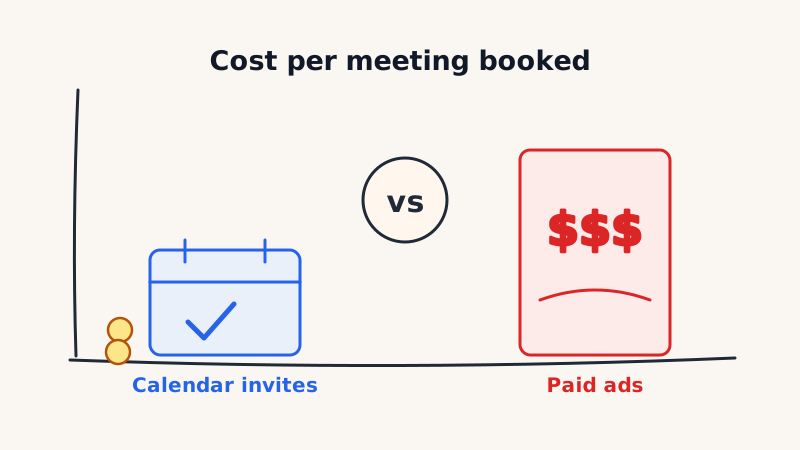
Every pipeline meeting eventually lands on the same slide: cost per booked meeting. A VP looks at the paid budget, looks at how many demos it produced, and quietly wonders whether the money would have booked more meetings somewhere else. Paid ads are easy to fund because they feel measurable. But measurable is not the same as efficient.
Cold calendar invites sit at the other end of the spectrum. There is no media spend, no auction, no creative refresh treadmill. You send a calendar invite to a targeted prospect, and either they accept the slot or they do not. The economics look completely different, and for a lot of outbound teams they look better.
This guide runs both channels through the same scorecard: what you actually pay per booked meeting, how long the payback takes, how each one scales, and the specific situations where paid ads still win. No cheerleading, just the math.
The Two Channels Do Not Buy the Same Thing
Before comparing cost, it helps to be honest about what each channel actually purchases.
Paid ads buy attention and intent capture. You pay for impressions and clicks, then hope a fraction of that traffic converts through a landing page, a form, and a follow up sequence before anyone talks to sales. You are renting reach and betting that a small slice of it turns into a conversation.
Cold calendar invites buy a specific slot on a specific calendar. There is no funnel to leak through. The ask and the conversion event are the same object: the meeting itself. A prospect either accepts the time or they do not, and an acceptance is already a booked meeting rather than a lead you still have to chase.
That structural difference is why the cost math diverges so hard. One channel pays for the top of a funnel and absorbs every downstream drop off. The other pays almost nothing and collapses the funnel into a single step.
Cost Per Booked Meeting, Step by Step
Let’s build the number honestly for both sides. Your inputs will vary, but the shape of the math holds.
Paid ads path
A typical B2B paid social or search campaign might look like this:
- Cost per click: 6 to 15 dollars in competitive categories
- Landing page conversion to lead: 2 to 5 percent
- Lead to booked meeting: 5 to 15 percent
Run the middle of those ranges. At a 10 dollar click, a 3 percent lead rate, and a 10 percent lead to meeting rate, you need roughly 333 clicks to produce one booked meeting. That is about 3,300 dollars in media spend per booked meeting, before you count the landing page, the ad creative, the marketing ops time, and the retargeting budget you layer on to rescue the drop off.
Even at flattering assumptions, most B2B teams land somewhere between 400 and 2,000 dollars of paid spend per genuinely qualified, sales accepted meeting. The number climbs fast in enterprise categories where clicks are expensive and buying committees are small.
Cold calendar invite path
The calendar invite path has almost no media cost. Your inputs are a clean contact list, sending infrastructure, and rep or automation time. Assume:
- Accepted meeting rate on a targeted, well warmed list: 4 to 10 percent of invites sent
- Data and tooling cost amortized per invite: a few cents
At a 6 percent acceptance rate, 100 invites produce 6 booked meetings. The marginal cost of those invites is dominated by list quality and deliverability, not media. Teams running this channel well routinely report cost per booked meeting in the low tens of dollars, sometimes under 20 dollars, once the system is dialed in.
The gap is not small. It is often an order of magnitude. That does not automatically make calendar invites the right choice for every goal, but it does explain why so many outbound teams treat paid ads as a brand and demand generation lever rather than a primary meeting engine.
Payback and Cash Flow Are Different Too
Cost per meeting is only half the story. When the money comes back matters just as much for a growing team.
Paid ads have a long, leaky payback loop. You spend today, traffic trickles in, leads sit in a nurture sequence, and booked meetings show up weeks later. If your creative fatigues or the auction price spikes, your cost per meeting drifts upward while you are still paying to learn that. You are also renting the audience: the moment you pause spend, the pipeline stops.
Cold calendar invites have a short, owned payback loop. You send a batch this week and see accepted meetings within days. There is no audience to keep renting. Once your list, copy, and deliverability are working, you can scale volume up or down without re-entering an auction or rebuilding creative. That responsiveness is worth real money when you need to hit a number this quarter rather than next.
Deliverability is the one place this channel can quietly bleed cost. If your invites land in spam or your domain reputation slips, your effective cost per meeting rises just like a paid auction. Validating your list before you send with a tool like Scrubby keeps invalid addresses from dragging down sender reputation, which is the closest thing calendar outreach has to a rising ad price. Protecting deliverability is protecting your unit economics.
Where Paid Ads Still Win
This is not an argument to zero out paid budget. Paid ads do things calendar invites cannot, and pretending otherwise leads to bad decisions.
Reaching people who are not on your list. Calendar invites require a named contact and an email. Paid ads can put you in front of prospects you have never identified, including buyers actively searching for a solution right now.
Capturing live intent. Search ads intercept people at the exact moment they type a problem into Google. No outbound channel matches that timing. When someone is in-market today, paid search is often the fastest way to be in the room.
Building brand and air cover. Paid impressions warm a market so that your outbound, including your calendar invites, lands on a name people already recognize. A prospect who has seen your brand three times accepts an invite at a higher rate than a cold stranger. The channels compound.
Feeding retargeting. Ads can re-touch website visitors and event attendees at scale in a way manual outreach cannot. That is genuine incremental reach.
The honest framing is that paid ads are a demand capture and awareness engine, while calendar invites are a demand conversion engine. Judging paid ads purely on cost per booked meeting undersells the awareness value, and judging calendar invites on brand reach undersells their conversion efficiency.
How to Run the Comparison for Your Own Team
Numbers from a blog post are a starting point, not your answer. Run this simple test to get your real cost per booked meeting on each channel.
- Pick one month and one fixed budget window. Track paid spend and outbound tooling cost separately.
- Count only sales accepted meetings. A form fill is not a meeting. A no-show is not a meeting. Hold both channels to the same bar so the comparison is fair.
- Divide fully loaded cost by accepted meetings for each channel. Include creative, ops time, data, and tooling, not just the obvious line item.
- Look at payback timing, not just the ratio. A channel that returns meetings in three days is worth a premium over one that returns them in three weeks when you are cash constrained.
- Check the compounding effect. Are your calendar invite acceptance rates higher in markets where you also run brand ads? If so, the channels are helping each other and should be budgeted together.
A purpose-built calendar outreach platform like Kali makes step two easier, because acceptances are tracked as booked meetings by default rather than reverse engineered from a messy lead funnel. When your conversion event and your reporting event are the same object, cost per meeting stops being a guess.
The Blend Most Teams Land On
After running the math, most outbound teams do not pick one channel and kill the other. They split by job.
They fund paid ads to capture in-market intent and keep the brand warm, accepting a higher cost per meeting as the price of reach and demand creation. Then they lean on cold calendar invites as the efficient conversion layer that turns identified accounts into booked meetings at a fraction of the cost, without waiting on an auction or a nurture sequence to mature.
The mistake is treating paid ads as your primary meeting engine because the dashboard is pretty, while ignoring a channel that books meetings for a tenth of the cost. Look at the fully loaded cost per booked meeting, look at payback timing, and let the math decide the budget split. In most B2B motions, that math moves a meaningful share of the meeting target off paid media and onto calendar invites, and the pipeline gets cheaper without getting smaller.
Attention is expensive and getting more so. A slot on the calendar is cheap and always available. Build your mix around that difference and your cost per booked meeting takes care of itself.