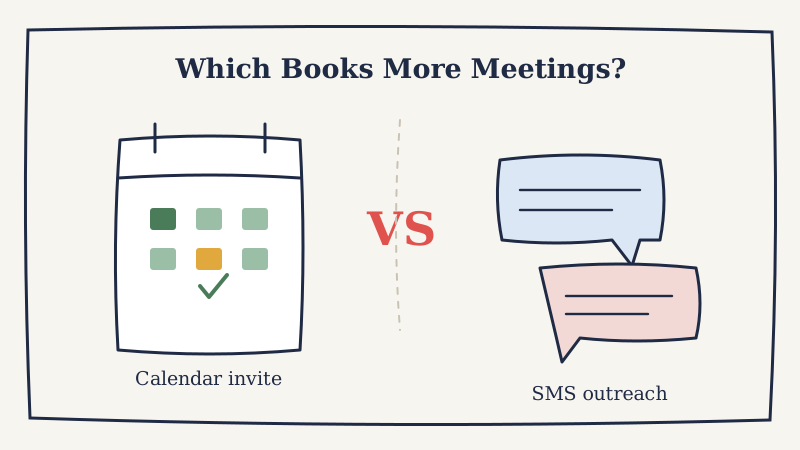
Cold SMS has a seductive pitch. Text messages get opened almost instantly, they feel personal, and they land on the one device a prospect never puts down. For a few years, outbound teams treated cold texting as the secret channel that everyone else was too timid to use.
The shine has worn off. Carriers tightened the rules, regulators sharpened the penalties, and prospects grew tired of work pitches arriving on their personal phones. Meanwhile, a quieter channel kept booking meetings without any of that baggage: the cold calendar invite, which skips the chit chat and puts a specific time directly in front of the buyer.
This guide runs cold SMS and cold calendar invites through the same scorecard: reach, conversion, compliance risk, cost, and the moments where one channel clearly beats the other. By the end you will know which one deserves more of your team’s pipeline and where blending them makes sense.
The Core Difference in How Each Channel Works
Cold SMS is a conversation opener. You send a short text, hope the prospect replies, and then try to steer that reply toward a booked meeting. The ask is indirect. You are not requesting a meeting on the first touch, you are requesting permission to keep talking. Every booked meeting requires a chain of replies that can break at any link.
A cold calendar invite is a direct ask. You send a meeting invitation with a specific time, a short agenda, and a clear value proposition in the description. The prospect sees a concrete proposal, not an open ended question. They accept, decline, or propose a new time. There is no multi message dance required to get to the point, because the point is already on their calendar.
That difference, indirect conversation versus direct proposal, shapes nearly everything else. SMS trades on immediacy and informality. Calendar invites trade on clarity and intent. One asks the prospect to start a chat. The other asks them to commit to a slot.
Reach and Open Behavior
Cold SMS earns its reputation on open rates. Texts are read within minutes, often seconds, and almost none go unseen. On raw attention, SMS is hard to beat. The problem is what that attention costs. A work pitch on a personal phone reads as an intrusion to many buyers, and the same urgency that gets the message opened also gets it resented. High open rates do not guarantee high welcome.
There is also a hard ceiling on reach. You can only text a prospect if you have a valid mobile number, and accurate mobile data for B2B buyers is scarce, expensive, and decays fast. Plenty of decision makers never expose a direct mobile line at all. Your addressable audience for cold SMS is a fraction of the audience you can reach by other means.
Calendar invites have a different reach profile. A calendar invite does not need a mobile number, and it does not depend on the prospect being available at a specific second. It lands in their calendar and waits. Calendar notifications surface with more urgency than a marketing email and stand apart from the crowded inbox. The prospect has to actively dismiss the invite rather than passively let it scroll away. Tools like Kali are built around this exact mechanic, sending personalized cold calendar invites at scale so reps reach buyers without hunting for cell numbers that mostly do not exist.
Conversion: What Happens After You Reach Someone
Here is where the indirect nature of SMS hurts. Getting a reply is not getting a meeting. A prospect texts back a question, the rep answers, the thread stalls, and the rep has to revive it. Each step leaks prospects. Even when the conversation flows, the rep still has to propose times, wait for confirmation, and send a separate invite to actually lock the slot. The channel is fast to open and slow to close.
Calendar invites collapse that funnel. The conversion event and the booking event are the same action. When a prospect accepts, the meeting is on both calendars with a time and an agenda already attached. There is no scheduling back and forth, because the schedule was the message. A lower percentage of recipients may accept than the percentage who open a text, but the ones who accept have committed to a specific slot rather than agreeing to keep chatting.
The intent signal is also cleaner. A prospect who accepts a calendar invite has looked at a real time and a real agenda and decided it is worth showing up. That is a stronger commitment than a prospect who fired off a one word reply to a text out of reflex. Cleaner acceptance usually means better show rates, which is the metric that actually feeds pipeline.
Compliance and Brand Risk
This is the category where cold SMS gets genuinely dangerous, and it is the part most teams underestimate. Texting people for business is heavily regulated. In the United States, the TCPA and carrier level rules around A2P messaging require consent frameworks, registered campaigns, and clear opt out handling. Cold texting prospects who never gave consent is not a gray area, it is a category of risk that carries real statutory penalties per message and growing enforcement.
Beyond the legal exposure, there is brand damage. A cold text to a personal phone can read as a violation even when it is technically allowed, and an annoyed prospect is a prospect who will never buy. The channel that gets the highest open rate also carries the highest chance of leaving a sour first impression.
Calendar invites operate in friendlier territory. Sending a business meeting invitation to a business contact is an ordinary, expected professional gesture. It does not require the same consent machinery as cold texting, and it does not feel like a stranger reaching into someone’s pocket. The downside risk to your brand and your legal team is dramatically lower.
Cost, Capacity, and Data Quality
Cold SMS looks cheap per message, but the real costs hide elsewhere. Sourcing accurate mobile numbers is expensive and the data rots quickly. Registering campaigns and maintaining compliance takes ongoing work. And because the channel is conversational, every booked meeting consumes rep time across multiple back and forth messages. The per message price is the smallest line item.
Calendar invite outreach shifts the capacity equation. Because the ask is direct and the channel is largely automated, a single rep can put far more qualified invitations in front of prospects per day than they could ever sustain in live text threads. Rep time moves away from babysitting stalled conversations and toward preparing for the meetings that actually get accepted.
Neither channel survives bad data, though. A calendar invite sent to a dead, invalid, or mistyped address bounces or lands nowhere, which wastes the channel’s biggest advantage. Running your list through a verification tool like Scrubby before you send keeps invitations flowing to real, reachable inboxes and protects your sender reputation, the same way clean mobile data is the only thing that keeps an SMS program from burning budget on disconnected numbers.
When Cold SMS Still Wins
Cold SMS is not useless, and dismissing it entirely will cost you in the right scenarios. There are clear situations where a text is the stronger move:
- Opted in or warm contacts. When a prospect already raised a hand, requested info, or gave a number at an event, a text is fast, welcome, and compliant.
- Time sensitive nudges. Reminding a confirmed prospect about a meeting in an hour, or catching someone before a deadline, plays to the immediacy SMS is built for.
- Reps and recruiting. Candidates and consumers often expect texts in ways that B2B buyers do not, and the channel feels native in those contexts.
- Local or mobile first audiences. Some industries and regions simply live on text, and meeting them there beats forcing email or calendar behavior.
In each of these, the prospect either expects the message or has a relationship that earns it. That is the difference between SMS that books meetings and SMS that gets you reported.
When Cold Calendar Invites Win
For most cold B2B outbound, calendar invites are the safer, more scalable engine:
- Net new prospects with no prior relationship. A direct meeting proposal feels professional where a cold text feels invasive.
- Buyers without exposed mobile numbers. You can reach a calendar without ever finding a cell phone.
- Compliance sensitive industries. Regulated sectors cannot afford the legal exposure of cold texting, and a calendar invite sidesteps it.
- High volume programs. When you need reach and repeatability, the asynchronous, automated nature of invites scales in a way conversational texting never will.
The Honest Verdict
If you have consent and a real relationship, SMS is a fast, high attention channel worth using carefully. But as a cold, top of funnel engine for net new B2B meetings, it is fragile: limited by scarce mobile data, throttled by regulation, and quick to damage your brand if you push it.
Cold calendar invites win the cold outbound matchup on the metrics that matter most for pipeline: broad reach without phone numbers, a direct ask that books the meeting in a single action, cleaner intent that lifts show rates, and a compliance profile that lets you scale without legal anxiety. SMS is a precision tool for warm moments. Calendar invites are the durable channel for booking meetings with people who have never heard of you.
The best teams use both deliberately: calendar invites to open net new pipeline at scale, and SMS reserved for the warm, opted in, time sensitive moments where a text genuinely helps. Lead with the channel that asks for the meeting, and keep your list clean enough that the ask actually lands.