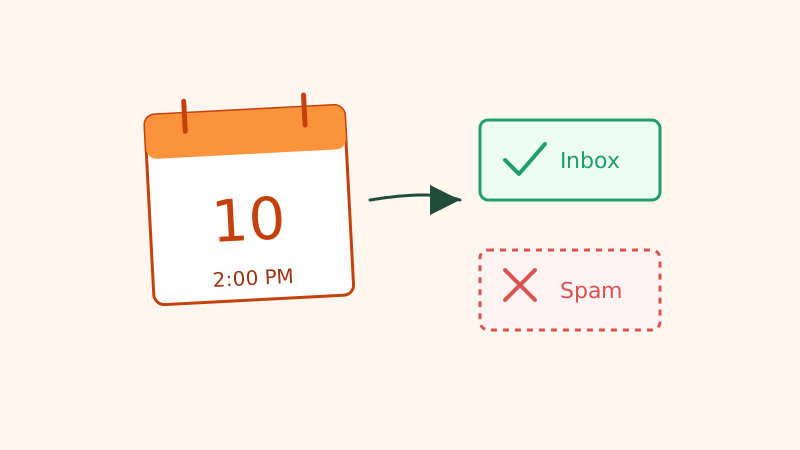
Every sales team that tries cold calendar invites asks the same first question: will these just get marked as spam like cold email does? It is a fair worry. If invites landed in the junk folder at the same rate as cold email, there would be no point using them.
The short answer is that a calendar invite follows a different delivery path than a marketing email, and that difference is exactly why prospects see it. But “different” does not mean “immune.” Understanding how invite delivery works tells you what to do, and what to avoid, to keep your acceptance rates high.
Why an invite is treated differently than an email
A cold marketing email and a calendar invite are not the same object to a mail system. A bulk promotional email gets scored by content filters trained on marketing patterns: spammy phrases, image-heavy templates, link density, sender reputation, list-unsubscribe headers, and engagement history. Those filters are tuned to catch broadcast mail.
A calendar invite arrives as a meeting request. The recipient’s mail client recognizes the format and surfaces it as an event, often rendering the accept and decline buttons right in the inbox. Because it reads as a one-to-one scheduling action rather than a campaign blast, it sidesteps a lot of the promotional-filtering machinery that buries cold email. That is the core reason invite open and acceptance rates run higher than cold email reply rates, a gap we have written about in calendar invite open rates vs cold email.
That said, an invite is still delivered over email infrastructure. The same sending domain, the same server, the same reputation. So while the content filters treat it differently, the underlying deliverability fundamentals still apply.
Where invites can still go wrong
An invite can underperform or get filtered for reasons that have nothing to do with the invite format and everything to do with the basics:
- A bad sending domain. If your domain reputation is already damaged from prior spam complaints, that reputation follows your invites. A meeting request from a blacklisted domain is still a message from a blacklisted domain.
- Sending to dead or invalid addresses. This is the quiet killer. Every invite sent to a nonexistent mailbox is a hard bounce, and a pile of hard bounces drags your sender reputation down for everyone you mail next, invites included.
- Volume spikes. Blasting hundreds of invites from a cold domain in an hour looks like exactly the kind of automated behavior filters are built to catch. Ramp matters.
- Generic, mass-cloned invites. If every invite has the identical title and a vague description, recipients flag them, and flags teach the filter.
Notice that most of these are reputation and list-quality problems, not invite-specific ones. Which is good news, because they are all fixable.
Protect the list before you protect the invite
The single highest-leverage move for invite deliverability is mailing a clean list. Bounces are the fastest way to wreck a sending domain, and once the domain is hurt, even a perfectly formatted invite suffers.
That means verifying your contact list before you send invites to it. A surface-level check is not enough for B2B data, where a large share of corporate domains are catch-alls that accept everything and confirm nothing. Running the list through a deeper validation pass, with a tool like Scrubby that actually resolves whether a mailbox exists behind a catch-all, keeps the dead addresses from ever generating a bounce. Clean list first, invites second. The order is not optional.
Keep the sending fundamentals boring
Beyond list hygiene, the same deliverability hygiene that protects email protects invites:
- Authenticate your domain with SPF, DKIM, and DMARC so receiving servers trust your mail.
- Warm up new sending domains before they carry cold volume, and ramp gradually rather than spiking.
- Cap volume per inbox so no single mailbox looks like a firehose.
- Personalize the invite (title, description, and timing) so it reads as a real meeting request, not a template. Our guide on calendar invite descriptions that make prospects show up covers the specifics.
- Mind the cadence. A relevant invite to the right person at a sane volume behaves like legitimate scheduling, because it is.
The takeaway
Cold calendar invites do not land in spam at the rate cold email does, and the reason is structural: a meeting request travels a different path through the inbox and reads as a scheduling action rather than a broadcast. But invites still ride on your email reputation, so they are only as deliverable as your domain and your list let them be. Clean the list before you send, authenticate and warm your domains, keep volume sane, and personalize each invite. Do that, and the invite format does the rest of the work that cold email cannot.