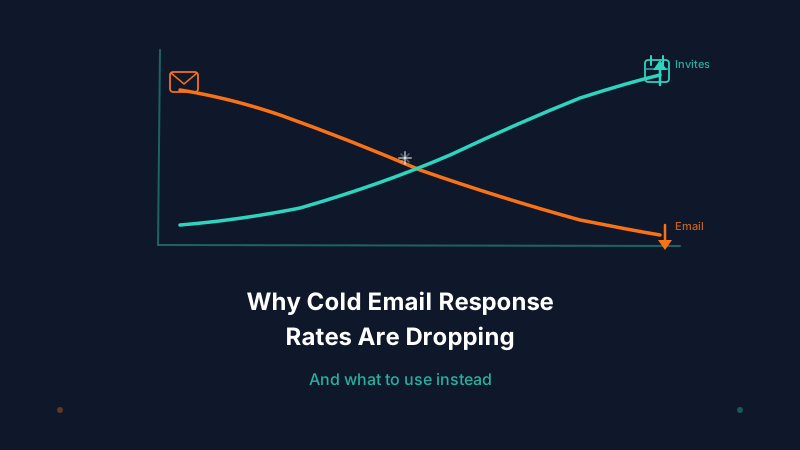
The benchmarks have been moving in one direction for three years. Open rates are down. Response rates are down. Meeting book rates are down.
Sales teams respond the same way every time: more sequences, better subject lines, A/B testing everything. It helps at the margins. It does not solve the underlying problem.
The problem is not your copy.
What the Numbers Actually Say
Cold email open rates dropped from roughly 21% in 2020 to about 15% in 2024. Response rates now sit between 1-5% for most B2B outbound teams.
Put that in practical terms. If you send a 200-person email sequence, you are looking at 2 to 10 responses. Most of those responses are not meetings. Some are “not interested.” Some are “wrong person.” Some are auto-replies.
This is not a company-specific problem. It is happening across verticals — SaaS, professional services, fintech, healthtech. The channel itself is degrading.
The Real Reason Cold Email Is Harder
Three reinforcing factors are driving the decline, and none of them will reverse:
Inbox saturation. The average business professional receives 120+ emails per day. Your cold email is one of dozens of outbound messages competing for attention. Even if your subject line is perfect, the prospect may never scroll down far enough to see it.
Trust deficit. Cold email is no longer unusual. Everyone gets it. The default interpretation when a prospect sees an unfamiliar sender with a pitch is “sales email.” They have pattern recognition for outbound messages, and the instinct is to delete or ignore. It does not matter how personalized your email is — the format itself triggers skepticism.
Deliverability erosion. Google and Microsoft have tightened their filtering significantly over the past two years. Bulk sending patterns, new domains, and low engagement rates all trigger spam classification. Your email may never reach the inbox at all. You are optimizing copy that prospects literally cannot see. Even teams that invest in list hygiene with tools like Scrubby to validate emails and reduce bounces find that deliverability headwinds keep getting stronger.
These three factors compound each other. More emails in the inbox means lower engagement. Lower engagement means worse deliverability. Worse deliverability means even fewer prospects see your message. The cycle accelerates.
The Metric You Are Actually Optimizing For
Response rate is a proxy metric. The real metric is pipeline velocity — how quickly you move from first touch to booked meeting to qualified opportunity.
Consider the cold email timeline: 3-5 touches across 2-3 weeks to earn a single response. That response converts to a meeting maybe 30-50% of the time. So you are looking at a 1-3% conversion from first touch to booked meeting, spread over weeks.
Every optimization you make to email copy moves that number by fractions of a percent. Better subject line? Maybe 0.2% improvement. Shorter email? Maybe 0.1%. You are grinding for marginal gains in a channel with a structural ceiling.
What Changes When You Stop Depending on Response Rates
KALI uses cold calendar invites instead of cold email as the primary outreach mechanism. The difference is not incremental — it is structural.
KALI uses cold calendar invites that land on the prospect’s calendar, not just in their inbox. There is far less competition for attention, and no open rate to depend on. The prospect sees the invite because their calendar is not cluttered with 120 other items.
The action required is binary: accept or decline. There is no reply to compose. No thread to manage. The friction is dramatically lower than email.
Acceptance rates are higher because the decision is simpler. A calendar invite for a 20-minute call on Tuesday at 2pm is easy to say yes to. An email asking “would you be open to a quick call?” requires the prospect to think, decide, find a time, and write a response.
The prospects who accept are warmer because they made a deliberate decision. They looked at the invite, read the context, checked their calendar, and clicked accept. That is a fundamentally different level of intent than someone who replies “sure” to a cold email.
How It Works
The process is straightforward:
- Share your target list. Give KALI your ICP criteria and the prospects you want to reach.
- Kali builds the strategy. We research each prospect, identify the right angle, and create personalized calendar invites with specific times.
- Invites go out. Calendar invites are sent on a managed cadence, timed to land when prospects are most likely to check their calendars.
- Accepted meetings land on your rep’s calendar. When a prospect accepts, the meeting appears directly on your sales rep’s calendar. No back-and-forth scheduling.
- Weekly reports. You get visibility into accepts, declines, and engagement metrics so you can see exactly what is working.
Frequently Asked Questions
Why are cold email response rates dropping?
Three main factors: inbox saturation (120+ emails per day for most professionals), trust deficit (prospects immediately recognize and dismiss cold outreach), and deliverability erosion (Google and Microsoft filtering out bulk senders more aggressively). These factors are structural and will not reverse.
What is a good alternative to cold email for B2B outreach?
Cold calendar invite outreach is emerging as the most effective alternative. It lands on a less crowded surface (the calendar) rather than depending on a reply, and produces higher response rates because the action required is simpler — accept or decline rather than read and reply.
Is a 1-3% cold email response rate normal?
Yes. Most B2B cold email campaigns now see 1-5% response rates, with the majority landing between 1-3%. This is down significantly from 4-8% response rates that were common in 2020-2021.
Should I still monitor what competitors are doing with their outreach?
Absolutely. Keeping an eye on how competitors approach outbound helps you differentiate your own messaging. Tools like CAM let you track competitor website changes so you can spot new positioning, pricing shifts, or feature launches in real time and adjust your outreach accordingly.
How does KALI differ from tools like Outreach or Salesloft?
Outreach and Salesloft are email sequencing tools — they help you send more email, faster. KALI is a different channel entirely. Instead of sending emails, KALI sends calendar invites directly to prospects’ calendars. It is not an email tool. It is a calendar-based outreach service.
Does cold calendar invite outreach work for B2B companies?
Yes. Calendar invite outreach works especially well for B2B because the target buyers — directors, VPs, and C-suite executives — manage their schedules through Google Calendar or Outlook. Their calendars are the one surface they check multiple times per day, which means your invite gets seen.