Most teams that try cold calendar invites judge the channel on a single campaign. They pull a list, write an invite, send a few hundred, and watch the acceptance rate. If the number disappoints, they conclude the channel does not work and move on.
The channel almost always works. What usually fails is the stack around it. A calendar invite is the last step in a chain that starts with data and ends with measurement, and a weak link anywhere upstream quietly caps your results before the invite ever reaches a prospect. Bad addresses waste sends. A cold domain lands invites in spam. No monitoring means you find out about a deliverability problem three weeks after it started tanking your pipeline.
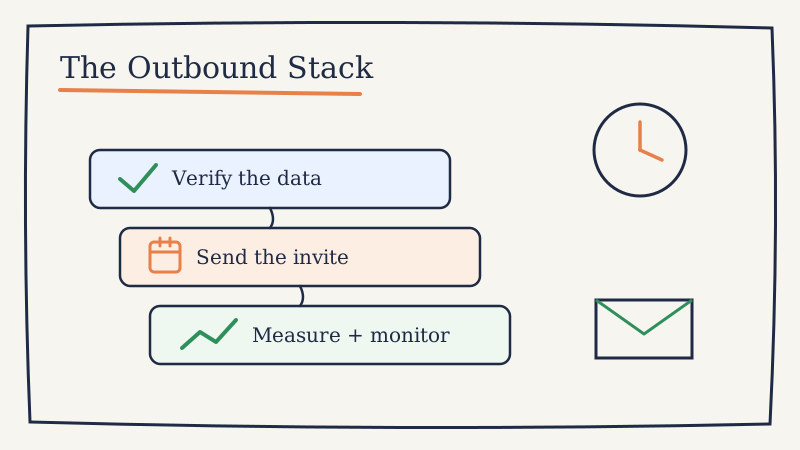
This guide breaks down the tech stack that a serious cold calendar invite program needs. Think of it as three layers stacked on top of each other: the data layer, the sending layer, and the measurement layer. Each one depends on the one below it. Get all three right and the channel produces meetings predictably instead of in random bursts.
Why a Calendar Invite Program Needs a Real Stack
Cold email has had two decades to mature. There are dozens of tools for warming domains, rotating inboxes, verifying lists, and tracking replies. Calendar invite outreach is newer, so teams often try to run it with duct tape: a spreadsheet, a shared calendar, and a lot of manual copy and paste.
That works for the first fifty invites. It falls apart at scale, and it falls apart in ways that are hard to diagnose. When acceptance rates drop, was it the copy, the list, the send timing, or the sending reputation? Without a proper stack you cannot tell, because you have no way to isolate any single variable.
A real stack gives you two things. First, it removes the manual work so a rep can send hundreds of personalized invites instead of dozens. Second, and more important, it gives you visibility into each layer so that when something breaks, you know exactly where to look. The rest of this post walks through the three layers in the order they actually matter.
Layer One: The Data Layer
Everything starts with the list. A calendar invite sent to a stale, mistyped, or abandoned address is worse than wasted effort, because invalid sends damage your sender reputation and drag down every future campaign from the same domain.
Sourcing and Enrichment
The top of the data layer is where you build the list. This is your enrichment and prospecting tooling: the platforms that turn a target account into a named contact with a title, a role, and an email address. The goal here is match accuracy, not volume. A list of five hundred precisely targeted contacts will always outperform five thousand loosely qualified ones, because calendar invites reward relevance far more than reach.
Verification and List Hygiene
This is the layer teams skip most often, and it is the one that quietly kills the most campaigns. Every list decays. People change jobs, companies fold, catch-all domains accept anything, and typos slip through enrichment. If you send invites to those addresses, a chunk of them bounce, and bounces are one of the fastest ways to torch your sending reputation.
Before any invite goes out, run the entire list through verification. A dedicated validation service like Scrubby checks each address for deliverability, flags risky catch-all and role-based accounts, and removes the traps that would otherwise register as bounces. Clean the list first, and the rest of the stack has a fighting chance. Skip this step, and you are building the sending and measurement layers on sand.
A simple rule of thumb: never send to a list you have not verified within the last two weeks. Contact data goes stale faster than most teams expect, and a list that was clean last quarter is not clean today.
Layer Two: The Sending Layer
Once the data is clean, the sending layer decides whether your invites actually reach calendars and whether they get accepted. This layer has three jobs: reputation, personalization, and send discipline.
Sending Infrastructure and Reputation
Calendar invites still ride on email infrastructure. The invite itself is delivered as a meeting request, but it travels through the same authentication and reputation systems that govern email. That means your sending domain needs the fundamentals in place: SPF, DKIM, and DMARC configured correctly, a warmed domain, and a sending volume that ramps gradually rather than spiking on day one.
A brand new domain that fires off five hundred invites on its first morning looks exactly like a spammer to every mailbox provider. Ramp slowly. Start with a modest daily volume, increase it week over week, and keep an eye on how invites are landing. Reputation is earned in weeks and lost in a single reckless send.
Personalization at Scale
An invite that reads like a mail merge gets declined. An invite that references the prospect’s role, a specific trigger, or a relevant agenda gets accepted. The hard part is doing that personalization across hundreds of invites without a rep spending ten minutes on each one.
This is the core problem a purpose built platform solves. A tool like Kali is designed specifically for cold calendar invite outreach: it personalizes each invite, handles the sending mechanics and reputation hygiene, and places invites directly on prospect calendars at scale. Instead of a rep manually creating events one at a time, the platform runs the send while keeping each invite individualized enough to earn an accept.
Send Discipline
The last piece of the sending layer is timing and cadence. When you send matters as much as what you send. Invites that land during working hours in the prospect’s time zone get seen sooner and accepted more often. Cadence matters too: a single ignored invite is not a dead lead, but the follow up needs to be spaced and phrased so it reads as persistent rather than pushy. The sending layer should let you schedule around time zones and sequence follow ups automatically, so send discipline is enforced by the system instead of relying on a rep to remember.
Layer Three: The Measurement Layer
The first two layers get invites onto calendars. The third layer tells you whether it is working and warns you when it stops. Most teams treat measurement as an afterthought, which is why they discover problems weeks late.
The Metrics That Matter
Acceptance rate is the headline number, but it hides too much on its own. Track the full funnel: invites sent, invites delivered, invites accepted, meetings held, and meetings that turned into pipeline. A high acceptance rate paired with a low show rate points at a copy or expectation problem. A low acceptance rate paired with a normal show rate points at a targeting or deliverability problem. You can only draw those conclusions if you are measuring each stage separately.
Deliverability Monitoring
Here is the failure mode that costs teams the most pipeline: a deliverability problem that goes undetected. Your domain gets flagged, invites start silently landing in spam, and because nobody is watching, the campaign keeps running and burning contacts for weeks before anyone notices the acceptance rate slid.
The fix is continuous monitoring rather than periodic spot checks. Watch your sender reputation, your bounce rate, and whether your invites are actually reaching inboxes. Website and infrastructure monitoring tools like CAM can alert you the moment a key page, endpoint, or signal changes, so a problem surfaces as an alert the same day instead of as a mystery in next month’s numbers. The principle is the same across the stack: the earlier you catch a break, the less pipeline it costs.
Closing the Loop
Measurement is only useful if it feeds back into the other two layers. A spike in bounces sends you back to the data layer to re verify. A drop in acceptance during a specific window sends you back to the sending layer to adjust timing. A gap between accepts and held meetings sends you back to the invite copy. The measurement layer is not a report you read at the end of the quarter. It is the control system that keeps the other two layers honest.
Putting the Stack Together
The three layers are not optional add ons to each other. They are a sequence, and each one protects the investment you made in the one before it.
- Data layer. Source precise contacts, then verify every address before sending so bounces never reach your reputation. Clean data is the foundation the entire stack rests on.
- Sending layer. Authenticate and warm your domain, personalize every invite at scale, and enforce timing and cadence discipline so invites both arrive and get accepted.
- Measurement layer. Track the full funnel, monitor deliverability continuously, and feed every signal back upstream so problems get fixed in days, not quarters.
A team running all three layers does not treat a disappointing campaign as a verdict on the channel. They treat it as a signal, trace it to the layer that broke, and fix it. That is the difference between a team that gives up on calendar invites after one soft campaign and a team that books meetings from the channel month after month.
If you are starting out, build the stack from the bottom up. Get your data clean with a verification step, put a real sending platform behind your invites, and stand up monitoring before you scale volume. The teams that win with cold calendar invites are not the ones with the cleverest copy. They are the ones whose stack does not have a weak link.
Ready to build the sending layer of your stack? See how Kali runs cold calendar invite outreach at scale, and clean your list first with Scrubby so every invite you send counts.