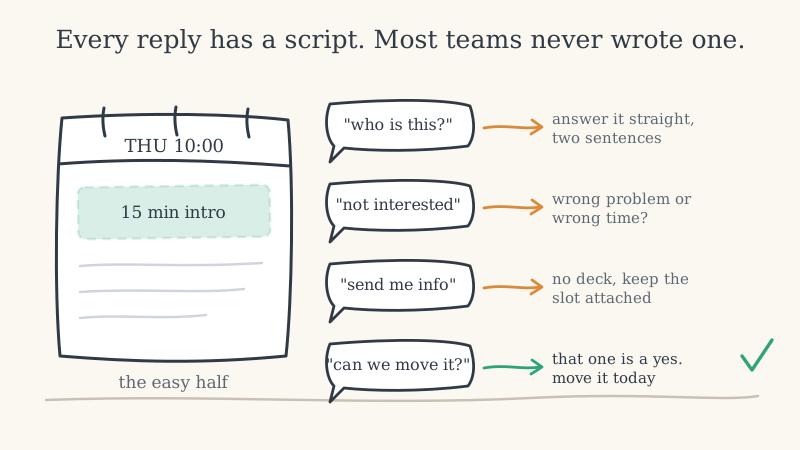
Most outbound teams build a sending motion and forget to build a receiving motion.
They write the invite copy, tune the send windows, warm the domains, and then the first replies land and nobody knows what to do with them. A prospect writes back “who is this?” and the rep either ignores it or sends a four paragraph pitch. A prospect tentatively accepts and nobody follows up. A prospect declines with a note, which is the single most valuable thing that can happen in outbound, and the rep logs it as a loss and moves on.
This is the part of cold calendar invite outreach that nobody writes playbooks for, and it is where most of the leakage is. The invite is the easy half. The reply is where the meeting is actually won or thrown away.
Here is the thing that makes it worth solving: a calendar invite generates far more replies than a cold email does. That is not an accident of copy quality. An invite is a request for a commitment on a specific date, and a specific date demands a specific answer. An email asking “do you have 15 minutes sometime?” can be ignored with zero social cost. An invite sitting on Thursday at 10am cannot. The prospect has to do something with it, and a meaningful share of them will tell you why.
So you get more replies, and the replies carry more information. You also get a handful of sharp ones, because asking for a calendar slot from a stranger is a bolder move than asking for attention. Both of those things are fine, and both are handleable with a script.
First, the frame: a reply is not an outcome, it is a routing decision
The mistake underneath almost every bad reply handling habit is treating a response as a verdict. Accepted means won. Declined means lost. Anything else means confused.
That is wrong on all three counts. Treat each reply instead as a signal that tells you which of four states the prospect is in:
- Identity gap. They do not know who you are or why this landed. Nothing about your offer has been evaluated yet.
- Timing mismatch. They understand it and are not available, not in cycle, or not ready. The offer is not the problem.
- Relevance mismatch. They understand it and it is genuinely not their problem, or not their job, or not their company’s shape.
- Interest with friction. They want it but something about the format, the length, the attendee list, or the agenda is in the way.
Every reply you will ever get sorts into one of those four. Your job is to classify fast and respond with the move that fits the state, not with a generic nurture message. Mislabeling is what kills deals. Reading “not right now” as a relevance mismatch and dropping the account loses a meeting you had already earned.
The replies you will actually get, and what to send back
What follows is the taxonomy. For each one: what it signals, the move, and a script you can lift. Keep every one of these short. The single biggest error in reply handling is answering a one line question with a pitch.
1. “Who is this?” or “Do we have a meeting scheduled?”
State: identity gap. This is the most common reply in the whole category and it is not hostile, it is literal. They saw a calendar entry from an unfamiliar name and want to know what it is.
The move: answer the question asked, in two sentences, then restate the invite’s value without re-pitching. Do not apologize for reaching out. Do not open with “I know this is unexpected.” Answer plainly.
Hi Dana, no existing meeting, I sent that one over cold. I’m with [Company] and we help [one specific outcome for companies like theirs]. I put 15 minutes on Thursday because I had a specific thought about [their observable situation]. If it is not useful, decline it and I will not chase you.
That last clause does more work than anything else in the message. It removes the fear that accepting opens a door they cannot close.
2. “Not interested”
State: usually relevance mismatch, sometimes identity gap wearing a relevance mask. Two words tells you almost nothing about which.
The move: one question, no persuasion. You are buying information, not fighting the no. The worst version of this reply is a rebuttal, because a rebuttal confirms the prospect’s suspicion that accepting anything from you means a fight.
Understood, I’ll close it out. One thing so I don’t waste your time again: is this a wrong-problem thing or a wrong-time thing? Either answer is useful and I will not follow up on it.
Roughly a third of people answer that. When they say wrong time, you have just converted a dead account into a dated one. When they say wrong problem, you have a disqualification you can trust, which is worth real money against a list you are paying to work.
3. A decline with a reason attached
State: depends entirely on the reason, which is why this is the best reply you can get.
The move: treat the reason as the content of the deal and respond to it specifically. “We already use a competitor” is a different message from “I’m not the buyer” is a different message from “we are in a hiring freeze.”
Thanks for telling me, that is more than most people do. Given [their reason], I’d put this down for [specific later trigger] rather than now. I’ll send a fresh invite when that lands. Nothing from me in between.
Then actually honor it. A scheduled, reason-aware return is the highest converting second touch in outbound, and our own notes on re-engaging cold prospects with calendar invites go deeper on how to time that return.
4. “Send me some information instead”
State: interest with friction, about 60 percent of the time. The other 40 percent is a polite exit.
The move: do not send a deck. A deck ends the thread. Send a two or three line answer to the specific question they would have asked on the call, and attach the invite back to it.
Happy to. The short version: [two sentences answering the real question]. The part that is hard to put in writing is [the thing that genuinely requires a conversation, with specifics]. I left Thursday 10am on your calendar for exactly that. If you would rather read first, say the word and I will send the longer writeup.
You lose nothing by offering the document. You lose the meeting by leading with it.
5. “Can we move it?” or a counter-proposed time
State: interest with friction, and you have effectively already won. This reply is a yes with a scheduling note on it.
The move: accept whatever they propose, instantly, without negotiating. Same day response matters more here than anywhere else in the sequence, because enthusiasm decays and a reschedule request that sits for two days becomes a no-show.
Done, moved to Tuesday 2pm, updated invite is on your calendar. I’ll come with [the one specific thing]. Anything you want me to look at beforehand?
6. “Why is this on my calendar?” (annoyed version)
State: identity gap with heat. The content is the same as reply 1, the tone is not.
The move: short, direct, no groveling, remove it if they want it gone. Over-apologizing reads as a second imposition.
Fair question. I sent it cold, which I know is forward. Deleting it now. The reason I tried: [one concrete sentence about them, not about you]. If that is ever worth 15 minutes, I’m here, and you will not hear from me otherwise.
A real fraction of these turn into meetings later, almost entirely because you did what you said and went quiet.
7. “I’m not the right person”
State: relevance mismatch at the contact level, not the account level. The account may be perfect.
The move: ask for the handoff explicitly, by role, not by name. “Who handles this?” is easy to ignore. A named role with a reason is not.
Thanks, that’s helpful. Who owns [the specific function] these days? Happy to go direct and leave you out of it entirely.
This is also the cheapest path into multi-threaded accounts, since you now have an internal referral rather than a cold entry point.
8. Tentative or “maybe” acceptance
State: interest with friction, specifically calendar uncertainty. Almost nobody treats this as a reply at all, which is why it leaks so badly.
The move: confirm the agenda, not the time. A tentative accept usually means “I will go if it turns out to be worth it,” so give them the reason it will be.
Saw the tentative, no pressure either way. For what it is worth, I’m planning to cover [two specifics] and it will run closer to 12 minutes than 15. If you would rather push it a week, just say so.
9. Silence after an accept
State: not a reply, but it is the state that costs you the most, because a booked meeting that no-shows burns the slot and the pipeline entry both.
The move: a reminder that re-sells the agenda rather than just confirming the appointment. “Looking forward to our call tomorrow” does nothing. A line that reminds them why they accepted does. KALI sends AI-personalized show-up reminders before every booked meeting for this exact reason, and attendance on booked meetings runs in the 35 to 45 percent range with them in place.
The rules that sit above the scripts
Scripts are the easy part. These four habits are what separate teams that compound replies from teams that burn them.
Respond within the business day, always. Reply latency is the highest leverage variable in the entire receiving motion. A same day answer to “who is this?” converts dramatically better than a next week answer, because the invite is still sitting visibly on their calendar when they read it. By day three it has been deleted and your message has no context to land in.
Never answer a short reply with a long one. Match length or go shorter. A four sentence answer to a six word question signals that every future interaction will cost them more time than they want to give.
Honor the exit, visibly. Saying “I will not chase you” and then chasing is the fastest way to turn a neutral prospect into someone who marks you as spam. Saying it and meaning it is also, counterintuitively, what makes the later re-entry work.
Log the reason, not just the outcome. A CRM full of “no reply” and “declined” teaches you nothing. A CRM where declines carry wrong-time, wrong-person, wrong-problem, and already-have-one tags becomes a targeting instrument within a quarter. This is the part that makes next quarter’s list better than this quarter’s.
Why this matters more on calendar than on email
On a cold email channel, reply handling is a small optimization because there are so few replies to handle. At a 1 to 3 percent reply rate, the receiving motion is a rounding error on the sending motion.
Calendar invites invert that. Acceptance rates in the 8 to 12 percent range mean the volume of real human responses is multiples higher, and the responses are richer because the ask was concrete. That makes the receiving motion a primary lever rather than a cleanup task. A team with good scripts and same day response can get meaningfully more meetings out of the identical send volume as a team that only watches the accept button. The side-by-side on calendar invites versus cold email covers the engagement gap in more detail, but the practical implication is the one above: when a channel produces replies, the replies become the work.
The teams that treat every response as a routing decision rather than a verdict end up with three things their competitors do not have: more meetings from the same list, disqualifications they can actually trust, and a dated re-entry plan for every account that said no for a reason. KALI runs the sending, the AI follow-ups for non-responders, and the show-up reminders as a managed service, which leaves your reps doing the one thing that genuinely requires a human: answering the person who wrote back.