An inbound lead is the most valuable thing that hits your funnel all day. Someone raised their hand, gave you their contact details, and told you they want to talk. And most teams still manage to waste it.
The waste rarely happens because the lead was bad. It happens because the follow-up is slow, the ask is vague, and the prospect is left to do the scheduling work themselves. By the time your rep sends “happy to find time, what does your week look like,” the buyer has moved on, booked with a competitor, or lost the spark of intent that made them fill out the form in the first place.
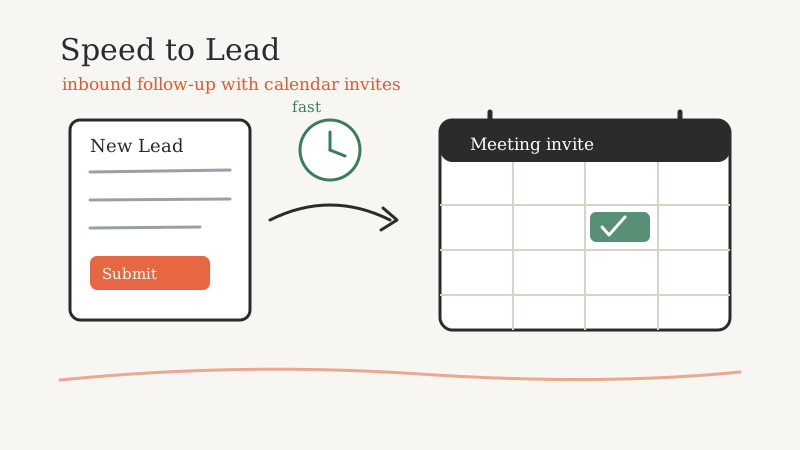
This is a guide to fixing that with a specific tactic: sending a cold calendar invite as the very first inbound follow-up touch. Not a “let’s connect” email. An actual meeting request, on their calendar, within minutes of the form fill.
Why speed to lead decides who wins the deal
The research on inbound response time has been consistent for over a decade, and it is brutal. The odds of qualifying a lead drop sharply after the first few minutes and fall off a cliff after the first hour. A lead contacted in the first five minutes is many times more likely to convert than one contacted an hour later.
Yet the median B2B company still takes hours, sometimes more than a day, to respond to an inbound form. That gap is the single largest source of wasted pipeline in most funnels, and it is entirely self-inflicted.
Two things are happening in those wasted minutes:
- Attention decays. The prospect filled out your form in a specific moment of intent. They were on your pricing page, comparing options, thinking about the problem. Every minute that passes pulls them back into their day and away from you.
- Competitors move. A buyer researching your category is rarely researching only you. Whoever gets a real conversation on the calendar first frames the evaluation and usually wins it.
Speed to lead is not a nice-to-have metric for the operations dashboard. It is the mechanism that determines who gets the meeting.
Why the classic inbound follow-up fails
The standard inbound play is an auto-reply email plus a rep who reaches out “as soon as they can.” Both pieces are weak.
The auto-reply confirms receipt and asks the prospect to wait. It creates no momentum. Nobody has ever booked a deal off “thanks, someone will be in touch.”
The rep email usually arrives late and, worse, it offloads the scheduling work onto the buyer. “Would you be open to a quick call? Let me know a few times that work for you” sounds polite, but it asks a busy person to stop, check their calendar, propose windows, and wait for a reply. Every one of those steps is a place to drop off. Reply-based scheduling can eat several days of back-and-forth for a meeting that a single click could have booked.
The result is a paradox: the hottest leads in your funnel get the same slow, high-friction follow-up as everyone else, and most of them evaporate.
How a calendar invite changes the inbound follow-up
A cold calendar invite flips the follow-up from a request into a proposal. Instead of asking the prospect to schedule, you present a specific time on their calendar that they can accept, decline, or reschedule with one tap.
For an inbound lead, this is close to ideal, because the intent is already there. The prospect asked to talk. All you are doing is removing every step between that intent and a confirmed meeting. There is no “let me check my calendar,” no reply thread, no waiting. There is a meeting, at 2:00 PM Thursday, with an agenda, sitting in their calendar next to their other commitments.
The calendar is also the one surface a professional treats as the source of truth for their time. An email can be skimmed and forgotten. A calendar entry has to be dealt with. That is exactly the property you want when a lead is hot and the window is short. This is the core reason tools like Kali lead with the invite itself rather than another email in a crowded inbox.
Used this way, the calendar invite is not a cold outreach tactic at all. It is a warm-response accelerator that meets a raised hand with the fastest possible path to a conversation.
The inbound calendar-invite play, step by step
Here is a concrete sequence you can operationalize this week.
1. Validate the email the instant the form is submitted
Inbound forms attract typos, throwaway addresses, and the occasional bot. If you fire a calendar invite at an invalid or risky address, you either bounce (hurting sender reputation) or waste a slot. Run every inbound email through real-time verification before you act on it. Passing your form submissions through a validation layer like Scrubby catches the bad addresses so your invite only goes to a real, reachable person. This protects both your booking rate and your domain health, which matters enormously when your invites need to land, not get filtered. If deliverability is shaky, review your SPF, DKIM, and DMARC setup before you scale the play.
2. Trigger the invite automatically, within minutes
The whole point is speed, so a human should not be the bottleneck. Wire your form so that a qualified submission triggers a calendar invite automatically, or routes to a rep with a one-click “send invite” action. Aim for minutes, not hours. If your team can only respond during business hours, set the default proposed time to the next available business slot rather than making the lead wait for a human to wake up.
3. Propose a specific, near-term time (and make it easy to change)
Do not send an open-ended “pick anything” link as your only option for a hot lead. Propose an actual slot, ideally within the next 24 to 48 hours while intent is fresh, and make rescheduling trivial. The specific proposal does the deciding for them; the easy reschedule removes the risk of proposing the wrong time. You get the commitment of a real meeting without the friction of a blank calendar.
4. Write a description that earns the acceptance
An inbound lead already knows who you are, so use the invite body to confirm value, not to re-pitch. Reference what they came in for, state exactly what the meeting will cover, and set a clear length. A tight, relevant invite description is one of the biggest levers on whether the meeting actually happens. Keep it to a few lines: why this call, what they will leave with, and how long it will take.
5. Follow up on non-acceptance without starting over
Not every invite gets accepted on the first try, even for inbound. If a prospect does not respond within a day, a short nudge referencing the pending invite outperforms a fresh cold email, because the meeting is already sitting on their calendar waiting for a decision. Build a light follow-up sequence so a single missed acceptance does not kill the lead.
Measuring whether it works
You are trying to move three numbers, and you should track all three:
- Time to first meaningful touch. Measure from form submission to invite sent. Your target is minutes. This is the input metric that drives everything else.
- Invite acceptance rate. The share of invites that turn into a confirmed meeting. Inbound acceptance should run well above cold acceptance because the intent is already present; if it does not, your timing, targeting, or deliverability needs work.
- Show rate. A booked meeting only counts if the prospect shows. Because the meeting is already on their calendar with an agenda, calendar-invite bookings tend to hold better than reply-scheduled ones, but you should still confirm the day before.
If you already track speed to lead for your email and phone follow-up, add the calendar-invite path as a distinct branch and compare. Most teams find the invite path books meetings faster and with fewer touches than the reply-based path it replaces.
Where this play fits, and where it does not
Calendar invites shine when intent is clear and recent: demo requests, pricing-page form fills, “contact sales,” content downloads from high-intent pages, and event or webinar sign-ups. In those cases the prospect has effectively pre-agreed to a conversation, so proposing a time is welcome, not presumptuous.
The play is weaker for very low-intent inbound, like a newsletter subscribe or a top-of-funnel ebook grab from someone who is just browsing. For those, an invite can feel too fast. Nurture them first, watch for a stronger signal, and save the invite for when intent sharpens. The skill is matching the aggressiveness of the ask to the strength of the signal.
The takeaway
Inbound leads are expensive to generate and easy to waste. The waste almost always comes from slow, vague follow-up that hands the scheduling burden back to the buyer at the exact moment they were ready to move.
A cold calendar invite, fired within minutes of the form fill, validated for deliverability, and proposing a specific near-term time, collapses the distance between intent and a booked meeting. It is the simplest way to win the speed-to-lead race, and the race usually decides the deal. Validate the address with Scrubby, send the invite with Kali, and stop letting your best leads cool off in a reply thread.