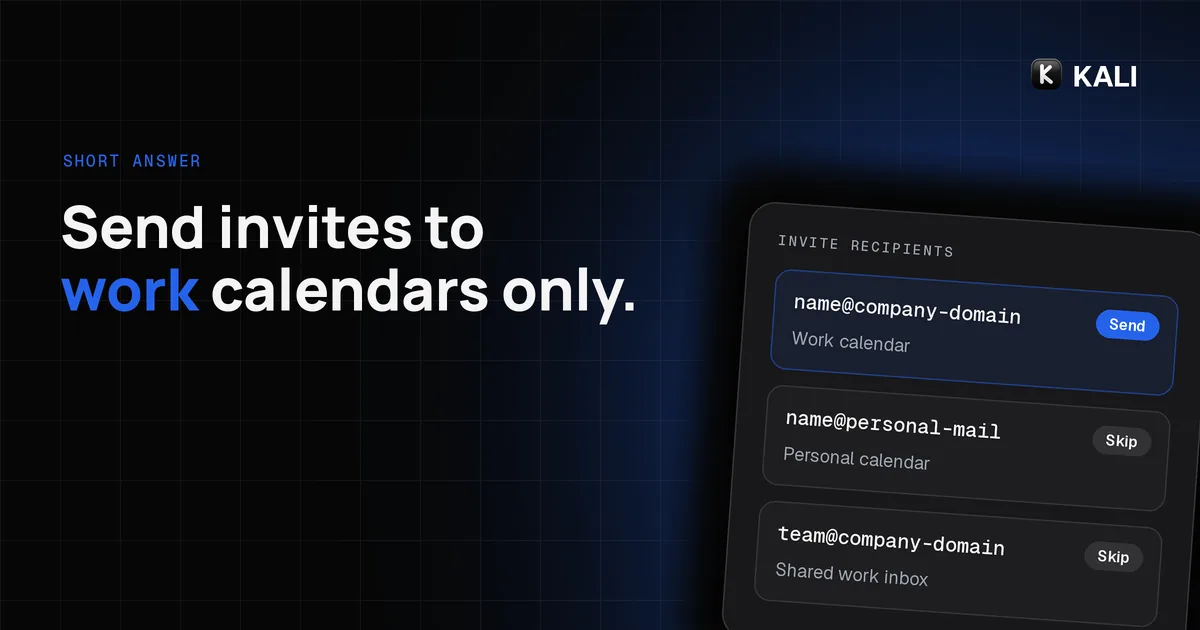
Short answer: in almost every case, no. A cold calendar invite asks for time in someone’s working day, so it should go to their work address and land on their work calendar. A personal address puts your meeting next to school pickups and doctor’s appointments, which feels intrusive, carries more privacy risk, and seldom books a meeting worth having. If the only address you have is personal, find the work address or use a different channel.
Why the Work Address Is the Right Target
A cold invite works because it fits into how people already plan their working week. It appears where they look at their meetings, it can be accepted or declined in one tap, and it sits alongside the rest of their professional schedule.
A personal calendar is a different space. People share it with family, view it on weekends and use it for their private life. A sales meeting request showing up there crosses a line that a cold email to the same address does not, because it lands on a calendar, not only in an inbox.
| Work address | Personal address | |
|---|---|---|
| Where the invite appears | Work calendar, next to other meetings | Private calendar, sometimes shared with family |
| How it is likely to feel | A normal business request | An intrusion into private time |
| Privacy and compliance posture | The usual basis for B2B outreach | Often treated as higher risk, check with counsel |
| Who can act on it | The person, their assistant, their team | Only the person, often outside work hours |
| Fit with CRM and account data | Matches the company record | Hard to tie to an account |
The Privacy Question
Data protection rules in many regions treat business contact details and personal contact details differently. A personal email address is more clearly personal data, and using it for unsolicited sales outreach can be harder to justify. This is not legal advice, and the rules vary by country, so review your approach with counsel. Our overview of whether cold calendar invites are legal covers the main frameworks.
If your list mixes work and personal addresses, you take on extra risk for contacts who are also less likely to respond well.
How Personal Addresses Get Onto Lists
Personal addresses usually creep in through:
- Enrichment tools that return whatever address they find, work or personal
- Old event or webinar sign-ups where people registered with a personal address
- Inbound forms that did not require a work address
- Founders and very small companies that genuinely run their business from a personal mailbox
Filter for common consumer email domains when you build the list, and flag what remains for a decision rather than sending by default. Our guide to verifying your email list before sending cold calendar invites covers the wider checks.
The Exceptions
There are a few cases where a personal-domain address is effectively the work address:
- A sole trader or founder who uses that address for all business correspondence and publishes it as their business contact
- A prospect who gave you that address for business purposes, for example by asking you to follow up there
Even then, be careful with tone and timing, and make it easy to say no. If you are not sure the address is used for business, treat it as personal.
What to Do Instead
- Look for the work address. Check the company domain and verify the address before you use it.
- Reach a colleague or assistant if the person’s work address is unavailable. Our guide to cold calendar invites for executive assistants and gatekeepers covers how.
- Use another channel such as a professional network message, and offer the invite once they reply.
- Leave the contact out of this campaign. A smaller, cleaner list books better meetings than a bigger one padded with personal addresses.
FAQ
Is a cold email to a personal address any better? It is less intrusive than a calendar entry, but the same privacy concerns apply. Prefer a work address for both.
What if a prospect accepts an invite sent to their personal address? Run the meeting well, then ask whether they would prefer future communication at their work address, and update your records.
Should we suppress all consumer email domains? As a default, yes, for cold invites. Review exceptions by hand rather than letting them through automatically.
KALI builds and checks every list as part of a fully managed cold calendar invite service, so invites go to the right work calendars. See how it works.