Calendar invite outreach has one quiet dependency that almost nobody talks about: the address you send the invite to has to be real. A cold calendar invite is still delivered over email infrastructure, which means it inherits every deliverability rule that governs the inbox. Send invites to a list full of dead, mistyped, or catch-all addresses and you will not just miss those prospects. You will quietly damage your ability to reach the good ones too.
Most teams learn this the hard way. They build a list, load it into their calendar outreach tool, and fire off a few hundred invites. Acceptance rates look fine for a week, then they fall off a cliff. The campaign did not get worse. The sending reputation did, because too many invites bounced.
Why bounces matter more for invites than you think
When a cold email bounces, the damage is contained to email. When a calendar invite bounces, the same mailbox provider that scores your domain for spam is watching. Invites are sent from your real sending domain and your real calendar identity, so a wave of hard bounces tells Google and Microsoft the same thing it would for any sender: this account is mailing addresses that do not exist.
A high bounce rate is one of the fastest ways to torch sender reputation. Once your reputation drops, the providers stop trusting your domain, and the invites that would have landed cleanly start getting filtered or silently dropped. The prospects with valid addresses, the ones you actually wanted to reach, never see the invite. You spent your best leads paying for the cost of your worst data.
This is the part that surprises people. Bad data does not just waste the bad records. It taxes the good ones.
What a dirty list actually contains
A raw prospect list, especially one pulled from a scraper or an aging CRM, is rarely as clean as it looks. Typical problems include:
- Hard invalid addresses where the mailbox does not exist and the invite bounces immediately.
- Typo domains like
gmial.comoroutlok.comthat fail silently. - Role addresses like
info@orsales@that rarely accept invites and often flag senders. - Catch-all domains that accept everything, so you cannot tell whether the specific person exists until the bounce arrives.
- Spam traps that exist only to catch senders mailing unverified lists, and that can blacklist your domain outright.
You cannot eyeball your way out of this. A list can look perfectly reasonable and still hide a 15 to 20 percent invalid rate. The only reliable fix is to verify every address before the campaign runs.
Verification is the cheapest insurance you can buy
Running a list through a verification pass before you send is the highest-leverage thing you can do for a calendar campaign. A good validator like Scrubby checks whether each mailbox actually exists, flags risky catch-all and role addresses, and strips the records that would bounce, all before a single invite goes out. Tools like Scrubby are particularly useful for the hard cases that simple syntax checkers miss, like catch-all domains where you need an actual mailbox-level answer rather than a guess.
The economics are not close. Verification costs a fraction of a cent per record. A damaged sending domain costs you weeks of recovery and every booked meeting you would have closed in that window. You are trading a tiny known cost for protection against a large unknown one.
Practically, the workflow looks like this:
- Pull or build your prospect list.
- Run the full list through verification and remove invalid, risky, and unknown addresses.
- Load only the clean, deliverable records into your calendar outreach platform.
- Send your invites with a sending reputation that stays intact.
That third step is where Kali comes in. Once your list is clean, Kali sends cold calendar invites that land directly on the prospect’s calendar instead of fighting for attention in a crowded inbox. The calendar channel already enjoys far higher visibility than cold email, but that advantage only holds if your invites are reaching real people on a trusted domain. Clean data is what keeps the channel working.
Verify on an ongoing basis, not just once
List hygiene is not a one-time event. Email addresses decay at roughly 2 to 3 percent per month as people change jobs, companies fold, and mailboxes get retired. A list you verified six months ago is already meaningfully stale. If you run calendar campaigns continuously, build verification into your cadence: re-check addresses before each new send, and re-validate any list that has been sitting unused.
This is especially important when you are re-engaging older segments. The prospects who went quiet last quarter are exactly the ones most likely to have changed roles, which means their old address is now a bounce waiting to happen. Verify before you re-engage, every time.
The simple rule
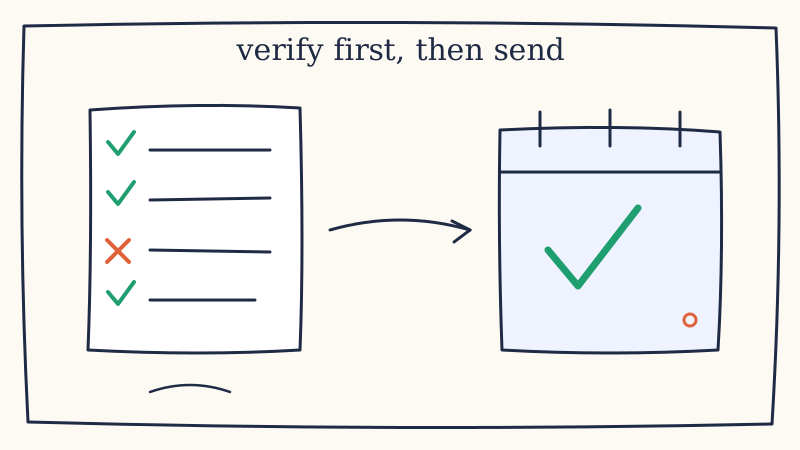
Treat verification as a non-negotiable step, not an optional extra. Before any cold calendar invite campaign goes out, the list should be clean. The sequence is always the same: verify first, then send. Skip the first half and the second half stops working, not just for the bad records but for the entire campaign.
Calendar invites give you a real edge in a channel that most of your competitors are ignoring. Protect that edge by protecting your data. Clean the list, keep your domain trusted, and let the channel do what it does best: get your meeting in front of the right person at the right time.