Managed service providers and IT services firms sell into one of the hardest inboxes in B2B. Their buyers, the IT directors, VPs of infrastructure, CISOs, and office managers who own vendor decisions, get pitched by every MSP, VAR, and security vendor in the market. They have seen the “free network assessment” email a hundred times. They filter aggressively, and their spam gates are configured by people who do deliverability for a living.
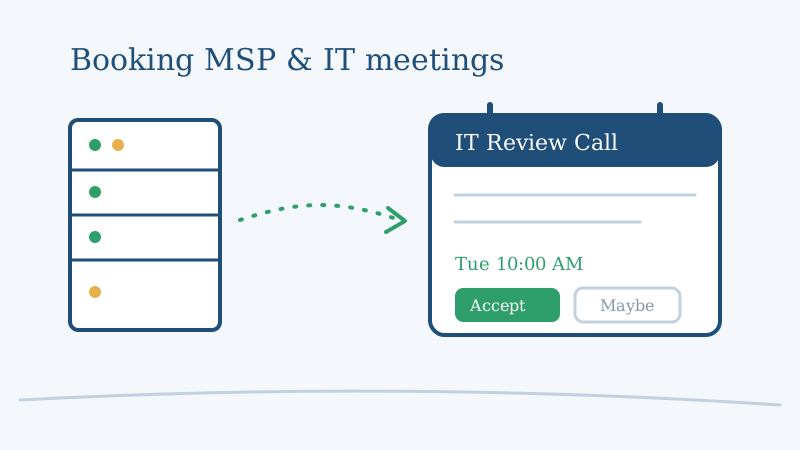
That is exactly why the MSP channel that still breaks through is not another cold email. It is the cold calendar invite: a real meeting request that lands in the calendar app, not the promotions tab. This playbook covers how MSP and IT services teams use calendar invites to book assessment calls, security reviews, and quarterly business reviews with technical buyers who ignore everything else.
Why cold email fails MSP sellers specifically
Every outbound channel decays, but IT buyers punish cold email faster than most segments for three reasons.
First, they are technically literate. An IT director recognizes a spun-up sending domain, a tracking pixel, and a mail-merge token gone wrong instantly. What reads as “personalized” to a marketing VP reads as “automated spam” to someone who administers Exchange or Google Workspace for a living.
Second, their filters are strict by policy. Many IT shops run their own quarantine rules, block unknown senders, and flag bulk patterns. Your open rate is not low because your subject line is weak. It is low because the message never reached a human.
Third, the market is saturated. When an IT manager gets a dozen near identical “let us audit your stack” emails a week, the entire category gets muted. You are not competing on message quality anymore, you are competing against a mental spam folder the buyer built years ago.
Calendar invites sidestep all three problems. They arrive through a different pipe (the calendar system), they render as a structured event rather than a marketing email, and they are rare enough in the wild that they still earn a second look. Tools like Kali send cold calendar invites at scale specifically to reach buyers who have trained themselves to ignore the inbox.
The three meetings MSPs should book with invites
Do not use calendar invites to sell. Use them to book a specific, low friction meeting the buyer can say yes to. For MSP and IT services teams, three meeting types convert best.
The infrastructure or security assessment. A 30 minute call framed as a review of their current environment, not a pitch. IT leaders will trade half an hour for an outside read on their gaps, especially around backup, patching, and endpoint security.
The renewal or contract review. If a prospect’s current MSP contract or software agreement is coming up, a calendar invite timed to that window lands with real urgency. This works best when paired with a monitoring signal (more on that below).
The quarterly business review your competitor is not running. Many in-house IT teams and small MSPs never run a structured QBR. Offering one, even before you are the vendor, positions you as the more mature operator.
Each of these fits naturally into a calendar slot. The invite itself should name the meeting, propose a specific 20 to 30 minute window, and keep the description to two or three lines of value plus a clear “decline if the timing is off” line. Overloading the description with a sales narrative kills acceptance.
Timing invites to buying signals
Cold calendar invites work far better when they are not random. For IT services, the highest intent windows are usually observable from the outside.
A prospect posting a job for a systems administrator, a security engineer, or a help desk lead signals either growth or a gap you can fill. A company that just announced an acquisition is about to face an integration project. A firm whose website or portal starts throwing errors, going down, or shipping a visible tech change is telling you something about the state of their stack. Website and infrastructure monitoring tools like CAM surface exactly these changes, and an invite sent within a day or two of a detected issue reads as timely rather than cold.
The pattern that works: watch for a trigger, then send a calendar invite that references the meeting’s value in the context of that moment, without being creepy about how you know. “Wanted to grab 25 minutes to walk through backup and continuity options” lands very differently the week after a prospect’s site went down than it does on a random Tuesday.
Deliverability still decides everything
Here is the trap MSP sellers fall into: they assume that because a calendar invite is not email, deliverability does not matter. It does. Calendar invites are generated and delivered through email infrastructure, and a low quality list will torch your sender reputation just as fast as a bad email blast, if not faster.
IT buyers are exactly the audience most likely to have role addresses (it@, admin@, helpdesk@), catch-all domains, and stale contacts left over from staff turnover. Sending invites to those addresses drives bounces, spam complaints, and calendar system flags that suppress your future sends.
Clean the list before you send. Run every address through validation to strip catch-alls, role accounts, and dead mailboxes. Scrubby validates hard to verify addresses, including the catch all domains that are common in IT and infrastructure companies, so your invites reach real people and your acceptance rate reflects genuine interest rather than a list full of noise. A validated list of 300 IT decision makers will book more meetings than an unscrubbed list of 3,000, and it will keep your sending reputation intact for the next campaign.
Pair validation with the deliverability basics: warm the sending account, keep daily volume conservative, authenticate your domain, and space sends out rather than blasting. The calendar invite is the tip of the spear, but the plumbing behind it decides whether the spear ever gets thrown.
A sample 10 day sequence
Calendar invites are a channel, not a one shot tactic. Blend them into a short multi touch sequence so a single unaccepted invite does not end the conversation.
Day 1. Send the calendar invite for a specific assessment slot. Two line description, clear meeting name, easy decline.
Day 3. If unaccepted, send a short email that references the invite. Not “did you get my invite,” but a one line reason the meeting is worth 25 minutes, tied to their context.
Day 5. A LinkedIn touch or connection request from the rep, no pitch, just a face and a name to go with the invite.
Day 7. Send a second calendar invite proposing a new time, acknowledging the first slot may not have worked. Alternate the day of week and time of day.
Day 10. A final short breakup message that leaves the door open and offers an asynchronous alternative (a recorded walkthrough or a one page assessment checklist).
Across the sequence, the calendar invites do the heavy lifting on booking while the email and social touches build enough familiarity that the second invite feels warm. Keep the whole sequence to under two weeks so the trigger that started it is still relevant.
What good looks like
MSP and IT services teams that run calendar invite outreach well tend to share a few habits. They target narrow: a defined vertical or company size where their offer is obviously relevant, not a sprawling list. They validate every list before sending. They tie sends to observable signals rather than blasting on a schedule. They keep invite descriptions short and meeting focused. And they treat the invite as one instrument in a sequence, not the entire song.
Get those right and the numbers follow. The whole reason the channel works is scarcity: IT buyers are drowning in email and almost no one is competing for the calendar. A relevant, well timed, deliverable invite to a real person is one of the few outbound motions that still earns a technical buyer’s attention.
If you sell managed services, security, cloud, or IT support and your cold email numbers have flatlined, the calendar is the channel worth testing next. Start with a tight list, validate it with Scrubby, send a small batch of assessment invites through Kali, and measure acceptance against your current email reply rate. For most MSP teams, the gap is not close.