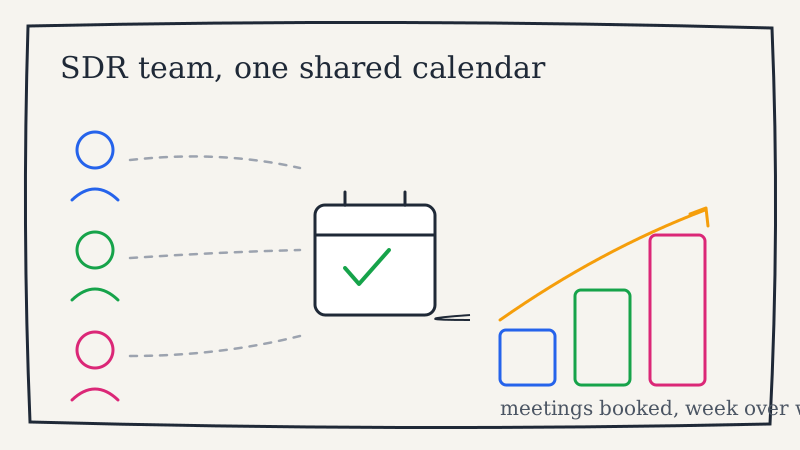
One rep sending cold calendar invites is an experiment. Ten reps sending them is an operation, and operations break in ways experiments never do. The same tactic that books a solo founder three meetings a week can quietly torch a whole team’s sending domain, double book the same account across two territories, and turn a promising channel into a support ticket.
The problem is almost never the tactic. Cold calendar invites work because they collapse the funnel: the ask and the conversion event are the same object, a slot on the prospect’s calendar. The problem is that most teams scale the sending without scaling the system around it. This playbook is the system. It covers how to divide territory, standardize the message without flattening it, protect deliverability across many senders, and run the weekly ritual that keeps every SDR pointed at quota.
If you are still evaluating whether the channel belongs in your mix at all, start with Kali and the fundamentals of why calendar invites out-open cold email, then come back here to operationalize it.
Why Team Scale Changes The Game
A single rep has one calendar, one sending identity, and one mental model of the accounts. Nothing collides. Add reps and three new failure modes appear at once.
Collision. Two SDRs work the same account from two angles and the prospect gets two invites in a week. Now you look disorganized instead of persistent, and the account remembers your company for the wrong reason.
Deliverability blast radius. One rep with a sloppy list can spike spam complaints that follow the shared domain. When calendar invites route through email infrastructure, one bad sender drags down everyone’s inbox placement, not just their own.
Inconsistent quality. Your best rep writes a tight, specific invite. Your newest rep writes something generic that gets declined and trains prospects to ignore your brand. At scale, the floor matters more than the ceiling, because the floor is what most prospects see.
Every section below exists to neutralize one of those three risks while keeping the volume high enough to actually move pipeline.
Step 1: Divide Territory So Invites Never Collide
Before a single invite goes out, the team needs a rule that guarantees any given account belongs to exactly one rep at a time. The cleanest splits are the boring ones.
- By named account list. Assign explicit account lists per rep and lock them for the quarter. Overlap is impossible because the boundary is a static list, not a fuzzy heuristic.
- By geography or segment. Region, company size band, or industry vertical. Works well when your ICP clusters cleanly, and it lets reps build pattern recognition inside a lane.
- By buying stage or motion. One pod runs net-new cold accounts, another runs re-engagement of closed-lost. This keeps messaging coherent because the situation is coherent.
Whatever you choose, write it down and enforce it in the CRM, not in a spreadsheet nobody opens. A shared source of truth is the only thing that survives contact with a busy quarter. If your team runs true account-based motions with multiple contacts per company, the collision math gets harder, and the account-based outreach playbook covers how to multi-thread without stepping on each other.
Step 2: Standardize The Message Without Flattening It
The instinct at scale is to hand every rep the same template and call it consistency. That is how you get a hundred identical invites that read like a mail merge and get declined in bulk. The better model is a shared skeleton with mandatory personalization slots.
A team template should lock the structure and leave the specifics open:
- Fixed: meeting length, the value framing, the tone, the call to action, the location or video link format.
- Open, and required: the trigger reason (why this prospect, why now), the one line of context that proves you did homework, and the specific outcome you will cover in the slot.
This gives you a quality floor without turning reps into robots. New hires cannot ship something off-brand, and veterans still have room to be sharp. For the actual language, the library of invite messages that get accepted is a good starting bank, and every rep should personalize beyond the first-name token using the personalization guide.
Meeting length deserves a team-wide default. Fifteen minutes clears a lower acceptance bar than thirty and is easier to ramp new reps on. If you have not set a standard, the 15 vs 30 minute breakdown makes the case.
Step 3: Protect Deliverability Across Many Senders
This is the section that saves your quarter. When one identity sends, deliverability is a personal problem. When ten identities share infrastructure, it is a team problem, and it compounds.
Get the authentication foundation right before adding volume. Every sending domain needs correct SPF, DKIM, and DMARC records so that invites are cryptographically vouched for rather than treated as forgeries. Skip this and even perfect copy lands in spam.
Then put guardrails around behavior:
- Cap per-sender volume. Respect daily sending limits per identity rather than pushing one hot mailbox to the ceiling. Spread load across senders instead of overloading one.
- Clean the list before it touches a calendar. A calendar invite to a dead mailbox is worse than a bounced email because it can generate hard bounces and confused auto-responses that hurt reputation. Run every list through validation with a tool like Scrubby so reps are only inviting real, reachable people. This single step removes most of the deliverability variance across a team.
- Warm new senders before full volume. A brand new identity blasting invites looks exactly like an attacker. Ramp gradually, the same way you would with cold email.
The blast-radius risk is real, but it is entirely preventable. Authentication plus validated lists plus sane per-sender caps turns deliverability from a recurring fire into a solved problem.
Step 4: Instrument The Funnel So You Manage Numbers, Not Vibes
You cannot coach what you do not measure, and calendar invites give you a cleaner funnel than most channels because there are fewer steps to track. At the team level, watch these:
- Acceptance rate per rep. The leading indicator of targeting and message quality. A rep well below the team median has a list problem or a copy problem, and the fix differs.
- Acceptance to show rate. Accepting a slot is not attending it. Track the gap, because a great acceptance rate with a bad show rate points at weak confirmation and reminder habits. The acceptance rate vs show rate distinction is where a lot of teams fool themselves.
- Show to opportunity rate. This tells you whether reps are booking the right people or just booking anyone to hit an activity number.
Roll these into one shared dashboard so a manager can see the whole team at a glance and spot the rep who needs help this week, not next month. Booked meetings are the headline number, but the ratios are where coaching actually happens.
Step 5: Run The Weekly Ritual
Systems decay without a heartbeat. The teams that hold quota month after month run a tight weekly cadence that turns the metrics above into action.
- Pipeline review, 30 minutes. Look at booked meetings by rep against the pace needed to hit quota. Anyone off pace gets attention now.
- Message teardown, 15 minutes. Pull two accepted invites and two declined ones. Read them out loud. Patterns become obvious fast, and the whole team learns from one rep’s win or miss.
- List refresh. Reassign stale accounts, pull in new ones, and confirm no collisions crept in. A quarter-long territory lock still needs weekly hygiene.
- Deliverability check. Glance at bounce and complaint signals per sender. Catching a drifting sender in week one is trivial. Catching it in week six is a rebuild.
That is the entire operating system: divide cleanly, standardize with room to personalize, protect the shared domain, measure the ratios, and run the ritual. None of it is complicated. All of it is skipped by teams that treat a channel as a hack instead of an operation.
The Ramp Plan For New SDRs
New hires are where team quality goes to die, because they arrive fast and learn slow. Compress the ramp with a fixed sequence.
- Week one: shadow accepted-invite teardowns and send only from the approved template with a manager reviewing every personalization slot before it goes out.
- Week two: own a small, validated account list with a per-day cap well under the team limit, so early mistakes cannot hurt deliverability.
- Week three onward: full volume with weekly acceptance-rate check-ins until they hold the team median for two consecutive weeks.
A new rep who ramps on a clean system in three weeks is worth more than a veteran improvising on a broken one. The system is the moat, not any individual’s talent.
When To Add Sending Capacity Versus Add Reps
Growth teams hit a fork: pipeline is short, so do you hire another SDR or squeeze more from the ones you have? Cold calendar invites make this decision unusually clear, because acceptance rate tells you which lever is loose.
If team acceptance rates are healthy and reps are at their volume caps, you are capacity constrained, so add senders or reps. If acceptance rates are soft, adding reps just multiplies a targeting problem, so fix the message and the list first. Hiring into a broken system is the most expensive mistake in this whole playbook, and the funnel metrics from Step 4 tell you exactly which side of the fork you are on.
The Bottom Line
Cold calendar invites scale beautifully when the team scales the system around them and terribly when it does not. The channel itself is not the variable. Territory rules, a shared-but-flexible template, deliverability guardrails, honest funnel metrics, and a weekly ritual are what turn a clever solo tactic into a repeatable team engine that hits quota on purpose instead of by luck.
If you are ready to run this at team scale, Kali is built to send, track, and manage cold calendar invite outreach across a whole SDR org, and pairing it with clean lists from Scrubby removes most of the deliverability risk before it ever reaches a calendar. Build the system once, and quota stops being a monthly scramble.