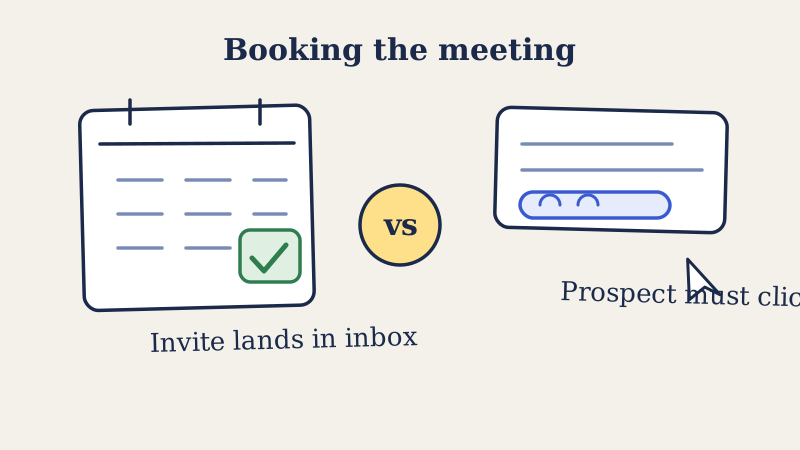
Almost every outbound rep has done the same thing: written a tight cold email, built to a clear ask, and closed with a scheduling link. “Grab a time that works for you here.” It feels efficient. It feels professional. And in cold outreach, it quietly kills conversion.
The problem is not Calendly. Calendly is an excellent tool for warm demand, inbound leads, and people who already want to talk to you. The problem is what a scheduling link asks a cold prospect to do, versus what a calendar invite does on their behalf. Those are two very different plays, and treating them as interchangeable is why a lot of “book a time” outreach lands flat.
This guide breaks down the real difference in mechanics, friction, and psychology, then gives you a framework for when to send a link and when to send an invite.
The core difference: pull versus push
A Calendly link is a pull mechanism. You send it, and the prospect has to pull the meeting into existence. They click, wait for a page to load, scan a grid of open slots, pick a day, pick a time, confirm their time zone, type their name and email, and submit. Only then does the meeting exist. Every one of those steps is a place to drop off.
A cold calendar invite is a push mechanism. You create a specific proposed time and push it directly into the prospect’s calendar as a pending event. It shows up alongside their real meetings. The ask collapses from “go do a multi-step task on a website” to “accept, decline, or propose a new time.” That is one tap instead of eight.
In warm scenarios this gap barely matters, because a motivated buyer will happily click through a link. In cold outreach, where the prospect has zero prior intent and near-zero patience, the difference between one tap and eight steps is the difference between a booked meeting and a deleted message. This is the whole premise behind calendar-first outreach tools like Kali, which send the proposed time as a real invite rather than a link the prospect has to chase.
Friction, step by step
Let us actually count the clicks, because the gap is bigger than most reps assume.
The Calendly path from a cold email:
- Read the email and decide it is worth a moment.
- Click the link (often flagged or wrapped by an email security gateway first).
- Wait for the scheduling page to render.
- Read the meeting description and duration.
- Choose a date from the calendar view.
- Choose a time slot.
- Confirm or correct the detected time zone.
- Enter name, email, and sometimes answer qualifying questions.
- Submit and wait for confirmation.
The calendar invite path:
- See a pending event appear on the calendar for a proposed time.
- Tap accept, decline, or propose new time.
Nine steps of self-service versus two. And that Calendly path assumes the link even survives the trip. Many corporate email filters rewrite or sandbox outbound links, so a scheduling URL can arrive broken, delayed, or draped in a scary security warning. A calendar invite travels as a standard .ics event, which is native infrastructure every email client already knows how to render.
The psychology of a pre-proposed time
There is a subtler reason invites outperform links in cold outreach, and it comes from behavioral science: defaults are powerful.
When you send a link, you hand the prospect a blank canvas and a chore. They have to generate the intent, do the work, and make every decision from scratch. Blank canvases invite procrastination. “I will book that later” is where most scheduling links go to die.
When you send an invite for a specific time, you have supplied a default. The prospect is no longer starting from zero. They are reacting to a concrete proposal that is already sitting in their calendar. Reacting is far easier than initiating. Even if your proposed time does not work, you have shifted them from “should I do this at all” to “does Thursday at 10 work, or should I move it,” which is a much warmer question to be answering.
A pending event also creates a small, honest sense of presence. It occupies space in their day. A link is an option they can ignore forever with no cost. An event on the calendar is a tiny open loop that nudges a decision.
Where Calendly still wins
This is not an argument that scheduling links are bad. They are the right tool in several situations, and pretending otherwise would be dishonest.
- Inbound and warm demand. Someone who filled out a form, replied “yes, let us talk,” or clicked a pricing page wants to meet. Handing them a link to self-select the perfect slot is respectful and fast. Do not push a fixed time on a warm buyer who is ready to pick their own.
- You genuinely do not know their availability. For a first touch with a busy executive across time zones, a link lets them find a slot that fits without a back and forth. Though a good invite tool lets you propose a smart default and still offer “propose new time,” which captures most of that benefit.
- Round-robin and team routing. If a meeting needs to route to whichever of five reps is free, link-based tools handle that assignment logic natively.
- Rescheduling loops. Once a relationship exists and meetings recur, a link is a low-friction way for a known contact to move things around.
The rule of thumb: links are for people who already want to meet you. Invites are for earning the meeting from people who do not know you yet.
Deliverability is the hidden variable
Neither channel matters if your message never reaches a real inbox, and this is where a lot of outbound math quietly breaks.
Cold outreach at volume tends to burn through low-quality contact data. Send a scheduling link to a stale or fake address and it bounces into the void. Send a calendar invite to a bad address and you get the same result, plus a small hit to your sender reputation from the bounce. Either way, wasted sends drag down your whole program and inflate your cost per meeting.
Before you run either play at scale, clean the list. Running your addresses through a verification tool like Scrubby removes invalid and risky contacts so your invites and links actually reach humans, and so your acceptance and click metrics reflect real prospect behavior instead of a data problem masquerading as a messaging problem. Deliverability is upstream of the entire link versus invite debate, and skipping it will make even the better channel look broken.
Measuring the two fairly
If you want to test invites against links for your own audience, compare them on the same denominator so the result is honest.
- Do not compare click rate to acceptance rate. They measure different actions. Compare booked meetings per 100 delivered messages. That is the number that pays your team.
- Track show rate separately. A booked meeting that no one attends is not a win. Both channels can produce ghosted meetings, so watch attendance, not just bookings.
- Segment by temperature. Split warm replies from truly cold first touches. You will very likely see links win on warm and invites win on cold, which tells you to use both, not to crown one.
- Hold volume and copy constant. Change only the closing mechanism. If you also rewrite the pitch, you cannot attribute the lift.
Run that test for a few weeks with a clean list underneath it, and the data will tell you where each channel belongs in your sequence. For most teams the honest answer is a blend: invites to open cold accounts and force a decision, links to make it effortless once a prospect has raised a hand. Purpose-built platforms such as Kali exist precisely because the cold end of that spectrum was underserved by link-first scheduling.
The bottom line
A Calendly link and a cold calendar invite look like the same ask, but they distribute the effort in opposite directions. A link makes the prospect do the work of creating the meeting, which is fine when they want to and fatal when they do not. An invite does that work for them and asks only for a yes, a no, or a new time.
For warm, inbound, ready-to-buy conversations, keep sending links. For the hard part of outbound, opening a meeting with someone who has never heard of you, a specific proposed time in the calendar will out-book a link nearly every time. Clean your list first with something like Scrubby, pick the mechanism that matches the prospect’s temperature, and measure both on booked meetings per hundred sends. The channel that wins is the one that removes the most friction at the exact moment you are asking for the meeting.