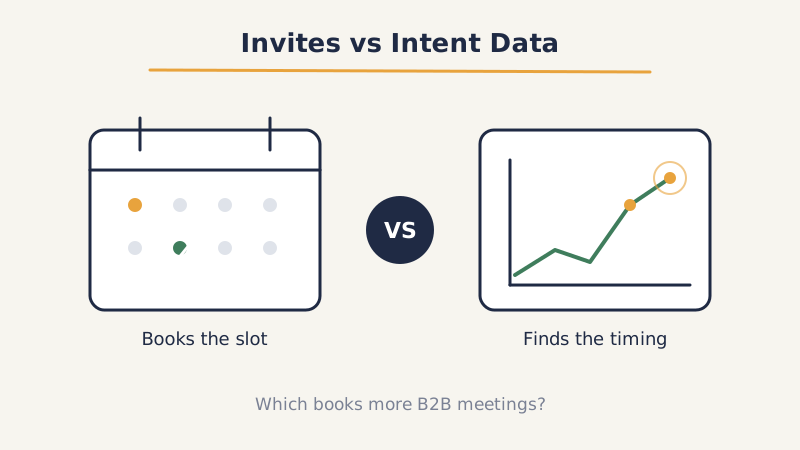
Every few quarters a new outbound religion sweeps through B2B sales. Right now the loudest one is intent data. Buy a feed, watch the surge scores light up, and pounce on accounts the moment they show buying signals. The pitch is seductive: stop spraying cold outreach at everyone and only talk to people who are already in-market.
It is a genuinely good idea. It is also frequently sold as a replacement for the work that actually books the meeting, and that is where teams get burned.
Here is the honest version. Intent data and cold calendar invites are not competitors. They answer two completely different questions. Intent data answers when and who. A cold calendar invite answers how you actually get on the calendar. Confuse the two and you end up with a beautiful list of in-market accounts and a pipeline that still is not moving.
Let us break down what each one really does, where each one fails, and why the teams booking the most meetings run both at once.
What intent data actually is
Intent data is any signal that suggests an account is researching a problem you solve. It comes in a few flavors:
- Third-party intent. Aggregators track content consumption across the web and tell you that, say, a mid-market logistics company has been reading a lot about route optimization this week.
- First-party intent. Signals from your own properties: pricing page visits, repeated docs views, a demo request that went cold, an email that got opened five times in a day.
- Signal-based triggers. Job changes, new funding, a competitor being ripped out, hiring for a role that implies your category, a new office opening.
The value is timing. A prospect who is actively researching your category is dramatically more likely to take a meeting than the same prospect approached at random. Nobody serious disputes this.
What intent data does not do is talk to anyone. It is a targeting layer, not an outreach channel. It tells you where to point the cannon. It does not fire.
What cold calendar invites actually do
A cold calendar invite is exactly what it sounds like: instead of sending another cold email asking for a meeting, you send a real calendar invitation for a specific time, with a short, respectful note explaining who you are and why the slot is worth their fifteen minutes.
The mechanic matters. A cold email lands in an inbox that already has two hundred other emails fighting for attention, and it asks the prospect to do work: reply, suggest times, go back and forth. A calendar invite lands in a far less crowded surface, the calendar, and it presents a concrete decision: accept, decline, or propose a new time. That is a much lower-friction ask, and it is why well-run calendar invite programs consistently out-book plain cold email on a per-touch basis. We covered the mechanics of this in depth in our breakdown of calendar invites versus cold email, and platforms like Kali exist specifically to run this motion at scale without you manually creating invites one at a time.
The key point for this comparison: a calendar invite is a channel. It is the thing that turns interest into a booked slot. It does not, on its own, tell you who to send it to.
The head to head
Put them side by side and the division of labor is obvious.
| Dimension | Intent data | Cold calendar invites |
|---|---|---|
| Core job | Tells you who is in-market and when | Books the actual meeting |
| Output | A prioritized account list | A confirmed slot on the calendar |
| Strength | Timing and prioritization | Conversion from interest to booking |
| Weakness | Does nothing without an outreach channel | Less efficient if aimed at the wrong accounts |
| Fails when | Treated as a substitute for outreach | Sprayed at accounts with zero fit or timing |
| Cost model | Ongoing data subscription | Cost per invite sent and meeting booked |
Read that table again and the trap becomes clear. Almost every team that says “intent data did not work for us” made the same mistake: they bought the data, watched the surge scores, and then reached out with the exact same tired cold email everyone else uses. They upgraded their targeting and left their conversion mechanism untouched. Of course results barely moved.
Likewise, teams that blast calendar invites at a huge, unfiltered list get mediocre acceptance rates and conclude the channel is spammy. It is not spammy. It is untargeted. They skipped the prioritization layer.
The channel and the targeting layer each cover the other’s weakness. That is the whole story.
Where intent data quietly falls short
A few uncomfortable truths that vendors skip in the demo:
Intent is noisy. Third-party intent especially is probabilistic. An account “surging” on your topic might be a single curious intern, a competitor doing research, or a team that will not have budget for two quarters. You are buying a nudge in the odds, not a guarantee.
Intent decays fast. A surge signal is worth the most in the first few days. If your outreach process takes a week to act on the list, you are reaching out after the window has cooled. Speed of follow-through matters more than the data itself.
Everyone buys the same feeds. If you and four competitors all subscribe to the same intent provider, you are all descending on the same accounts in the same week. The differentiator is no longer who you contact. It is how you contact them. This is exactly why the outreach channel, not the data, decides who wins the meeting.
That last point is the one intent-data-first teams underrate the most. When targeting is commoditized, execution is the moat.
Where cold calendar invites fall short
Fair is fair. The invite channel has real limits too.
It rewards relevance. A calendar invite is a confident ask. Sent to someone with no fit and no timing, that confidence reads as presumptuous, and your acceptance rate suffers. The channel punishes bad targeting more visibly than email does.
It needs clean data underneath. An invite sent to a dead mailbox or a person who left the company is wasted, and repeated bounces hurt your sender reputation. Verifying the list before you send is not optional. Running your list through a validation tool like Scrubby first protects both your acceptance rate and your deliverability.
It is not a research tool. The invite tells you nothing about who is in-market. Left to its own devices, it is only as good as the list you feed it.
Notice the symmetry. The invite channel’s biggest weakness (needing a well-prioritized list) is precisely intent data’s biggest strength. And intent data’s biggest weakness (doing nothing on its own) is precisely what the invite channel fixes.
The real answer: run them as one system
The question “which books more meetings” has a boring but correct answer: the two together book far more than either alone, and it is not close. Here is the stack that actually works.
1. Build the signal layer. Combine third-party intent with first-party signals and trigger events. Do not rely on a single feed. A job change plus a pricing page visit plus a funding announcement is a far stronger signal than any one of them alone. If you sell into competitive displacement, tracking when a target account is evaluating or churning from a rival is one of the highest-quality signals you can get. Tools like CAM let you monitor competitor and website changes so those displacement moments become a trigger you can act on instead of news you hear too late.
2. Prioritize ruthlessly. Use the signals to rank accounts into tiers. Tier one is fit plus active intent. Tier two is fit with a weaker signal. Tier three is fit with no current signal. This ranking decides how much personalization each account earns.
3. Reach out with the channel that converts. For tier-one accounts, lead with a cold calendar invite referencing the specific, relevant reason now is the right time. This is where Kali does the heavy lifting, turning a prioritized list into confirmed slots without your reps hand-crafting each invitation. The invite is the payload; the intent data is the guidance system.
4. Verify before you send. Push every list through email validation first so invites reach real, active mailboxes and your sender reputation stays intact.
5. Close the loop. Feed acceptance and show-up data back into your scoring. Accounts that accept invites are giving you the strongest first-party signal there is. Let that sharpen the next round of prioritization.
Run this way and each layer makes the other better. Intent data stops being a list that gathers dust and becomes the trigger for a channel that actually converts. Calendar invites stop being a volume play and become a precise, well-timed ask aimed only at accounts that are ready.
So which one should you invest in first?
If you already have a functioning outreach motion and your problem is that you are talking to the wrong accounts at the wrong time, invest in the signal layer. Intent data will lift a channel that already works.
If you have great targeting but your outreach still leans on cold emails that get ignored, fix the channel first. Adding calendar invites to a list you already trust will move your booked-meeting number faster than any data subscription, because you are upgrading the step where interest turns into a slot. If your emails are getting ignored in general, our guide on reaching prospects who ignore your emails walks through why the calendar is a better surface than the inbox.
For most teams, the honest sequence is: get the channel converting, then layer intent on top to point it at the right accounts. A precise cannon with no ammunition books nothing. Plenty of ammunition with no aim wastes it. You need both, and the calendar invite is the shot that actually lands the meeting.
Intent data tells you the door is open. A cold calendar invite is you walking through it with a specific time already on the table. Stop treating them as rival strategies and start treating them as two halves of the same meeting-booking machine.