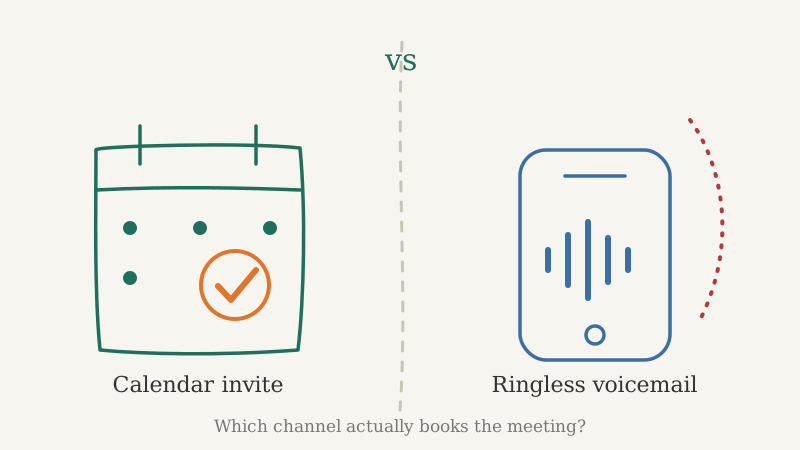
Ringless voicemail (RVM) has a clever pitch. You deposit a pre-recorded message straight into a prospect’s voicemail box without ever ringing their phone. No interruption, no awkward live conversation, and the prospect hears a real human voice on their own schedule. For teams tired of dials that go nowhere, it sounds like the shortcut nobody else is using.
The problem is what happens after the voicemail lands. A dropped message is not a booked meeting. It is a hope that a busy buyer will listen to the whole thing, remember your name, and take an action you never actually made easy for them. Meanwhile, a quieter channel puts a concrete time in front of the buyer and asks them to do one thing: accept.
This guide runs ringless voicemail and cold calendar invites through the same scorecard: reach, conversion, compliance risk, cost, and the moments where each channel earns its place. By the end you will know which one deserves more of your pipeline and where a blend makes sense.
How Each Channel Actually Works
Ringless voicemail uses a server-to-server connection to insert an audio file into a carrier’s voicemail system. The prospect’s phone shows a new voicemail notification, often with no accompanying missed call. To respond, the listener has to stop what they are doing, play the message, absorb it, and then remember to call back, email, or search for you later. Every one of those steps is a place to lose them.
A cold calendar invite works differently. Instead of asking the prospect to remember and act later, it places a specific meeting on their calendar with a clear time, a short agenda, and a title they can read in two seconds. The buyer sees exactly what you are proposing and makes a single binary decision: accept, decline, or propose a new time. The call to action is not buried in a 25 second recording. It is the invite itself.
That structural difference drives almost everything below. RVM is a broadcast that hopes for a callback. The calendar invite is a proposal that requests a commitment.
Reach and Attention
RVM does get attention in the sense that a voicemail notification is hard to ignore. But attention is not the same as engagement. Buyers have been trained by years of spam calls to treat unknown voicemails with suspicion, and many delete a message from an unrecognized number before listening past the first sentence. The ones who do listen still face friction: your callback number spoken aloud is easy to mishear, and there is no clickable link inside a voicemail.
A calendar invite arrives inside a tool the prospect already checks many times a day. It shows up in a context built for exactly one purpose, scheduling time. The prospect does not need to transcribe a phone number or reconstruct your ask. Everything they need to decide is on the screen. When the invite is well written, acceptance is a single tap.
For a deeper look at why the calendar surface earns more considered attention than a crowded inbox, see our breakdown of calendar invite open rates versus cold email.
Conversion to a Booked Meeting
This is where the gap becomes hard to argue with. Ringless voicemail optimizes for delivery, not conversion. Vendors love to quote high “listen rates,” but a listen is not a meeting. The path from a heard voicemail to a confirmed slot is long and leaky: the prospect has to feel enough curiosity to call an unfamiliar number back, catch you at a time you can talk, and then negotiate a meeting time live. Most never start that journey.
The cold calendar invite collapses that funnel. The meeting is the message. When a prospect accepts, the meeting is already on both calendars with a time, a location or video link, and an agenda. There is no separate scheduling round, no phone tag, and no “let me check my calendar and get back to you.” The accept click is the booking.
That does not mean invites convert everyone. Plenty of prospects decline or ignore them, and the acceptance rate depends heavily on targeting, timing, and how the invite is written. If you want to raise that number, our guides on why prospects decline calendar invites and calendar invite descriptions that get prospects to show up walk through the specifics. The point is that even an ignored invite fails at the last step of the funnel, while a voicemail fails at nearly every step.
Compliance and Risk
Compliance is the quiet reason many teams quietly abandon RVM. In the United States, ringless voicemail has faced repeated legal scrutiny under the Telephone Consumer Protection Act, and courts and regulators have signaled that dropping messages onto mobile phones without prior consent can carry the same exposure as an unsolicited robocall. Penalties are assessed per message, which means a single large drop can create outsized liability. Rules also vary by jurisdiction, so a program that looks safe in one region may not be in another.
Cold calendar invites are not consequence free, but the risk profile is calmer. An invite sent from a legitimate business address, to a business contact, about a relevant business topic, sits in the same category as ordinary professional email and is governed by familiar frameworks. The practical safeguards are the ones you already know: clean data, real personalization, and easy opt-out. Sending to accurate, verified addresses is the foundation, which is why teams pair invites with an email validation step using a tool like Scrubby before a campaign goes out. A bounced or spam-trapped address hurts your sender reputation no matter how good the invite is.
Cost and Operational Overhead
RVM looks cheap per drop, often a few cents per message. But the true cost includes recording and re-recording audio, managing carrier deliverability, sourcing verified mobile numbers (which are harder to get and more expensive than business emails), and staffing the callbacks that trickle in on an unpredictable schedule. The cost per booked meeting, which is the only number that matters, tends to be high because the conversion rate is low.
Calendar invite programs carry their own setup: list building, invite copy, send timing, and follow up. But the workflow is more predictable and more measurable. You can track acceptance, no-shows, and pipeline created per campaign, then optimize each stage. Because the ask and the booking are the same action, there is no separate scheduling operation to staff. For a full framework on measuring the return, see our guide on measuring calendar invite outreach ROI.
Scorecard Summary
| Factor | Ringless Voicemail | Cold Calendar Invite |
|---|---|---|
| Primary action requested | Call back later | Accept a specific time |
| Steps to a booked meeting | Many, high drop-off | One, the accept click |
| Attention quality | Interruptive, often deleted | Considered, in a scheduling context |
| Compliance risk | High, TCPA exposure per message | Moderate, standard business email norms |
| Cost per booked meeting | High, low conversion | Lower, measurable funnel |
| Data required | Verified mobile numbers | Verified business emails |
When Ringless Voicemail Still Makes Sense
RVM is not useless. It can work as a light reinforcement touch inside a larger multichannel sequence, especially with warm contacts who already know your brand, in industries where a personal phone call is expected, and in regions where you have confirmed the compliance picture and hold appropriate consent. As a supporting voice, a short and genuinely helpful voicemail can add a human layer to a sequence anchored by other channels.
What it should not be is your primary meeting-booking engine. Asking a stranger to listen, remember, and call you back is too many steps for a cold audience.
When Cold Calendar Invites Win
For the core job of turning a targeted cold list into booked meetings, the calendar invite is the stronger primary channel. It compresses the funnel, presents the ask in the exact context where scheduling happens, and treats acceptance as the conversion event rather than an afterthought. It pairs naturally with email and other touches, and it produces cleaner metrics because the booking and the response are the same action.
The most durable programs do not pick one channel and ignore the rest. They lead with the invite because it books meetings directly, protect deliverability with verified data, and use supporting touches only where they genuinely help. If you are deciding where the next hour of your team’s effort should go, put it into the channel that asks for the meeting outright. Kali is built for exactly that motion, turning cold calendar invites into booked meetings at scale.