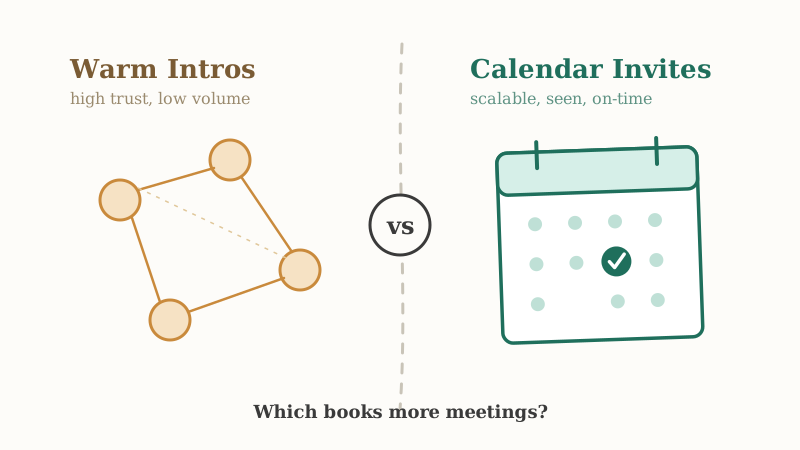
Ask any experienced seller what the best source of pipeline is and most will say the same thing without hesitation: a warm introduction. A trusted mutual connection vouching for you shortcuts weeks of trust building and lands you in front of a decision maker who is already inclined to say yes. Nothing in outbound converts better.
So why does almost no team hit quota on warm intros alone?
Because the channel has a ceiling that most people refuse to look at honestly. Warm intros are the highest converting source of meetings you have and the least reliable engine for filling a calendar week after week. Cold calendar invites sit at the opposite end: lower trust at the start, but a scale and predictability that referrals can never match.
This guide runs both through the same scorecard: conversion, volume, predictability, cost, and the exact moments where each one wins. By the end you will know how to weight the two so your pipeline does not live and die on who happens to owe you a favor this quarter.
The Core Difference: Borrowed Trust vs Earned Attention
A warm intro works because it borrows trust. When a respected connection forwards your name with a genuine endorsement, the prospect transfers some of the trust they already have in that person onto you. You skip the cold open entirely and start the relationship several steps ahead. That borrowed trust is the single most valuable asset in all of sales, which is why intros convert so well.
A cold calendar invite works on a different currency: earned attention. You are not borrowing anyone’s credibility. Instead you place a specific, low friction decision directly in front of the prospect, a real meeting time with a clear agenda sitting in their calendar, and let the relevance of the offer earn the response. There is no mutual friend in the loop. The invite has to stand on its own.
That distinction drives everything else. Borrowed trust is powerful but scarce, because you only have so many strong relationships to draw on. Earned attention is weaker per touch but effectively unlimited, because you can place a well crafted invite in front of any prospect who fits your profile, whether you know someone in common or not.
Conversion: Where Warm Intros Dominate
Let us give referrals their due, because they earn it. A warm introduction converts to a booked meeting at a rate no cold channel touches. When the intro is strong and the connector is credible, acceptance rates can run several times higher than any outbound touch. The prospect shows up predisposed to like you, the meeting is easier to book, and the downstream deal often moves faster and closes at a higher rate.
The show rate is better too. A prospect who agreed to meet because a trusted colleague asked them to feels a social obligation to honor it. Ghosting a referral means letting down the connector, not just some stranger who sent an invite. That accountability keeps no show rates low and keeps deals from stalling.
If conversion were the only metric that mattered, this would be a short article. Warm intros win on conversion, decisively, and it is not close. But conversion is only half the equation, and the other half is where the story flips.
Volume and Predictability: Where Cold Invites Dominate
Here is the uncomfortable truth about warm intros: you cannot manufacture them on demand. Your referral supply is capped by the size and generosity of your network, the goodwill of your existing customers, and the willingness of busy people to spend their own credibility on your behalf. Some weeks that well is full. Many weeks it is dry. You cannot walk into a quarter and decide to generate forty warm intros because you need forty meetings. The channel simply does not obey your quota.
Cold calendar invites obey your quota exactly. You decide how many qualified prospects to reach, you build the list, and you send. Because a calendar invite is asynchronous and does not depend on a mutual connection, the volume is bounded only by the size of your addressable market and the quality of your data. A single rep can put hundreds of relevant invites in front of the right buyers in the time it would take to chase down a handful of introductions.
Calendar invites also solve the reach problem that cold email increasingly cannot. Invitations land in the calendar, which is far less crowded than the inbox and surfaces with real urgency, so they get seen rather than buried. Tools like Kali are built around this exact mechanic, sending personalized cold calendar invites at scale so a team can generate predictable meeting volume without waiting on anyone to make an introduction.
Predictability is the quiet advantage that wins forecasts. A referral engine produces a jagged, unforecastable line. A cold invite engine produces a repeatable input you can dial up or down. When your board asks how you will hit next quarter’s number, “we will send X qualified invites at Y acceptance rate” is an answer. “We hope more customers refer us” is not.
Cost and Effort: The Hidden Comparison
People assume warm intros are free because no ad spend or tooling sits behind them. They are not free. They cost relationship capital, and that capital is finite and slow to rebuild. Every time you ask a customer or connection for an intro, you spend a little of the goodwill you have banked with them. Ask too often and you become the person who only reaches out when you need something. The true cost of a referral is the relationship maintenance, the favors owed, and the years of trust building that made the ask possible in the first place.
Cold calendar invites carry a different cost structure: tooling, accurate data, and the time to write invites that are relevant enough to accept. That cost is real but it is also controllable, repeatable, and it does not deplete a scarce personal resource every time you run the play. You can scale the spend up when you need more pipeline and pull it back when you do not, without burning any bridges.
There is one cost the invite channel cannot skip: list quality. Invitations sent to dead, invalid, or mistyped addresses bounce or vanish, which wastes the channel’s biggest advantage and quietly damages your sender reputation. Running your list through a verification tool like Scrubby before you send keeps invites flowing to real, reachable inboxes and protects the deliverability that makes the volume worth anything.
When Warm Intros Are Clearly the Right Call
Referrals are not a channel you scale, but they are a channel you should never neglect. Lean into them hard in these situations:
- Named enterprise accounts. When you are chasing a short list of high value logos, a single warm intro into the right buying committee is worth more than a thousand cold touches. Invest the relationship capital here.
- Expansion and upsell inside existing customers. Your current champions can introduce you to adjacent teams and new stakeholders. This is the warmest, cheapest pipeline you will ever generate.
- High trust, high consideration purchases. When the deal is large, risky, or deeply consultative, the borrowed credibility of an intro shortens a long sales cycle more than any other lever.
- Post win momentum. The best moment to ask for a referral is right after a customer sees real value. Build the ask into your success motion so the well refills on its own.
The pattern is consistent: warm intros win when the target is specific, the deal is large, and trust is the primary obstacle to the first meeting.
When Cold Calendar Invites Are the Right Call
Cold invites win in the conditions that describe most of the pipeline most teams actually need to build:
- Volume motions across a large market. When you need dozens of meetings a week and no referral network can supply them, the scale of asynchronous invites is the only realistic path.
- Breaking into accounts where you know no one. The majority of your total addressable market has no connection to you at all. Invites reach those buyers; referrals never will.
- Predictable, forecastable pipeline. When leadership needs a repeatable input tied to the number, a controllable invite engine beats a hope based referral trickle.
- Multi threading a live deal. Even inside an account you got into via a warm intro, invites let you reach the additional stakeholders your connector cannot personally introduce you to.
The pattern mirrors the other side: cold invites win when the list is large, the connections are absent, and the business needs volume it can count on.
The Honest Answer: Referrals for Peaks, Invites for the Baseline
The teams that build the most durable pipeline do not choose between these channels. They assign each one the job it is actually good at.
Warm intros are your peak performance channel. Treat them as a high conversion, low volume asset you cultivate deliberately: ask at the right moments, protect the relationships, and route every referral you earn toward your highest value targets. Never try to make referrals carry your baseline volume, because the moment you lean on them for quota they buckle.
Cold calendar invites are your baseline engine. They generate the predictable, forecastable meeting volume that keeps the number in reach every quarter, independent of whose favor you can call in. Make invites the floor your pipeline stands on, then let warm intros be the spikes that lift specific high value deals above it.
The mistake is treating this as an identity choice, the “we are a referral driven company” versus “we are an outbound machine” debate. It is not an identity. It is a portfolio. Measure acceptance rate, show rate, and cost per booked meeting for each channel inside your own funnel, fund the baseline with the channel you can control, and reserve your scarce relationship capital for the deals where borrowed trust changes the outcome. Run both, weighted to their strengths, and you stop betting your quarter on who happens to owe you a favor.