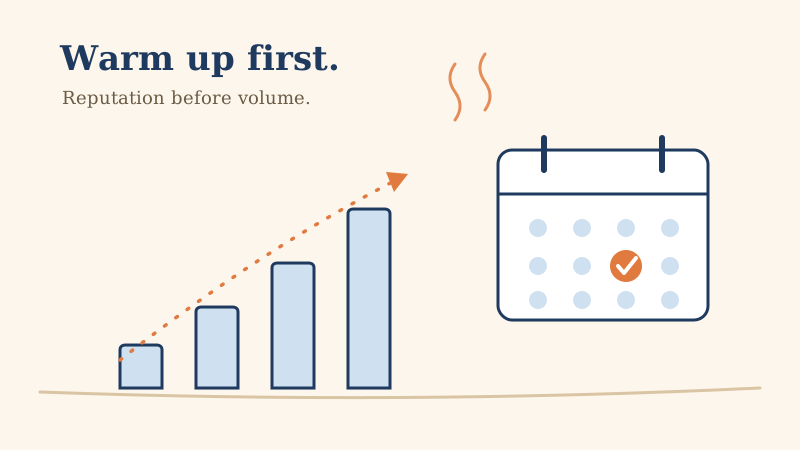
Most calendar invite campaigns that quietly underperform do not fail because of bad copy or weak targeting. They fail because the sending account was brand new and started blasting invites at full volume on day one. Mailbox providers treat a fresh account that suddenly sends 200 invites like a spammer, not a salesperson, and they respond by throttling delivery, routing invites to spam, or silently dropping them.
Calendar invites carry the same reputation signals as email, because the invite itself is delivered as an email message with a calendar attachment. That means everything you know about email warmup applies, plus a few wrinkles specific to invites. This guide walks through a practical 3-week warmup plan so your account earns trust before you ask it to carry a real campaign.
Why warmup matters more for invites
A cold email asks for a reply. A cold calendar invite asks for something heavier: it drops an event onto someone’s calendar and asks them to accept or decline. Because the action is more intrusive, mailbox providers and corporate filters scrutinize the sending account more closely. A new domain or mailbox with no track record is exactly the profile that triggers caution.
Warmup solves this by gradually proving three things to mailbox providers:
- The account sends consistent, human-paced volume rather than sudden bursts
- Recipients engage positively (opens, accepts, replies) instead of marking messages as spam
- The sending infrastructure is properly authenticated and stable over time
Skip warmup and you spend the first weeks of your campaign teaching providers to distrust you. Do it right and you bank reputation you can draw down later when volume ramps.
Before you send anything: get the foundation right
Warmup amplifies whatever reputation your account is building, so a broken foundation just helps you build a bad reputation faster. Lock these down first.
Authenticate the domain
Set up SPF, DKIM, and DMARC records on the sending domain before the first invite goes out. These records tell mailbox providers that your account is authorized to send on behalf of the domain. Without them, even a perfectly warmed account looks suspicious. If you are sending invites through Kali, follow the authentication setup before you launch any sequence, not after.
Use a separate domain or subdomain
Never warm up a new account on your primary corporate domain. If the campaign damages reputation, you do not want it bleeding into the email your whole company relies on. Register a dedicated outreach domain or a subdomain, warm it independently, and keep your main domain insulated.
Clean the list before the first send
The single fastest way to wreck a warmup is to send invites to dead, mistyped, or spam-trap addresses. Bounces and spam-trap hits during the fragile early days do disproportionate damage to a new account. Run every address through a validation pass first. Tools like Scrubby catch invalid and risky addresses before they bounce, which protects the reputation you are trying to build. Validate once before warmup and again before any large volume increase.
The 3-week warmup ramp
The core principle is gradual, consistent growth. Start small, increase volume slowly, and keep daily sends steady rather than spiky. Here is a schedule that works for most new accounts.
Week 1: establish a pulse (5 to 15 sends per day)
Start with 5 invites on day one and add a few each day, ending the week around 15. These first invites should go to the warmest, most reliable recipients you have: colleagues, friendly customers, partners, or anyone likely to accept the invite or reply. Positive early engagement is the strongest signal you can send a mailbox provider.
Keep the cadence human. Do not fire all 15 invites in one minute at 9:00 a.m. Spread them across business hours the way a real person would.
Week 2: build volume (20 to 40 sends per day)
Once week one shows clean delivery and no spam complaints, roughly double your daily volume. Begin mixing in real prospects, but keep a healthy share of high-engagement recipients in the mix to maintain your accept and reply rates. Watch your metrics daily. If delivery dips or invites start landing in spam, hold volume flat for a day or two before climbing again.
Week 3: approach campaign volume (50 to 100+ sends per day)
By week three a healthy account can handle most real campaign volumes. Continue increasing daily sends toward your target, but let your engagement data set the pace. A steady acceptance rate and low complaint rate mean you can keep climbing. Any deterioration means you climbed too fast.
After three weeks of clean sending, your account has a track record. You can now run full campaigns without the throttling and spam placement that hit cold accounts.
Metrics to watch during warmup
Warmup is not a fixed calendar you follow blindly. It is a feedback loop. Let these numbers tell you whether to accelerate, hold, or pull back.
- Delivery rate: the share of invites that reach the inbox. It should stay high. A sudden drop means a provider started filtering you.
- Acceptance and reply rate: positive engagement is the reputation fuel of warmup. If it falls, slow down and send to warmer recipients.
- Spam complaint rate: keep this near zero. Even a few complaints during warmup can stall progress for days.
- Bounce rate: a clean list keeps this low. A spike usually means list hygiene slipped, so revalidate before continuing.
If you run outreach across multiple domains or want to know the moment delivery degrades, set up monitoring so you are alerted to changes rather than discovering them a week late. A monitoring tool such as CAM can watch for the kind of silent shifts that erode a campaign before anyone notices.
Common warmup mistakes
A few patterns sink new accounts over and over. Avoid them.
Ramping too fast. The most common error. Going from 10 to 100 invites overnight reads as exactly the spike providers are trained to punish. Patience in week one pays off for months.
Inconsistent sending. Sending 50 invites on Monday, none Tuesday and Wednesday, then 80 on Thursday looks erratic. Steady daily volume builds trust faster than the same total sent in bursts.
Ignoring engagement signals. Volume without positive engagement does not build reputation, it just builds risk. Early invites should go to people who will actually accept or reply.
Reusing a burned domain. If a domain already has a poor reputation, warmup will not magically rehabilitate it quickly. Start clean when the history is bad.
Putting it together
Warming up a new account is the least glamorous part of launching calendar invite outreach and the part that most determines whether your campaign lands in the inbox or the spam folder. Authenticate the domain, isolate it from your primary email, validate the list, then ramp volume over three weeks while watching delivery and engagement. The account that earns trust slowly will carry far more campaign volume than the one that demanded it on day one.
Get the foundation right and the rest of your invite strategy, your copy, your timing, your targeting, finally gets the delivery it deserves.