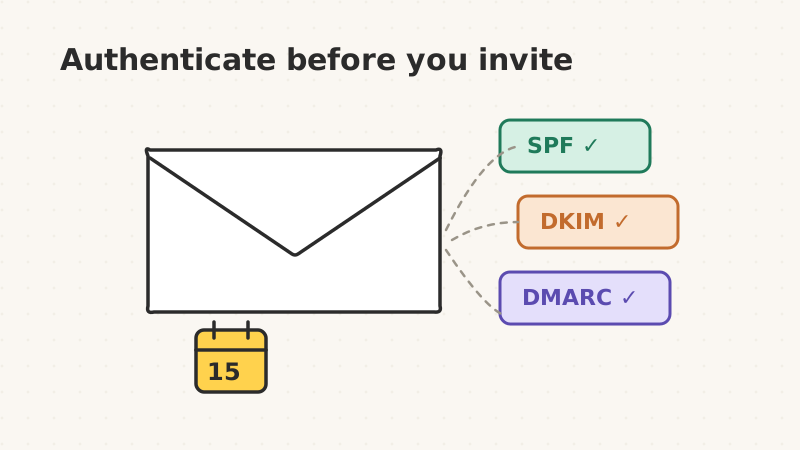
Most teams that run cold calendar invite outreach obsess over the message copy and the send time, then wonder why acceptance rates crater. The usual culprit is not the invite at all. It is authentication. A calendar invite is delivered as an email carrying an .ics payload, which means it passes through the exact same trust checks Gmail, Outlook, and Apple Mail apply to any inbound message. If those checks fail, your invite never reaches a human. It lands in spam, gets silently dropped, or triggers a security warning that guarantees a decline.
This guide walks through the three records that govern whether your invites are trusted: SPF, DKIM, and DMARC. Get these right and you remove the single biggest invisible reason cold invites underperform.
Why authentication matters more for invites than for plain email
A calendar invite is a higher-trust action than a normal email. It asks the recipient to put something on their calendar, block time, and often accept a video link. Mailbox providers know this, so they scrutinize the sending domain harder. An unauthenticated invite is not just filtered like spam, it can be flagged as a spoofing or phishing attempt because attackers frequently abuse invite payloads.
The result is binary. A properly authenticated invite shows up as a clean, native calendar event with an Accept button. An unauthenticated one either disappears or arrives wrapped in a red warning banner. There is no middle ground where a great subject line rescues a failing domain.
If you want the full picture of how invites render across providers, our breakdown of calendar invite deliverability across Gmail, Outlook, and Apple Calendar pairs well with this authentication setup.
SPF: proving your servers are allowed to send
SPF (Sender Policy Framework) is a DNS record that lists which mail servers are permitted to send on behalf of your domain. When an invite arrives, the receiving server checks the sending IP against your SPF record. If the IP is not authorized, SPF fails.
A basic SPF record looks like this:
v=spf1 include:_spf.google.com include:sendgrid.net ~allThree rules keep SPF healthy for invite senders:
- Include every sending source. If you send invites through Google Workspace, a sequencing tool, and a calendar automation platform, all three must appear in the record. Miss one and those invites fail.
- Stay under the 10 DNS lookup limit. SPF caps at ten nested lookups. Chaining too many
includestatements causes a permanent error that fails every message. Flatten or consolidate providers if you are near the limit. - Use
~all, not-all, while testing. A soft fail marks suspicious mail without hard-bouncing it, which gives you room to catch a misconfiguration before it kills a live campaign.
SPF alone is not enough because it breaks when messages are forwarded, but it is the foundation everything else builds on.
DKIM: signing the invite so it cannot be tampered with
DKIM (DomainKeys Identified Mail) attaches a cryptographic signature to each message, including the invite payload. The receiving server fetches your public key from DNS and verifies the signature. If it matches, the provider knows the message genuinely came from your domain and was not altered in transit.
DKIM is the record that survives forwarding, which matters for invites because they often get forwarded internally when a prospect loops in a colleague or an assistant. If your DKIM signature is valid, that forwarded invite still authenticates. If it is not, the second recipient sees a broken, untrusted event.
To set it up, generate a DKIM key pair in your sending platform, publish the public key as a TXT record at the selector your provider specifies (for example google._domainkey.yourdomain.com), and confirm the platform signs outbound invites. Most Workspace and Microsoft 365 setups enable this in a few clicks, but sequencing and automation tools each need their own DKIM record, so audit every tool in your stack.
DMARC: the policy that ties it together
DMARC (Domain-based Message Authentication, Reporting, and Conformance) is where SPF and DKIM become a real defense. DMARC tells receiving servers what to do when a message fails authentication, and it requires alignment, meaning the domain in the visible From address must match the domain that passed SPF or DKIM.
A starter DMARC record looks like this:
v=DMARC1; p=none; rua=mailto:[email protected]; adkim=s; aspf=sRead the policy tags from least to most strict:
p=nonemonitors and reports without affecting delivery. Start here so you can see who is sending as your domain.p=quarantinesends failing mail to spam.p=rejectblocks failing mail outright.
The mistake to avoid is jumping straight to p=reject before your legitimate invite sources are aligned. Do that and you will bounce your own campaign. Run p=none for two to four weeks, read the aggregate reports the rua address collects, confirm every real sending source passes, then tighten to quarantine and eventually reject. Mailbox providers increasingly reward domains at p=quarantine or stronger with better inbox placement, so reaching a strict policy directly lifts acceptance rates.
A pre-campaign authentication checklist
Before you send a single cold invite, verify:
- SPF exists, includes every sending platform, and stays under 10 lookups
- DKIM is enabled and signing on every tool that sends invites, not just your primary mailbox
- DMARC is published, alignment is strict, and you are actively reading reports
- Your sending domain has warmed up gradually rather than blasting volume on day one
- Your recipient list is validated so hard bounces do not tank your sender reputation
That last point is where many authenticated domains still fail. Perfect DNS records cannot save you if half your list is invalid, because every bounce signals to providers that you are a careless sender. Running your list through a verification tool like Scrubby before a campaign protects the reputation your SPF, DKIM, and DMARC records worked to build. Authentication and list hygiene are two halves of the same deliverability problem.
Where the calendar layer comes in
Authentication gets your invite delivered. Execution gets it accepted. Once your domain is trusted, the variables that move acceptance rates become the invite content, the timing, and the follow-up sequence rather than raw deliverability. This is the point where a purpose-built calendar outreach platform like Kali earns its keep, because it handles the sending infrastructure, tracks acceptance signals, and keeps your invite volume within limits that protect the reputation you just secured.
Get the authentication foundation right first. A great calendar invite sent from an unauthenticated domain is a great invite nobody sees. A plain invite sent from a fully aligned domain reaches the inbox every time, and that is the version of the campaign that books meetings.
The short version
SPF says which servers can send. DKIM proves the invite is genuine and untampered. DMARC enforces both and tells providers how to treat failures. Set all three, verify your list before you send, then let your invite content do the work. Skip them and no amount of copywriting will get your cold calendar invites onto a prospect’s schedule.