Most of the advice about cold calendar invite outreach stops at the moment the prospect clicks Accept. That makes sense. Acceptance is the hard part, and it is the number everyone reports.
But an accepted invite is only a slot on a calendar. Pipeline starts when the meeting is held and ends with an agreed next step. The thirty minutes in between are where a lot of good outreach quietly goes to waste, because the rep runs the call as if it were an inbound demo request. It is not.
This guide covers what makes a meeting booked from a cold invite different, how to prepare for it, a call plan you can reuse, the awkward moments to expect, and what to do in the hour after you hang up.
Why This Meeting Is Different
An inbound demo request comes from someone who went looking. They filled in a form, they know roughly what you sell, and they arrive with a question. A meeting booked from a cold calendar invite starts from a different place in three ways.
The prospect accepted a topic, not a pitch. They read a short invite title and description, decided the subject was worth thirty minutes, and said yes. What they agreed to is whatever your invite promised. If the invite said “a 20 minute look at how teams like yours cut onboarding time”, that is the meeting they expect. A full product tour breaks that promise in the first five minutes.
Their context is thin. Some prospects accepted days ago and have forgotten the details. Some accepted from a phone between meetings. Few will have visited your website. You cannot assume they remember who you are or why the invite reached them.
Their commitment is light. Clicking Accept costs nothing. That is why the channel works, and it is also why the first meeting has to earn the second one. Nobody in the room feels they owe you anything yet.
None of this is a problem if you plan for it. It just means the first meeting is closer to a short, structured conversation than to a demo.
Before the Meeting: Twenty Minutes of Preparation
You do not need hours of research. You need to walk in knowing what the prospect saw, who is coming, and what you want to leave with.
Re-read the invite as they saw it
Open the event from the prospect’s side if you can, or at least re-read the exact title and description that went out. This is the contract for the meeting. Note the promise in it and the length you asked for. If you are not sure what makes a description land, our guide to calendar invite descriptions that get prospects to show up covers the structure.
Check the attendee list
Look at who is on the event now, not who you invited. Prospects forward invites to colleagues, add their manager, or swap themselves out. A new name on the list changes the meeting. Look the new person up so you are not surprised when they join.
Do ten minutes of account research
Enough to ask good questions, not enough to lecture them. Look for:
- What the company sells and to whom
- Recent changes you can see publicly, such as a new product, a new market, a funding announcement or a leadership hire
- The prospect’s role and how long they have been in it
- Anything in the original targeting that made this account a fit, such as the signal or list it came from
Write down two or three questions this research makes you want to ask. That is the whole output.
Decide what a good outcome looks like
Before the call, write one sentence describing the next step you would like to agree. A second meeting with a technical stakeholder. A trial set up on their data. A review with the person who owns the budget. If you do not know what you want at the end, the call will drift.
Confirm the day before
A short, human note the day before the meeting is the single most useful thing you can do for attendance. Keep it to two lines: the time in their time zone, and one sentence restating why the meeting is worth their time. Our guide to reducing no-shows on meetings booked by cold calendar invites goes deeper on confirmations and reminders.
The Call Plan
Here is a plan for a 30 minute first meeting. If your invite asked for 15 minutes, compress it rather than overrunning. Keeping to the time you asked for is part of building trust. There is more on choosing the length in 15 vs 30 minute cold calendar invites.
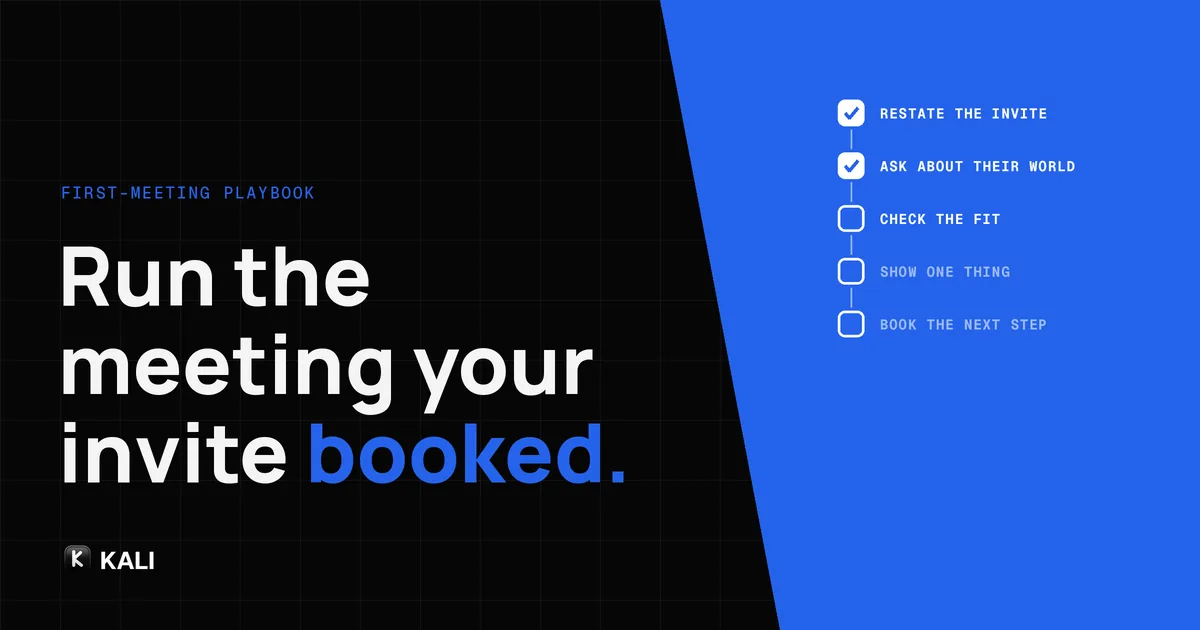
| Segment | Time | What you are doing |
|---|---|---|
| Open | 0 to 3 min | Restate why they are here, confirm the time, propose the agenda |
| Their world | 3 to 13 min | Questions about their current process and what is not working |
| Fit check | 13 to 16 min | Decide together whether the rest of the call is worth having |
| Show one thing | 16 to 24 min | One focused example tied to what they just told you |
| Next step | 24 to 30 min | Agree a specific next step and put it on the calendar |
Open: restate the invite, then ask permission
Start by saying, in one or two sentences, why the meeting exists. Use the words from the invite. “You accepted an invite about cutting onboarding time for new customers. I’d like to spend most of our time understanding how you do that today, then show you one thing that might help. Does that still work?”
This does three things. It reminds a prospect who has forgotten the details. It shows you meant what the invite said. And it gives them an easy moment to correct you if something has changed, which is far better than finding out at minute twenty.
Confirm the time you have. “We have until half past, is that still right?” If they now only have fifteen minutes, take it gracefully and cut the plan in half.
Their world: ask before you show
Spend the biggest block of the call on questions. You are trying to learn three things: how they handle the problem today, what it costs them when it goes wrong, and who else cares about it.
Good first meeting questions are specific and easy to answer:
- “Walk me through what happens today when a new customer signs.”
- “Where does that process usually slow down?”
- “Who else on your team feels it when that happens?”
- “What have you already tried?”
- “If you fixed this, what would it change for you this quarter?”
Use the two or three questions from your research here.
Resist the urge to answer every problem they mention with a feature. Take notes and keep asking. The more of their own words you have, the better the next segment goes.
Fit check: be willing to stop
About halfway through, pause and say what you have heard. “It sounds like the main issue is X, and it shows up mostly when Y. Is that fair?” Then decide, out loud, whether the rest of the meeting is useful.
If they are clearly not a fit, say so and offer to end early. “Honestly, based on what you’ve told me, I don’t think we’re the right fit for this, and I’d rather give you the time back.” This feels risky, but it is the most credible thing you can do in a first meeting.
If they are a fit, the summary becomes the bridge into the next segment.
Show one thing
Not the whole product. One example, chosen because it answers the main problem they just described. Use their language when you introduce it. “You said the slow part is X. Here’s how that works with us.”
Keep it short and leave room for questions. If they ask to see something else, that is a good sign, and it can be the reason for the next meeting.
If your product needs setup before it can be shown properly, show the outcome instead, for example a sample report or a short recorded walkthrough, and make the proper demo the next step.
Next step: book it while you are both there
The last five minutes decide whether this meeting becomes pipeline. Propose the specific next step you wrote down before the call, adjusted for what you learned. Then put it on the calendar while you are still on the line.
“Would it make sense to bring in your ops lead for a deeper look next week? I can send an invite now for Tuesday or Wednesday afternoon. Which is better?”
A next step that is agreed but not scheduled is much weaker than one with a time on it. If they need to check with someone, agree when you will follow up and send a short note that day.
The Awkward Moments, and How to Handle Them
Meetings booked from cold invites produce a few situations that inbound demos rarely do. Plan your response in advance.
“Remind me what this is about?” Treat it as normal, not as a bad sign. Give the one sentence from the invite, ask whether it is still relevant, and move into questions. Never act surprised that they forgot.
A different person shows up. The original prospect forwarded the invite or sent someone else. Thank them for coming, ask what they were told about the meeting, and adjust the plan to their role. They are often closer to the problem than the person you invited.
They bring a colleague. Good news. Ask each person what they hope to get from the call, and make sure the question segment includes both of them.
“How did you get on my calendar?” Answer plainly. You sent an invite because their role and company matched a problem you work on, and they accepted it. Do not be evasive. Prospects who ask this are usually curious rather than annoyed, and a straight answer settles it.
“What does it cost?” It is fine to be asked about pricing in a first meeting. If pricing depends on scope, say so, explain what it depends on, and offer to cover it properly once you understand their needs. Avoid quoting figures from memory that you may need to walk back later.
They are clearly not the decision maker. That is not a failed meeting. Ask how decisions like this get made at their company and who else would be involved, then make bringing that person in the next step.
Nobody shows up. Wait five minutes, send a short note offering two new times, and move on. Do not send a guilt-laden message. A rescheduled meeting is still a meeting. Our post on rescheduling a cold calendar invite without losing the meeting has templates.
The Hour After the Call
What you do straight after the meeting matters almost as much as the meeting itself.
Send a recap the same day. Three short parts: what you heard, in their words; what you showed and why; the next step with its date and time. Keep it short enough to read on a phone. This recap is often forwarded internally, so write it for someone who was not on the call.
Send the next invite immediately. If you agreed a next meeting, the invite should arrive before the prospect has closed the call window. Add anyone who needs to be there, and use the description to restate the purpose.
Log the meeting properly. Record in your CRM that the meeting came from cold calendar invite outreach, who attended, the problem they described and the agreed next step. If you skip the source field, you will never be able to tell which channel produced the pipeline. Our guide to syncing calendar invite outreach with HubSpot and Salesforce covers the field mapping.
Feed what you learned back into the campaign. The first meeting is the best research you will get on your targeting and your invite copy. If several prospects describe the problem in words your invite does not use, change the invite. If prospects from a certain segment keep turning out to be a poor fit, tighten the list.
Who Should Run the Meeting
Normally the person who sent the invite, because that is the name the prospect saw on the event. If someone else will run it, say so beforehand and add them to the existing event. There is more in who should send a cold calendar invite. Whoever runs it must know the meeting came from a cold invite, or they will open with a product tour.
How to Tell the First Meeting Is Working
Acceptance rate tells you whether the invite worked. It says nothing about the meeting. Track a few numbers past the acceptance:
- Held rate: of accepted meetings, how many actually happened
- Next step rate: of held meetings, how many ended with a scheduled next step
- Second meeting held rate: of scheduled next steps, how many happened
- Opportunity rate: of held first meetings, how many became qualified pipeline
Watch them over a few campaigns rather than reacting to any single week. If held rate is fine but next step rate is weak, look at the call plan, especially the questions segment and the final five minutes. If next steps are booked but second meetings do not happen, look at the recap and at who is being invited to the follow-up.
For the wider picture, our guide to measuring calendar invite outreach ROI for sales leadership shows how these numbers roll up.
The Short Version
A meeting booked by a cold calendar invite starts with a prospect who agreed to a topic and a time, has thin context and has committed very little. Prepare by re-reading the invite and checking who is coming. Open by restating the invite and asking permission. Spend most of the call on their world, check fit honestly, show one thing, and book the next step before you hang up. Then send a short recap the same day and feed what you learned back into the campaign.
KALI runs cold calendar invite outreach as a managed service, from targeting and invite copy to reply handling and confirmations, so your team arrives at each first meeting knowing why the prospect said yes. See how it works.